
AIRPORT TIPS
Child Makes a Mess on a Plane — Passenger Gets Furious and Crew Steps In
Sep
Flying with an infant can turn an ordinary moment into chaos in seconds.
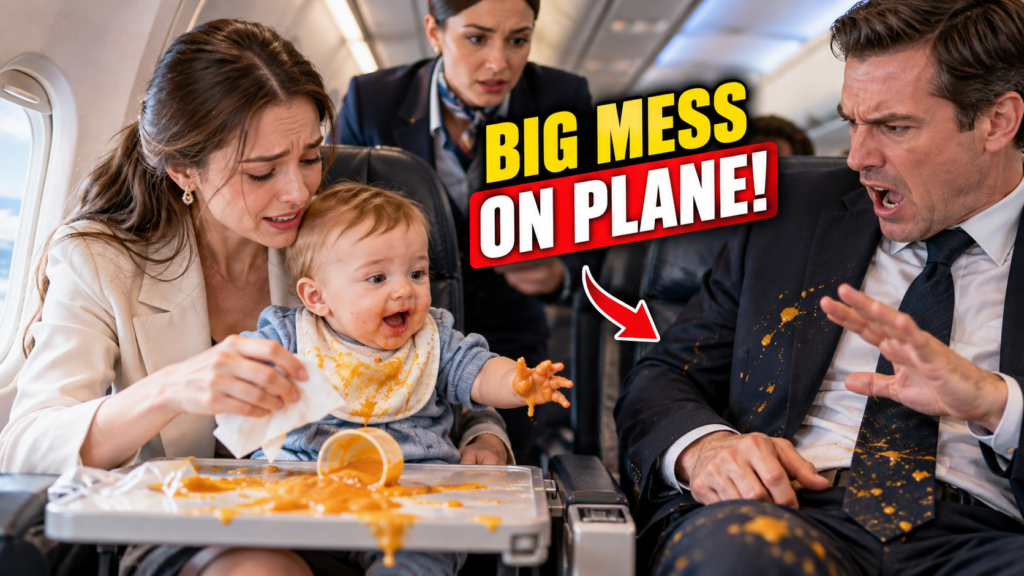
One moment, a mother is quietly feeding her baby. The next, there is food on the tray table, napkins on the floor, a startled infant—and an angry passenger staring at orange baby purée on his clothes.
That was exactly how this fictional cabin confrontation began.
The mother had not ignored her child. The baby had not intentionally thrown food. And the man sitting nearby had a legitimate reason to be unhappy when part of the mess reached his space.
But what happened next transformed a simple accident into a tense airplane passenger conflict.
The mother apologized immediately.
The passenger became furious anyway.
His voice rose.
The baby became frightened.
Other travelers started watching.
And then a flight attendant stepped into the aisle.
The incident raises a question familiar to almost anyone who has traveled around young children: Where is the line between a reasonable complaint and a reaction that makes an already difficult situation worse?
This is the story of a baby food mess on an airplane, an embarrassed mother trying desperately to fix it, an increasingly angry traveler—and a crew member forced to calm everyone down before the argument took over the cabin.
Part 1: A Quiet Meal Turns Into a Huge Baby Food Mess on the Airplane Child Makes a Mess on a Plane
Boarding was almost over.
Late-morning daylight poured through the aircraft windows while passengers settled into the narrow-body jet. Overhead bins remained open in a few rows. Travelers adjusted backpacks, checked their phones, and tried to get comfortable before departure.
Near the window on the left side of the cabin sat a 32-year-old mother traveling with her eight-month-old son.
She looked prepared.
Her cream blouse and camel blazer were neat despite the complicated reality of traveling with a baby. A small stack of napkins sat beside an opened container of orange baby purée on her tray table.
Her son wore a light-blue knitted romper and a cream feeding bib.
He was at the age when everything seemed interesting.
The spoon.
The food container.
His mother’s fingers.
The tray table.
The movement of people in the aisle.
And, unfortunately, the purée.
The Baby Wasn’t Trying to Cause Trouble
The mother lifted another small spoonful.
Her son reached toward it.
His hand moved faster than she expected.
The spoon shifted. The container moved. His arm swept across the limited space between his body and the tray.
Then came the mess.
Orange purée spread across the tray table.
A napkin dropped.
Several spots landed near the seat.
A few drops fell toward the floor.
And, most importantly, a small but unmistakable amount reached the neighboring passenger’s area.
The man in the aisle seat looked down.
There were orange spots near the edge of his seat and on the beige fabric covering his upper thigh.
For a second, nobody said anything.
The mother’s face changed immediately.
She knew what had happened.
The baby stared wide-eyed at the adults around him, apparently more surprised than anyone.
The man stared at his trousers.
Then at the messy tray.
Then at the mother.
His jaw tightened.
“Are You Kidding Me?! Look at This Mess!”
The quiet ended abruptly.
“Are you kidding me?! Look at this mess!”
Several passengers turned their heads.
The mother reached for the napkins.
“I’m so sorry. He’s just a baby. I’ll clean it up.”
She wasn’t arguing.
She wasn’t pretending nothing had happened.
She wasn’t blaming the passenger.
She was already trying to clean the tray while keeping one arm close to her son.
But the man was furious.
“He got food all over my seat!”
The mother looked increasingly embarrassed.
“It was an accident. I’m cleaning it right now.”
She gathered another napkin and started wiping the purée.
What could have remained an uncomfortable but ordinary travel mishap was now becoming something else.
The passenger wasn’t simply asking her to clean the mess.
His voice was getting louder.
“This is ridiculous! Control your child!”
The words landed differently from his first complaint.
The mother stopped for a fraction of a second.
She looked at her eight-month-old baby.
Then back at the man.
“He’s a baby! I’m doing my best!”
A Reasonable Complaint Starts Becoming a Cabin Confrontation
There are two truths in this moment, and recognizing both matters.
The passenger did not have to enjoy having baby food land in his space. Most travelers would be irritated if food unexpectedly reached their seat or clothing.
The mother also had a responsibility to respond to the accident.
And she did.
She apologized.
She started cleaning.
She acknowledged what happened.
But an eight-month-old infant cannot be expected to behave like an adult passenger. A sudden hand movement during feeding is not evidence of deliberate misconduct.
The problem was no longer only the orange purée.
It was the volume.
It was the anger.
It was the increasingly hostile atmosphere around a mother holding a baby.
The infant sensed it too.
His face began to change.
His eyes moved between his mother and the stranger.
His lower lip tightened.
The mother’s attention was now divided among three problems at once: cleaning the food, dealing with an angry stranger and keeping her baby calm.
A few rows away, a flight attendant noticed the commotion.
She turned toward them.
Why the Crew Needed to Pay Attention
Cabin crews routinely manage far more than beverage carts and service.
They are safety professionals working in an environment where even an ordinary disagreement can become disruptive if passengers continue escalating it.
The FAA’s unruly-passenger guidance focuses on serious behavior such as threats, assault, intimidation and interference with crewmember duties. An accidental baby-food spill by itself is not the kind of conduct that should casually be labeled an unruly-passenger offense.
Likewise, merely being annoyed by the spill does not automatically make the neighboring traveler an “unruly passenger.”
The critical issue is what people do next.
In this dramatized situation, the mother was trying to resolve the original problem.
The man’s shouting was creating a new one.
The flight attendant began walking toward the row.
And by the time she arrived, the baby was beginning to cry.
Part 2: The Angry Passenger Keeps Yelling — and the Flight Attendant Steps In
The flight attendant stopped beside the row.
Her arrival changed the dynamic immediately.
The mother still had napkins in her hand. Her baby was becoming increasingly distressed. The man remained visibly angry about the food on his trousers and seat area.
The flight attendant didn’t begin by accusing him of a crime.
She didn’t threaten him with police.
She didn’t tell him he would be banned from flying.
She addressed the immediate problem.
“Sir, please stop yelling. We’ll help clean this up.”
That distinction is important.
The Crew Addresses the Behavior, Not the Complaint
The passenger could still be upset.
The food spill had happened.
But the crew member was now asking him to lower the temperature of the confrontation so the situation could be handled.
Instead, he fired back:
“I shouldn’t have to sit next to this mess!”
The mother pulled her baby slightly closer.
The infant began crying.
Nearby passengers were now paying attention. Some looked uncomfortable. Others appeared irritated by the man’s tone.
The flight attendant maintained eye contact.
“I understand you’re upset, but you need to stop disrupting the cabin.”
That sentence changed the confrontation.
The crew wasn’t telling him he had no right to dislike what happened.
She was telling him how he needed to behave while the problem was being resolved.
What Crew Instructions Mean During a Cabin Dispute
FAA materials make clear that interfering with crewmembers while they perform their duties can carry serious consequences. Federal aviation rules specifically prohibit assaulting, threatening, intimidating or interfering with crewmembers in the performance of their duties.
That does not mean every disagreement with a flight attendant automatically becomes a federal offense.
Context matters.
Conduct matters.
The degree of interference matters.
Airlines also maintain their own contracts of carriage governing when passengers may be refused transportation or removed. Those policies can address disruptive or abusive conduct and failure to comply with crew instructions, although the exact wording and application vary by airline.
For example, Delta’s current domestic Contract of Carriage contains provisions allowing refusal of transport or removal under specified circumstances involving disorderly, abusive or violent behavior, interference with crew activities and certain failures to obey crew instructions. That is an example of one carrier’s policy—not a universal script that every U.S. airline applies identically.
In this story, however, the confrontation never needed to reach that level.
The angry passenger finally backed down.
“Fine. Just keep them away from me.”
It wasn’t a warm response.
It wasn’t an apology.
But it was de-escalation.
Why the Passenger Wasn’t Thrown Off the Plane
This is where dramatic social-media stories often go too far.
A video might be tempted to end with security storming down the aisle.
Or police arriving.
Or the angry passenger being dragged away.
Or a caption claiming he received a massive FAA fine.
None of that follows automatically from the facts of this scenario.
The passenger complained loudly.
The crew intervened.
He was instructed to stop disrupting the cabin.
And then he lowered the conflict instead of continuing to escalate it.
So the flight attendant responded:
“We’ll take care of the mess. Please remain calm and let us handle it.”
That was enough.
No handcuffs.
No police.
No invented lifetime ban.
No dramatic federal-crime announcement.
Just de-escalation.
Meanwhile, the Baby Was Now the One Paying the Price
The irony was impossible to miss.
The original mess could be cleaned.
A few napkins could wipe the tray.
The seat area could be addressed.
The passenger could clean the spots on his trousers.
But the shouting had frightened the infant.
The baby pressed closer to his mother and cried.
She shifted her focus away from the tray for a moment and comforted him.
Her expression showed the exhaustion familiar to many parents who have traveled with very young children: the feeling of trying to solve several problems simultaneously while knowing that everyone nearby can see you struggling.
The flight attendant handed her additional napkins.
The mother quietly thanked her.
The angry passenger sat back.
The cabin slowly returned to normal.
Traveling With a Baby on a Plane Is Predictable Only Until It Isn’t
Parents can prepare extensively for air travel.
They can pack extra clothes.
Bring wipes.
Carry additional diapers.
Choose familiar foods.
Time feedings.
Bring toys.
Pack pacifiers.
Plan around naps.
And then an infant can move one arm at exactly the wrong moment.
That’s the reality of flying with an infant.
Preparation reduces risk.
It doesn’t eliminate unpredictability.
The TSA allows many foods through airport security, although the screening rules differ depending on whether an item is a solid or a liquid/gel. TSA also has specific rules and screening accommodations for formula, breast milk, toddler drinks and baby/toddler food. Travelers carrying those items should review current TSA instructions before arriving at the checkpoint.
TSA guidance for traveling with children and baby food
But security-screening permission and onboard etiquette are separate questions.
Something being permitted through security does not mean a parent should assume a mess won’t matter to neighboring passengers.
A smart approach is simpler: prepare for the spill before it happens.
How Parents Can Reduce a Baby Food Mess on an Airplane
Parents should not be shamed for traveling with babies.
At the same time, a confined aircraft cabin makes small accidents more consequential because strangers are sitting inches apart.
A little preparation can make feeding much easier.
Choose Foods That Are Easier to Control
A full container of thin purée creates more potential mess than a small amount served at a time.
Parents can keep the main container secure and expose only what they need for each bite.
Resealable packaging can also help.
The goal isn’t to create a spill-proof baby—there is no such thing.
It’s to limit how far the mess can spread when the inevitable hand reaches for the spoon.
Keep Wipes and Napkins Within Immediate Reach
Do not bury cleaning supplies underneath clothes in the overhead bin.
If a spill occurs, the fastest way to reassure nearby passengers is to begin dealing with it immediately.
In the story, the mother’s immediate apology mattered.
So did the fact that she reached for napkins instead of pretending the spill wasn’t her problem.
Consider Timing
Feeding during calm portions of the travel process can be easier than trying to manage a complicated meal while passengers are squeezing through the aisle and bags are moving overhead.
That won’t always be possible.
Babies do not consult boarding schedules before becoming hungry.
But when parents have flexibility, reducing surrounding chaos can help.
Protect the Immediate Area
A bib, napkins and careful tray setup can contain a surprising amount of food.
Parents should also keep open containers away from the edge of the tray.
Again, none of this guarantees perfection.
It simply reduces the odds that a baby’s sudden movement becomes another passenger’s problem.
Part 3: What the Angry Passenger Could Have Done Differently
Imagine the same accident with a different response.
The baby knocks the food.
Purée reaches the neighboring passenger.
He looks down and says:
“Excuse me, some of that got on my seat.”
The mother replies:
“I’m so sorry. Let me clean it.”
He gives her space.
She wipes the area.
A flight attendant provides additional napkins if needed.
The incident ends.
No one becomes a villain.
No baby starts crying because adults are shouting.
No cabin full of strangers turns toward the row.
That’s the central lesson of this airplane passenger conflict.
Being Upset Doesn’t Require Humiliating Someone
The passenger’s initial frustration was understandable.
Food landed where it shouldn’t have.
But there is a difference between:
“Please clean this up.”
and:
“Control your child!”
Especially when the “child” is an eight-month-old infant.
An infant cannot understand airplane etiquette.
The adult responsible for the infant can—and in this case, the mother was already responding.
Continuing to berate her did not make the tray cleaner.
It did not remove the spots from his trousers.
It did not speed up the solution.
It frightened the baby and increased tension around the row.
Parents Also Have Responsibilities Toward Other Passengers
The opposite extreme isn’t helpful either.
“Babies are babies” should not become an excuse to ignore a preventable problem.
Parents sharing a confined cabin with strangers should make reasonable efforts to limit mess, noise and intrusion into other passengers’ space.
If food spills into someone else’s area, acknowledge it.
Apologize.
Clean what can safely be cleaned.
Ask the crew for help when needed.
Do not become defensive merely because another traveler mentions the problem.
In this story, the mother did those things.
That’s why the conflict ultimately became less about the accident and more about the passenger’s escalating response.
Airplane Etiquette With Children Requires Patience From Both Sides
Flying forces people with completely different expectations into an unusually small shared environment.
One passenger may be traveling for a critical business meeting.
Another may be exhausted after a connection.
A parent may have been awake since 4 a.m. managing bottles, diapers and luggage.
A baby may be overwhelmed by unfamiliar sounds and surroundings.
None of those realities gives one person unlimited control over everyone else.
Successful cabin etiquette depends on proportionality.
If a baby makes a mess, the parent should address it.
If the parent is actively addressing it, the neighboring passenger should allow the solution to happen.
If tempers rise, crew members need space to de-escalate the conflict.
What Nearby Passengers Should Do
Other passengers don’t need to turn every disagreement into a public confrontation.
In most situations, the best contribution is simply not making things worse.
Give the parent room to clean.
Avoid crowding the aisle.
Don’t start shouting at the angry traveler.
Don’t turn a minor dispute into a cabin-wide argument.
And if a situation appears to be escalating, allow the flight crew to handle it.
Crew intervention works best when five other passengers aren’t simultaneously trying to become referees.
Why “Crew Steps In” Is the Right Ending Here
The title of this story promises a crew intervention.
It does not require an arrest.
That matters.
Online aviation stories often escalate ordinary disputes into extraordinary punishments because those endings sound dramatic.
But believable storytelling is stronger when consequences match behavior.
Here, the flight attendant accomplished the immediate objective.
She stopped the shouting.
She acknowledged that the passenger was upset.
She helped the mother deal with the mess.
She gave a clear instruction about behavior.
And the passenger ultimately complied.
That is a successful de-escalation.
The goal of cabin conflict management isn’t to produce the most spectacular punishment possible.
The goal is to restore a safe, manageable environment.
FAA Rules Shouldn’t Be Used as a Social-Media Threat
The FAA has repeatedly emphasized its approach to unruly and dangerous passenger behavior. Serious interference with crewmembers can lead to enforcement consequences, and conduct involving threats or violence is far removed from an ordinary complaint about spilled food.
But it would be misleading to attach “FAA VIOLATION” to every argument aboard an aircraft.
It would also be misleading to claim that a passenger automatically receives a fine because he raises his voice once.
The factual question is not whether someone was rude.
It’s what the person actually did, how far the conduct escalated and whether it crossed applicable regulatory or airline-policy lines.
That distinction keeps aviation content both dramatic and credible.
What About the Baby Food Itself?
For families preparing to fly, food rules are another area where social-media advice can become oversimplified.
TSA’s security rules distinguish among different kinds of food and liquids. Baby and toddler nourishment also receives specific treatment under TSA procedures, including breast milk, formula and certain baby/toddler food. Parents should check current official guidance for quantities, screening procedures and what should be declared to officers.
TSA What Can I Bring? food guidance
Those rules concern getting items through security.
Once onboard, practical considerations matter too.
Strong smells, spill risk, limited tray space and close seating can all affect the experience of nearby travelers.
For parents, the most useful principle is not “Am I technically allowed to have this?”
It’s also:
“Can I manage this safely and reasonably in a very small space?”
The Mother Didn’t Need Perfection—She Needed a Chance to Fix the Accident
By the end of the confrontation, the cabin looked different.
The orange purée was being wiped away.
The flight attendant had brought more napkins.
The passenger was still irritated, but he had stopped arguing.
The baby was calming down in his mother’s arms.
And the other travelers slowly returned to their own conversations, screens and bags.
The mother hadn’t achieved a flawless flight.
She had experienced something far more realistic.
An accident.
An embarrassing moment.
A stranger’s anger.
A crying baby.
And then a solution.
There is an important difference between expecting parents to take responsibility and expecting them to control every movement an infant makes.
The first is reasonable.
The second is impossible.
The Passenger Had a Choice Too
The angry passenger could not control whether the baby moved his arm at exactly the wrong second.
He could control what happened after.
That is what makes this story resonate beyond one messy tray table.
Air travel is filled with things passengers cannot control:
delays,
weather,
crying babies,
seat neighbors,
boarding congestion,
turbulence,
and occasional accidents.
What travelers can control is how they respond.
The man had every right to point out that food had reached his space.
He could ask for help.
He could ask the mother to clean it.
He could call a flight attendant if he needed assistance.
But once the mother was already apologizing and cleaning, escalating the confrontation accomplished almost nothing.
It simply turned a spill into a scene.
Final Takeaway: A Small Airplane Mess Doesn’t Need to Become a Huge Conflict
A child making a mess on a plane can be frustrating.
For the parent, it can be humiliating.
For the neighboring traveler, it can be genuinely irritating.
For the baby, it may be nothing more than an accidental movement that lasts half a second.
The adults determine what happens next.
In this story, the mother responded correctly by apologizing and immediately trying to clean the baby food mess.
The passenger had a valid complaint when food reached his area, but his yelling intensified an incident that was already being addressed.
The flight attendant’s intervention brought the situation back under control.
No one needed to be arrested.
No one needed to be physically removed.
No imaginary aviation law needed to be invoked.
The crew simply needed the adults to calm down long enough to solve the actual problem.
And that may be the most useful lesson for anyone flying with—or sitting near—a young child:
Accidents happen in a cabin. Responsibility matters. Patience matters too.
When a parent is genuinely trying to fix the problem, giving them a few moments to do so can be the difference between a minor inconvenience and a confrontation everyone on the airplane remembers.
Frequently Asked Questions About a Child Making a Mess on a Plane
Can a baby bring food through airport security?
TSA provides specific screening rules for food and for baby/toddler nourishment. Formula, breast milk and certain baby/toddler food are addressed separately from ordinary liquid restrictions, subject to TSA screening procedures. Travelers should verify the latest rules before departure.
Is spilling baby food on an airplane an FAA violation?
An accidental baby-food spill by itself should not be described as an FAA unruly-passenger violation. FAA unruly-passenger enforcement focuses on substantially different conduct, including interference with crew duties and serious threatening or violent behavior.
Can a passenger complain when a child’s food reaches their seat?
Yes. A passenger can reasonably raise the issue and ask that the mess be addressed. The fact that the spill was accidental does not mean the neighboring traveler has to ignore food on their seat or clothing.
Can a flight attendant step into an argument between passengers?
Yes. Cabin crew may intervene when a dispute is affecting the cabin or interfering with their responsibilities. Passengers should allow crew members to manage and de-escalate the situation rather than turning it into a larger confrontation.
Would the angry passenger automatically be removed from the plane?
No. Removal is not an automatic consequence of being angry or complaining. Airline policies and applicable aviation rules depend on the actual conduct and circumstances. In this dramatized story, the passenger ultimately de-escalates and complies, so there is no need to invent a removal, arrest or FAA penalty.
Official Aviation Resources
For families planning to fly with an infant, current screening information is available directly from Transportation Security Administration (TSA). Guidance concerning unruly and dangerous passenger conduct is available from the Federal Aviation Administration (FAA).
Travelers should also check the specific airline’s current policies before departure because carrier procedures and contracts of carriage can differ.
