
AIRPORT TIPS
Over 60? Stop Dreading Long Flights: Your 2026 Packing List
Sep
Eight hours into a long flight, tiny annoyances can start feeling enormous.
Your neck can’t find a comfortable position. The cabin feels colder than you expected. Your headphones are buried somewhere above you. You’re thirsty, but your water bottle is empty. The medication you need is packed somewhere you can’t easily reach.
Meanwhile, another passenger seems remarkably comfortable.
Often, the difference isn’t that they bought a better seat. They simply prepared for the hours they would spend on the airplane, not just for what they would need after landing.
That’s the idea behind this packing list.
You don’t need to fill your carry-on with travel gadgets. Instead, prioritize a small number of items that solve predictable problems during a long flight.
Here are 10 things worth considering before your next long-haul trip.
1. An Empty Reusable Water Bottle
Start with one of the simplest items: an empty reusable water bottle.
For U.S. airport screening, TSA generally permits an empty drink container through the checkpoint. You can then fill it after security.
That distinction matters.
A full bottle may run into the normal liquids restrictions at the checkpoint, while an empty reusable bottle gives you a convenient way to carry water once you’re airside.
For a long flight, I prefer something that is:
- easy to open
- reliably leak-resistant
- not excessively bulky
- easy to fit into my personal item or seat-area storage
And fill it before boarding when possible.
The point isn’t to carry an enormous container. It’s to avoid realizing halfway through boarding that you left yourself without an easy water option.
2. Your Important Medications — In Your Carry-On
If there is one category I would think especially carefully about, it’s medication.
Medication that you may need during the journey should be accessible rather than buried in checked baggage.
That becomes even more important when the trip includes a long flight, connections, delays or the possibility that checked baggage arrives later than you do.
Keep important medications organized.
Depending on what you take and where you are traveling, you may also want to retain prescription information, labels or other supporting documentation.
International travel deserves additional planning because medication rules can differ by destination.
And don’t assume another traveler’s medication routine should automatically become yours.
Your medication schedule and medical needs are personal. If crossing time zones creates uncertainty about when to take a medication, ask an appropriate healthcare professional rather than improvising a new schedule during the trip.
The packing principle is simpler:
If you may need it during your journey, don’t make it unnecessarily difficult to reach.
3. One Lightweight Layer You Can Actually Use
Cabin temperature can be unpredictable from a passenger’s perspective.
You may feel perfectly comfortable during boarding and chilly several hours later.
Instead of packing a giant sweater solely for the airplane, consider one lightweight layer that also works at your destination.
That could be a:
- cardigan
- light zip layer
- overshirt
- lightweight sweater
Choose something that is easy to put on and remove while seated.
This is also where your overall packing strategy matters. A layer that works on the plane and during the trip earns its luggage space twice.
Avoid turning your seat into a pile of bulky clothing.
The goal is adaptable comfort, not bringing your closet into the cabin.
4. Comfortable Clothing for Hours of Sitting
A travel outfit can feel perfectly comfortable when you leave home and surprisingly irritating several hours later.
Before a long flight, ask a different question:
Will I still want to wear this after six, eight or ten hours of sitting?
Consider clothing that allows easy movement and doesn’t constantly require adjustment.
Depending on your preferences, that may mean avoiding:
- overly restrictive waistbands
- stiff clothing
- complicated layers
- accessories that become uncomfortable against the seat
- shoes you already know become painful after several hours
Comfort does not require looking sloppy.
A simple coordinated travel outfit can still look polished while being practical for a long day.
For travelers with specific mobility, circulation, skin, temperature or orthopedic needs, those individual requirements should take priority over generic packing advice.
5. Compression Socks — If They’re Appropriate for You
Compression socks appear on many long-flight packing lists, but this is one item where I would avoid a blanket “everyone should wear these” recommendation.
For some travelers, properly selected compression stockings may be useful in the context of prolonged travel. But the appropriate type and compression level can depend on the individual.
If you have medical conditions, circulation concerns, leg swelling, vascular issues or uncertainty about whether compression is appropriate, get individualized medical guidance.
Also remember that socks are not a substitute for sensible movement during a long trip.
When conditions allow and it is safe to do so, changing position and moving periodically can be part of a more comfortable travel routine.
The lesson here is:
Don’t buy a medical-looking travel product simply because it appears on every packing checklist. Make sure it is appropriate for you.
6. A Compact Neck or Lumbar Support
This is where personal preference matters enormously.
One traveler loves a neck pillow.
Another finds the same design pushes their head into an uncomfortable position.
Some people benefit more from a small lumbar support than from anything around the neck.
So I wouldn’t tell every traveler to buy the largest, thickest travel pillow available.
Instead, test your support before the trip.
Sit with it.
Lean against it.
Ask yourself whether it actually improves your position rather than simply adding another bulky object to your luggage.
For carry-on travel, compactness matters too.
A support item that consumes half your personal-item space needs to provide enough benefit to justify that space.
The best option is not necessarily the most elaborate one.
It’s the one you will actually use.
7. Noise-Reducing Headphones or Simple Earplugs
A long-haul cabin is rarely silent.
There is continuous aircraft noise, passenger movement and other normal cabin activity. Even when you aren’t trying to sleep, reducing some of that noise can make the experience feel less tiring.
Your solution does not have to be complicated.
It might be:
- noise-canceling headphones
- noise-isolating earbuds
- simple earplugs
If you use electronic headphones, charge them before leaving for the airport.
If they rely on a cable or adapter for certain entertainment systems, check what you need before the trip rather than discovering the problem after takeoff.
And keep the setup somewhere accessible.
A wonderful pair of headphones does little for you if they are buried in a carry-on you don’t want to retrieve.
8. An Eye Mask That You’ve Already Tried
An eye mask is tiny, light and easy to pack.
But comfort varies.
Some press too tightly around the eyes. Others slide around. Some feel warm after prolonged use.
Try yours at home first.
The goal is to reduce unwanted light when you want to rest—not spend half the flight adjusting another uncomfortable accessory.
An eye mask can be especially useful when your preferred sleep period doesn’t perfectly match the cabin environment.
Combine it with your chosen noise-reduction option and you have a compact rest kit without carrying an enormous amount of gear.
Just remember:
An eye mask does not guarantee sleep.
It simply removes one potential obstacle to it.
9. A Small Amount of Practical Food
Long flights can involve meal schedules that don’t perfectly match your appetite or normal routine.
Having a modest amount of familiar food available can be useful.
Choose items that:
- travel well
- are easy to eat
- don’t create a huge mess
- don’t require complicated preparation
- comply with applicable screening and destination rules
This does not mean filling half your carry-on with food.
And international travelers should be especially careful about what food products can legally be brought into the destination. Something that is fine to eat during your journey may not necessarily be something you should carry through customs after arrival.
Think of your snacks as backup—not a portable pantry.
If you have dietary or medical requirements, plan around your actual needs rather than relying on a generic snack list.
10. One Small “Seat Essentials” Pouch
This may be the simplest organizational trick on the entire list.
Before boarding, put the small things you expect to use during the flight into one compact pouch.
For example, depending on your needs:
- glasses
- earplugs
- charging cable
- eye mask
- tissues
- lip balm
- other small personal essentials
Then keep that pouch where it is permitted and accessible once you’re settled, rather than scattering individual objects through multiple bags.
Why does this matter?
Imagine you’ve finally found a comfortable position.
Then you realize your glasses are in the overhead bin.
Twenty minutes later you need your charging cable.
Later you want your eye mask.
Each item exists—but none of them is conveniently organized.
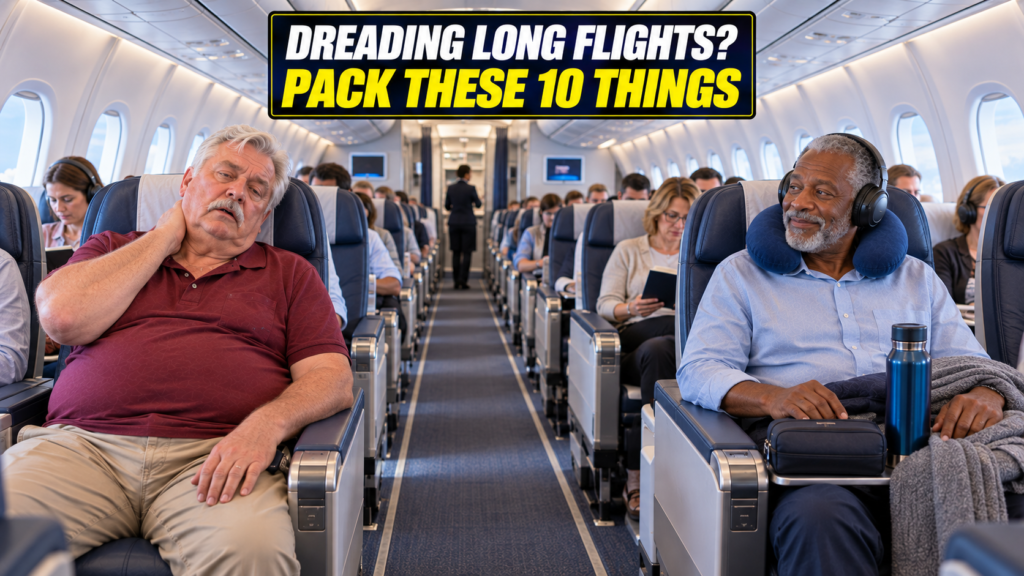
That is exactly the situation our exhausted traveler got wrong.
He packed for the trip.
The experienced traveler packed for the seat.
That small distinction can make a surprisingly big difference over many hours.
The Packing Mistake That Matters Most
There is a common theme running through all 10 items.
Accessibility.
A comfort item is not particularly useful during the flight if you cannot conveniently access it when you need it.
That doesn’t mean ignoring cabin baggage rules or leaving belongings loose around your seat. During taxi, takeoff, landing and whenever instructed by the crew, baggage and personal items need to be properly stowed.
Instead, organize before you settle in.
Ask yourself:
What am I likely to need during the flight?
Separate those items from things you only need after arrival.
That may mean your destination clothing stays packed away while a much smaller set of flight essentials is organized for appropriate access.
What I Would NOT Stuff Into My Long-Flight Bag
The travel-products industry can make it seem as though every inconvenience requires another gadget.
It doesn’t.
I would be cautious about buying:
Huge travel pillows that take up enormous space without actually helping your posture.
Multiple blankets and layers when one versatile layer would do the job.
Large collections of toiletries you won’t need until after landing.
Too many electronic gadgets that create more chargers, cables and things to keep track of.
Duplicate “just in case” items that solve the same problem.
Every extra item creates another thing to carry through the terminal.
For travelers who want an easier airport experience, reducing unnecessary weight can be just as valuable as adding comfort products.
My Simple Long-Flight Packing System
Before leaving home, I divide what I’m carrying into three mental categories.
Category 1: Things I need to travel
Identification, travel documents when required, medication and other genuine essentials.
Category 2: Things I may use during the flight
Water bottle, appropriate comfort items, headphones, eye mask, snacks and my small seat-essentials pouch.
Category 3: Things I need after landing
Most clothing, destination-specific items and anything else I don’t expect to use onboard.
That prevents the entire carry-on from becoming one giant miscellaneous container.
When I reach my seat, I know what matters during the next several hours.
Over 60? Comfort Should Be Personal
There is no single packing list that works perfectly for every older traveler.
One person may need prescription medication readily available.
Another may have specialized footwear.
Someone else may use a mobility aid or medical device.
Another traveler may be perfectly comfortable with almost none of the comfort products on this list.
So use lists like this as a framework—not a medical prescription or mandatory checklist.
Prioritize your individual needs.
And if a health condition affects how you should manage prolonged sitting, medication timing, compression garments, hydration or mobility, seek individualized professional guidance before your trip.
Before You Zip Your Bag, Ask These Five Questions
You can simplify the entire process by asking:
- What will I genuinely use while sitting on the aircraft?
- Can I access those items when appropriate without unpacking everything?
- Am I carrying bulky products that solve the same problem?
- Are my important medications and personal essentials properly organized?
- Have I packed for the flight itself—not only for the destination?
That final question is the one most people forget.
Your vacation may last a week or two.
But before it begins, you may spend a very long day navigating an airport and sitting on an airplane.
Preparing for those hours doesn’t require a giant carry-on.
It requires choosing a few useful items deliberately.
Because the goal isn’t to bring more.
It’s to arrive less exhausted.
