
AIRPORT TIPS
Over 65? Medicare Usually Won’t Cover You Abroad — Except in These 9 Situations
Sep
Many Americans over 65 spend years using Medicare at home and naturally assume that the same coverage will follow them when they travel.
Then something happens overseas.
A sudden illness. An unexpected hospital visit. A doctor on a cruise ship. An ambulance ride.
And eventually, someone puts a medical bill on the counter.
That is when an older traveler may ask a surprisingly important question:
“Wait—Medicare doesn’t automatically cover this overseas?”
In most situations, the answer for Original Medicare is no.
Original Medicare generally does not cover health care you receive outside the United States. But “generally” matters, because Medicare has several narrow exceptions that travelers often never hear about until they start researching an international trip.
There is another source of confusion, too.
Original Medicare, Medicare Advantage, and Medigap are not the same thing.
Some travelers may have additional foreign-travel protection through a Medigap policy or benefits offered by a particular Medicare Advantage plan. Those benefits should not be confused with the limited foreign-care rules of Original Medicare itself.
So before you leave the country, here are nine situations and costs worth understanding.
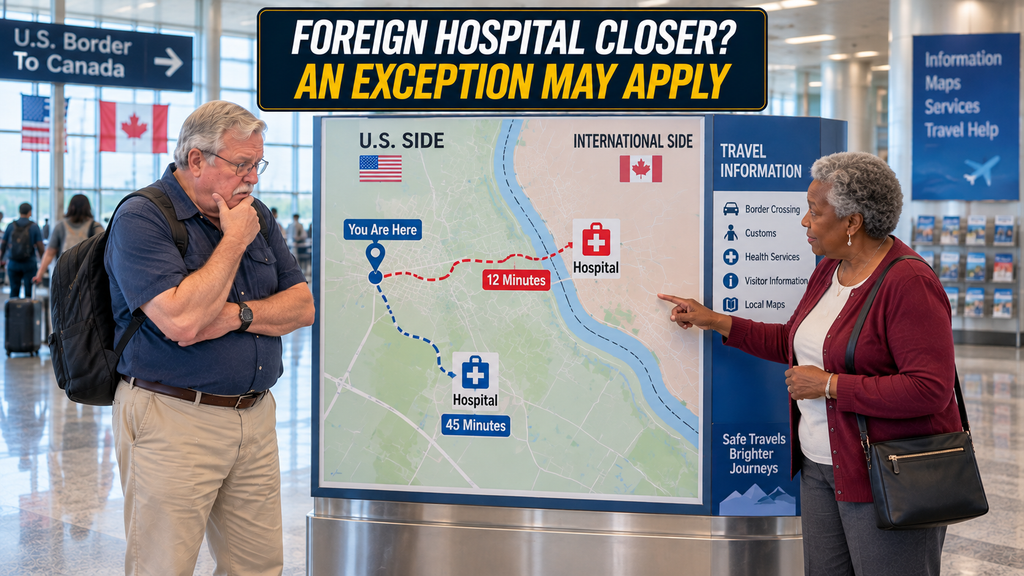
#9 — Emergency Care When a Foreign Hospital Is Closer
Imagine that you are still physically in the United States when a medical emergency occurs.
There is a hospital across an international border that can treat your condition—and it is closer than the nearest U.S. hospital capable of treating you.
That unusual geography can matter.
Medicare provides an exception for certain situations in which you are in the U.S. when an emergency occurs and a foreign hospital is closer or easier to access than the nearest appropriate U.S. hospital.
That does not mean Medicare becomes worldwide insurance simply because a foreign hospital happens to be nearby.
The circumstances have to satisfy Medicare’s requirements.
But this is an important exception for older Americans living or traveling near international borders.
The lesson is simple:
“Outside the United States” does not always mean “automatically excluded.”
Sometimes your location when the emergency begins—and the location of the nearest appropriate hospital—can change the answer.
#8 — Inpatient Care at a Qualifying Foreign Hospital
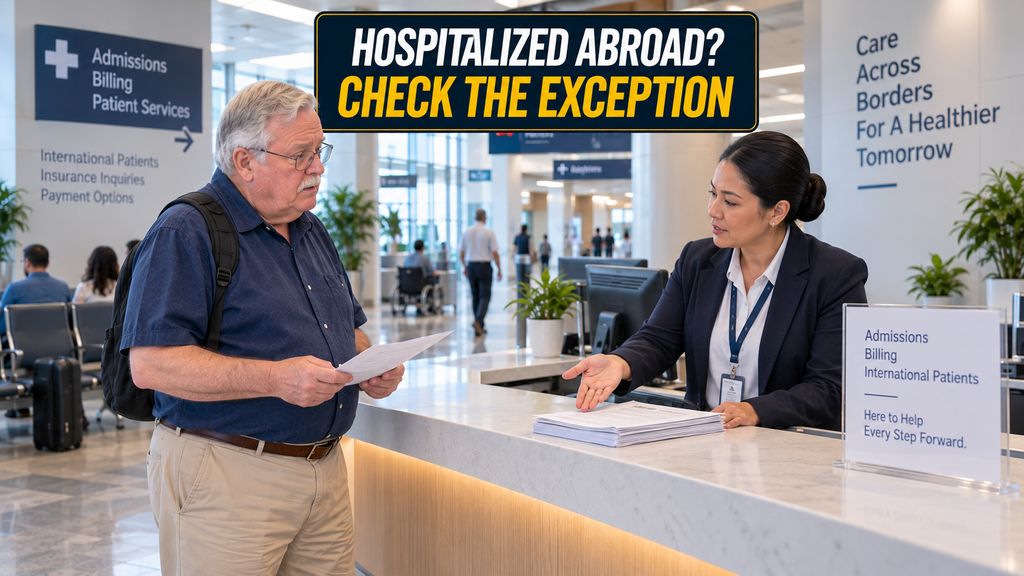
Suppose the situation in #9 qualifies and you are admitted to the foreign hospital.
What happens to the hospital charges?
Under qualifying circumstances, Medicare Part A may cover covered inpatient hospital services at the foreign hospital.
The critical phrase is “qualifying circumstances.”
Simply being admitted to a hospital while vacationing in another country does not activate Medicare Part A.
For example, an American traveler who becomes sick during a European vacation should not assume that showing a Medicare card at a European hospital means Medicare will automatically pay the inpatient bill.
That is precisely the assumption this article is designed to prevent.
The foreign hospital first has to fall within one of Medicare’s limited foreign-care exceptions.
Only then should the traveler start asking which covered services may qualify.
So if you see a headline suggesting:
“Medicare pays foreign hospital bills!”
be careful.
A more accurate statement is:
Medicare may pay certain covered hospital costs abroad when the situation meets one of its specific exceptions.
That is a very different promise.
#7 — Certain Doctor Services During a Covered Foreign Hospital Stay
A hospital stay involves more than the room itself.
Doctors may evaluate you, order treatment and provide professional services during your admission.
That raises another question:
If Medicare recognizes the foreign hospital stay under one of its exceptions, what happens to the physician charges?
In qualifying circumstances, Medicare Part B may cover certain doctor services associated with a covered foreign inpatient hospital stay.
Again, don’t shorten this to:
“Part B covers doctors overseas.”
That is far too broad.
If you simply schedule a routine appointment with a physician while vacationing overseas, you should not assume Original Medicare will pay because you have Part B.
The foreign-care exception still matters.
Think of this as a chain.
First ask:
Does this situation qualify for Medicare’s foreign-care exception?
Then ask:
Which services connected with that qualifying situation are covered?
Starting with those questions can prevent a traveler from turning a narrow exception into an imaginary worldwide benefit.

#6 — A Medically Necessary Ambulance to a Qualifying Foreign Hospital
Ambulance bills can be another source of confusion.
Under limited circumstances, Medicare may cover medically necessary ambulance transportation to a foreign hospital when that transportation is connected with qualifying covered inpatient hospital care and Medicare’s requirements are satisfied.
But once again, context is everything.
Do not interpret this as:
“Medicare covers ambulances overseas.”
It doesn’t create a general international ambulance benefit.
The foreign hospital and underlying situation need to qualify.
This distinction is particularly important because a traveler facing an emergency may not have much time to research insurance rules while transportation is being arranged.
That is another reason to understand your coverage before traveling.
If you have additional travel medical insurance, Medigap, or Medicare Advantage coverage, learn how emergency transportation works under those policies as well.
And find out whether the provider might expect payment from you first.
Coverage and payment at the scene are not necessarily the same thing.
#5 — An Emergency While Traveling Through Canada Between Alaska and Another State
This may be one of the strangest Medicare exceptions many travelers have never encountered.
Imagine driving between Alaska and another U.S. state.
The practical route takes you through Canada.
While traveling through Canada without unreasonable delay, you experience a medical emergency.
A Canadian hospital capable of treating you is closer than the nearest appropriate U.S. hospital.
Under Medicare’s rules, qualifying services at the Canadian hospital may be covered if the required conditions are met.
This exception exists because of Alaska’s geography.
But notice how specific it is.
It does not mean:
“Americans with Medicare are covered while vacationing in Canada.”
A week sightseeing in Vancouver is not the same scenario as traveling a direct route between Alaska and another U.S. state.
The route matters.
The circumstances matter.
The location of the appropriate hospitals matters.
And whether the journey involved unreasonable delay can matter.
This is a perfect example of why a short social-media claim such as “Medicare covers you in Canada” can be dangerously misleading.
The actual exception is much narrower.
#4 — A Foreign Hospital Is Closer to Your U.S. Home
Here’s another situation where geography can produce an unusual result.
Suppose you live in the United States, but the closest hospital capable of treating you is across the border.
The nearest appropriate U.S. hospital is farther away.
Medicare has rules that can allow coverage at a foreign hospital in certain circumstances when that foreign hospital is closer to your U.S. residence than the nearest appropriate U.S. hospital.
This is especially relevant to people who live near international borders.
And this exception is worth separating from the classic vacation-emergency scenario.
The key isn’t simply:
“I traveled abroad and needed a doctor.”
Instead, your U.S. residence and the relative locations of the hospitals are central to determining whether the exception applies.
That makes this another situation where you should resist universal statements.
Someone living hundreds of miles from an international border should not read about this exception and assume it gives them routine Medicare coverage during an overseas vacation.
It doesn’t.
Where you live and which appropriate hospital is closer can matter.
#3 — Certain Medical Services While You’re on a Cruise
Cruise travelers should pay particular attention here.
You board a ship in the United States.
Several hours later, you need medically necessary care from a doctor aboard the vessel.
Does Medicare cover it?
The answer is not simply yes or no.
Original Medicare can cover certain medically necessary services aboard a cruise ship when Medicare’s specific location and timing requirements are satisfied.
Medicare guidance explains that coverage may apply when the ship is in a U.S. port or, under qualifying circumstances, when the ship is within a limited period—commonly described as no more than six hours—from a U.S. port.
But once the vessel is outside the applicable Medicare conditions, you should not assume Original Medicare follows you indefinitely across the ocean.
So don’t interpret this section as:
“Medicare covers cruise medical centers.”
The better takeaway is:
On a cruise, the ship’s location can affect whether Medicare coverage is available.
Before sailing, check your exact situation.
Cruise medical care can become expensive, and billing procedures aboard a ship may be very different from visiting a provider near your home.
If your itinerary spends substantial time outside Medicare’s normal coverage territory, this is also a good reason to examine any additional travel medical protection you have.
#2 — Some Vaccines You Get Before International Travel
This one belongs in a different category.
It is not an example of Medicare paying for medical treatment you receive in another country.
Instead, it is a potential pre-trip health cost.
Medicare Part D covers recommended adult vaccines under Medicare’s applicable vaccine rules, and some vaccines travelers consider before international trips may fall within covered recommendations.
But the exact vaccine matters.
Your destination matters.
And a vaccine being useful for travel does not automatically mean every travel vaccine is covered in every circumstance.
So before paying, check the vaccine itself and your current coverage.
The timing matters too.
This is something to investigate before leaving the United States, rather than arriving at your destination and assuming Medicare will reimburse whatever preventive service you purchase there.
For travelers over 65, it can be useful to add one question to the pre-trip checklist:
“Are any vaccines recommended for my destination, and how are they covered under my plan?”
That is far more useful than assuming all travel vaccinations are either automatically free or automatically excluded.
#1 — Certain Medigap Policies Can Provide Foreign-Travel Emergency Benefits
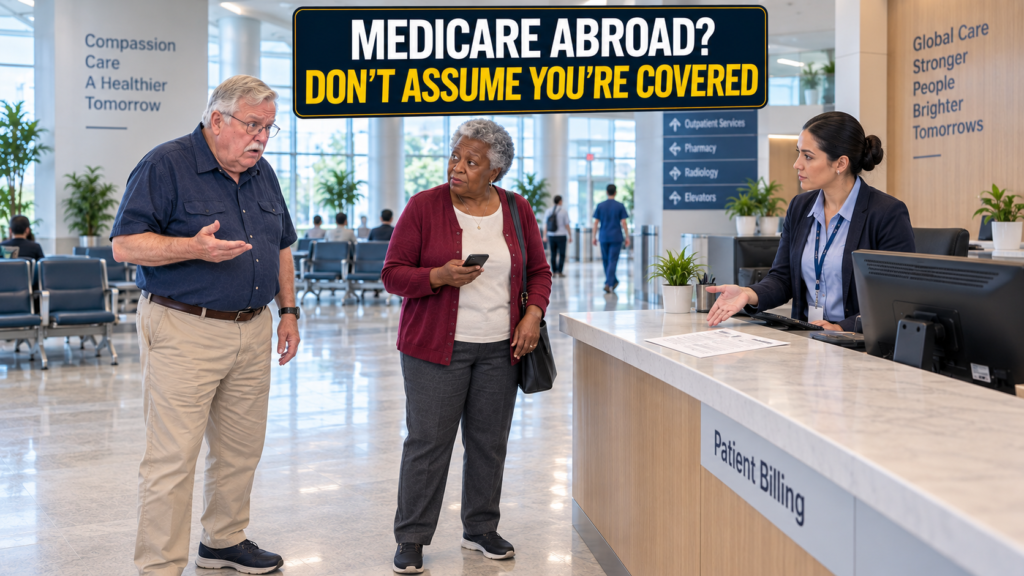
Now we return to the couple standing at the foreign hospital billing counter.
The husband looks at the bill.
He had assumed Medicare would take care of it.
His wife had asked a different question before they left home:
“What does our specific coverage actually do overseas?”
That distinction matters because Medigap is not Original Medicare.
Medigap is supplemental insurance sold by private insurers to help cover certain costs associated with Original Medicare.
And certain standardized Medigap plans include a foreign-travel emergency benefit.
For qualifying plans and qualifying emergency care, Medicare’s consumer guidance describes a benefit that generally pays 80% of certain medically necessary emergency care billed charges after a $250 annual deductible.
There are major limits.
The emergency must generally begin during the first 60 days of the trip, and the foreign-travel emergency benefit has a $50,000 lifetime limit.
Those numbers immediately show why “I have Medigap, so I’m covered overseas” is not a safe assumption.
First, your specific Medigap plan needs to include the benefit.
Then the care needs to meet the applicable conditions.
Deductibles and cost sharing can remain.
The 60-day trip limitation matters.
And the lifetime maximum matters.
That is why the wife in our opening story does not say:
“Don’t worry. Medigap will pay this.”
She says:
“That’s why I checked our Medigap coverage before we left.”
Those are two very different statements.
Checking is preparation.
Promising payment without reviewing the policy is guessing.
What About Medicare Advantage?
There is one more source of confusion.
Someone may say:
“My Medicare covers emergencies overseas.”
What they actually mean may be that their Medicare Advantage plan includes an international emergency or urgent-care benefit.
Medicare Advantage plans are offered by private companies approved by Medicare, and benefits beyond Original Medicare can vary by plan.
That means another traveler’s Medicare Advantage experience does not necessarily tell you what your own plan will do.
Before an international trip, examine your plan’s current coverage documents or contact the plan directly.
Ask about foreign emergency and urgent care.
Ask whether you might have to pay the provider first.
Ask how reimbursement works.
Ask what documentation you’ll need.
Ask whether there are geographic, time, dollar or other limitations.
And don’t wait until you’re standing at a hospital counter overseas to learn the answers.
Six Questions to Ask Before Leaving the United States
A good international medical-coverage check does not need to be complicated.
Before your next trip, ask:
- Does my exact coverage pay for emergency or urgent medical care outside the United States?
- What does my plan consider a qualifying emergency?
- Are there deductibles, percentages, trip-duration limits, geographic restrictions or lifetime maximums?
- Could I be required to pay the foreign provider myself and request reimbursement later?
- What receipts, medical records and itemized bills would I need to submit a claim?
- Do the gaps in my existing coverage make separate travel medical insurance worth considering?
Write down the answers.
Keep the appropriate plan contact information accessible while traveling.
And if you rely on a Medigap or Medicare Advantage benefit, check your specific current policy, not a friend’s policy and not a social-media post describing someone else’s plan.
Don’t Confuse “Covered” With “Free”
There is another word that causes trouble in articles like this:
covered.
A service being covered does not necessarily mean the traveler owes nothing.
Depending on the applicable benefit, there may still be deductibles, coinsurance, limits or reimbursement procedures.
A foreign provider also isn’t automatically part of the Medicare billing system you are accustomed to using at home.
You may encounter very different payment procedures.
That is why your preparation should go beyond asking:
“Does Medicare cover this?”
Ask:
“If this happens, who pays the provider initially, what might I owe, and how would I submit the claim?”
That question is far more useful when you’re thousands of miles from home.
The Most Expensive Mistake May Be an Assumption
Back at the hospital counter, the husband finally asks his wife:
“So Medicare and Medigap aren’t the same thing?”
“Exactly.”
That may be the most important exchange in the entire story.
Original Medicare generally provides very limited coverage outside the United States, with specific exceptions.
Certain Medigap policies can offer separate foreign-travel emergency protection under defined conditions.
Medicare Advantage plans may have their own international benefits, depending on the individual plan.
None of those statements means every overseas medical bill will be paid.
And none of them means an American traveler over 65 should avoid international travel.
They mean something much simpler:
Know what you have before you leave.
Check the exact plan.
Check the limitations.
Check how claims work.
And consider what you would do if a hospital expected payment before your insurer reimbursed you.
Because the worst place to discover a gap in your coverage is not while sitting comfortably at home with your policy documents in front of you.
It’s when a medical bill lands on a counter in a country thousands of miles away.
