
AIRPORT TIPS
Flying After 60? 9 Things to Wear — And What FAA Safety Guidance Actually Says
Sep
If you are over 60 and getting ready for a flight, you probably think carefully about what goes into your suitcase.
But what about what stays on you?
That question can matter more than travelers realize.
Not because the FAA has a secret dress code for older passengers. It does not.
But practical clothing choices can affect how comfortably you move through an airport, how easily you manage a long flight, and how prepared you are if the crew suddenly needs you to act quickly.
And one fictional situation illustrates the point perfectly.
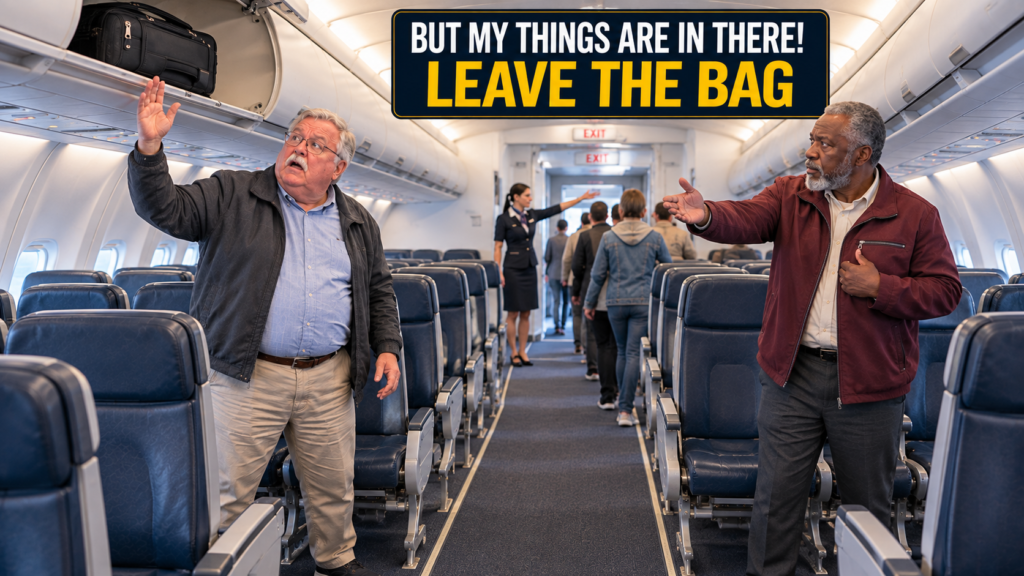
“BUT MY IMPORTANT THINGS ARE IN MY BAG!”
Imagine two older passengers standing in an airplane cabin after an evacuation has been ordered.
One is an inexperienced 69-year-old traveler.
The other is 71 and has flown many times.
The first man suddenly looks up.
His black carry-on is still inside the overhead compartment.
“Wait! My important things are in my bag!”
The experienced traveler points toward the exit.
“Leave the bag! We need to get out!”
The first man hesitates.
“But everything I need is in there!”
The experienced traveler touches the outside of the closed zippered pocket on his jacket.
“Mine isn’t.”
Four words.
But they reveal a major difference between the two travelers.
One of them is trying to solve a problem during the evacuation.
The other solved it before the emergency ever began.
FAA evacuation guidance tells passengers to follow crew instructions and leave carry-on baggage behind during an evacuation. Trying to retrieve luggage can interfere with getting people out efficiently.
That does not mean the FAA tells travelers over 60 to wear a particular jacket or carry specific belongings in their pockets.
It does mean there is a useful question to ask before your next flight:
If I had to leave my carry-on behind, would I be ready to move?
Here are nine things worth thinking about when deciding what to wear.
#9 — A Secure Zippered Pocket for Small Essentials
Our inexperienced passenger made a simple preparation mistake.
Too many things he considered important were in his carry-on.
That was fine while the bag remained accessible.
But once evacuation became the priority, the situation changed.
A secure zippered pocket can be useful for keeping a small number of appropriate essentials on your person before anything unusual happens.
The key word is secure.
A loose phone sticking halfway out of an open pocket is not the same thing.
Neither is a wallet sitting loosely in a shallow back pocket.
And this is not an instruction to stuff your clothing with everything you packed.
The goal is much simpler: think beforehand about the small items you genuinely do not want to be searching for at a critical moment.
The FAA does not require passengers to wear clothing with zippered pockets.
This is practical preparation inspired by a larger safety principle: if an evacuation is ordered, your carry-on should not become the reason you delay leaving.
Prepare before you need to leave the bag behind.

#8 — Secure, Practical Shoes
Air travel involves much more walking than sitting in an airplane seat.
You may cross a parking facility, walk through a large terminal, clear security, change concourses and eventually navigate a narrow aircraft aisle.
That makes footwear one of the most practical parts of a travel outfit.
For many older travelers, a secure shoe that stays properly on the foot and feels comfortable during normal walking may be more useful than footwear chosen primarily for appearance.
Think about the entire journey.
Can you walk comfortably through the terminal?
Does the shoe stay securely on your foot?
Can you stand and move naturally in it?
None of this means the FAA requires sneakers.
It does not.
The broader lesson is to choose footwear for the trip you are actually taking—not just for the hours you expect to spend sitting down.
Choose shoes for moving, not just sitting.
#7 — Think Twice About Making High Heels Your Only Travel Shoes
High heels are not simply “banned on airplanes.”
That would be an inaccurate way to frame the issue.
But evacuation creates a different context from ordinary boarding or sitting at your seat.
FAA passenger evacuation information specifically addresses high-heeled shoes in connection with evacuation slides, advising passengers to remove them before using a slide when possible.
That is a much narrower claim than saying the FAA has a rule telling older travelers what shoes to wear.
Still, it raises a practical question.
If the shoes you choose become inconvenient precisely when you need to move quickly, are they the best choice for your travel day?
For someone who enjoys wearing heels, that does not mean you need to abandon your personal style.
It means thinking about practicality as well as appearance.
Your travel shoes need to work in terminals, aisles and unexpected situations—not only while you are sitting at the gate.
Your airport shoes should still make sense when moving becomes the priority.

#6 — Clothing That Lets You Move Naturally
Some clothing feels perfectly comfortable when you are sitting still.
Then you try to stand.
Or reach down.
Or step sideways out of an airplane row.
Suddenly it becomes much less convenient.
Aircraft cabins already restrict movement.
There is little benefit in making that restriction worse with clothing that makes ordinary movement unnecessarily difficult.
This does not require a special “airplane uniform.”
It simply means considering mobility when you get dressed.
Can you stand naturally?
Can you walk without constantly adjusting your clothing?
Can you get in and out of your seat without fighting your outfit?
Those are practical questions at any age, but they can become especially worthwhile when comfort and easy movement matter more than they once did.
Again, this is practical travel advice.
It is not an FAA dress code.
If your clothes fight every movement, they probably are not ideal travel clothes.
#5 — Comfortable Long Pants
Long pants can be a practical choice for many older travelers because they provide coverage and can work across different parts of the journey.
But there is an important distinction here.
Long pants are not an FAA requirement for airline passengers.
The useful part is choosing something that lets you sit and move comfortably for hours.
Very restrictive clothing may become irritating during a long travel day.
On the other hand, an outfit that is comfortable only while standing may feel completely different after several hours in an airplane seat.
Try thinking beyond the first ten minutes.
Imagine sitting in the clothing for two, four or eight hours.
Then imagine standing up and walking through another terminal after landing.
That is a better test of travel clothing than simply looking in the mirror before leaving home.
Think comfort and mobility, not imaginary fashion rules.

#4 — A Breathable Base Layer
Airport travel can involve several different environments in a surprisingly short period.
You may feel warm carrying luggage through the terminal.
Then you sit near a cool window at the gate.
Boarding becomes warm again as passengers fill the aisle.
Later, the cabin may feel cooler than you expected.
One practical solution is a comfortable base layer.
That might be a lightweight shirt, blouse or T-shirt that you would be comfortable wearing by itself if you remove an outer layer.
The goal is flexibility.
You do not want your entire comfort strategy to depend on one heavy garment that is either on or off.
A breathable, comfortable base gives you a starting point that works across more conditions.
There is no FAA-approved fabric that older passengers are required to wear.
This is about managing an ordinary travel problem simply.
Start with something you can comfortably wear for hours.
#3 — A Lightweight Layer You Can Remove Easily
Now add the second half of the strategy.
A cardigan, lightweight jacket or similar removable layer can make changing conditions easier to manage.
Too cold?
Put it on.
Too warm?
Take it off.
But ease of use matters.
A complicated garment that requires you to stand in a narrow row and struggle with multiple fasteners is less convenient than something you can manage easily.
This is also where our opening story becomes relevant again.
A lightweight jacket may provide a secure zippered pocket for a few small essentials.
That does not mean your jacket should become another suitcase.
Do not overload your pockets.
The benefit is simply having an appropriate place for a few small items you deliberately chose to keep on your person.
And during normal flight conditions, keeping a useful layer accessible can also reduce unnecessary trips to the overhead compartment.
The best layer is one you can actually manage easily from your seat.
#2 — Socks That Actually Work With Your Shoes
Socks rarely appear on anybody’s list of exciting travel purchases.
But uncomfortable socks can make otherwise good shoes unpleasant surprisingly quickly.
Think about the combination rather than treating shoes and socks as separate decisions.
Do the socks bunch up?
Do they create uncomfortable rubbing?
Do they work properly with the shoes you intend to wear through the terminal?
Can you comfortably spend the day in that combination?
Those simple considerations are enough for most general travel advice.
Be careful about turning this into universal medical guidance.
For example, specialized compression garments are a different subject and may involve individual health considerations. Being over 60 by itself is not a reason for a travel article to prescribe a particular medical product to everyone.
For our purposes, the rule is much simpler.
Your shoes and socks should work as a system.
#1 — The Most Important Thing You “Wear” While Seated May Be the Seat Belt
Here is the item that is not really clothing at all.
Yet it may be more important than everything else on this list.
Your seat belt.
FAA passenger safety guidance encourages travelers to keep their seat belts fastened while seated, including because unexpected turbulence can occur.
That is worth remembering after the seat belt sign goes off.
The sign changing does not mean turbulence has become impossible.
If you are sitting comfortably, keeping the belt appropriately fastened means you do not have to predict exactly when the cabin might suddenly move.
This is one place where we can move beyond general clothing advice and talk about a direct aviation-safety habit.
You do not need a special travel jacket.
You do not need special “FAA-approved” pants.
But when you are sitting in your aircraft seat, use the restraint provided for you and follow crew instructions.
The most important thing you “wear” in your seat may already be attached to it.
WHAT SHOULD YOU LEAVE BEHIND DURING AN EVACUATION?
Now return to those two older passengers.
The inexperienced traveler made his mistake before the evacuation began.
He placed important belongings in his carry-on without thinking about what would happen if he suddenly could not take that bag with him.
Once an evacuation is underway, that is not the moment to fix the problem by stopping to retrieve luggage.
FAA evacuation guidance tells passengers to leave carry-on baggage behind and follow crew instructions.
That instruction exists for a reason.
A suitcase can cost time.
It can interfere with movement.
And baggage should not become more important than getting people out.
Our experienced passenger understood the practical consequence before he ever boarded.
He did not carry his suitcase to the exit.
He did not wear a backpack during the evacuation.
He did not stop and open his pocket to show everyone what was inside.
He simply had a few small essentials secured appropriately beforehand and was ready to move.
That is the behavior worth remembering.
THE DIFFERENCE HAPPENED BEFORE THE EMERGENCY
At the end of our scenario, both men walk toward the exit.
Neither one carries luggage.
Behind them, the same black carry-on remains in the overhead compartment.
But psychologically, their experiences are completely different.
One man looks back at the bag and thinks:
Everything I need is in there.
The other does not need to look back.
That does not mean he predicted an emergency.
It means he thought ahead.
And that is the real lesson behind this list.
There is no secret FAA wardrobe consisting of nine mandatory items for passengers over 60.
Instead, combine genuine aviation-safety guidance with practical travel preparation.
Wear shoes that make sense for moving.
Choose clothes that do not unnecessarily restrict you.
Use layers that are easy to manage.
Keep appropriate small essentials secure rather than assuming your carry-on will always be accessible.
And while you are seated, keep that seat belt in mind.
Because the smartest thing you wear on your next flight may not be the most fashionable thing.
It may simply be the thing that helps you stay comfortable, move easily, and leave your luggage behind when the crew tells you it is time to go.
