
CRUISE TIP
WHAT REALY HAPPENS DURING CRUISE DRUG CHECKS
Sep
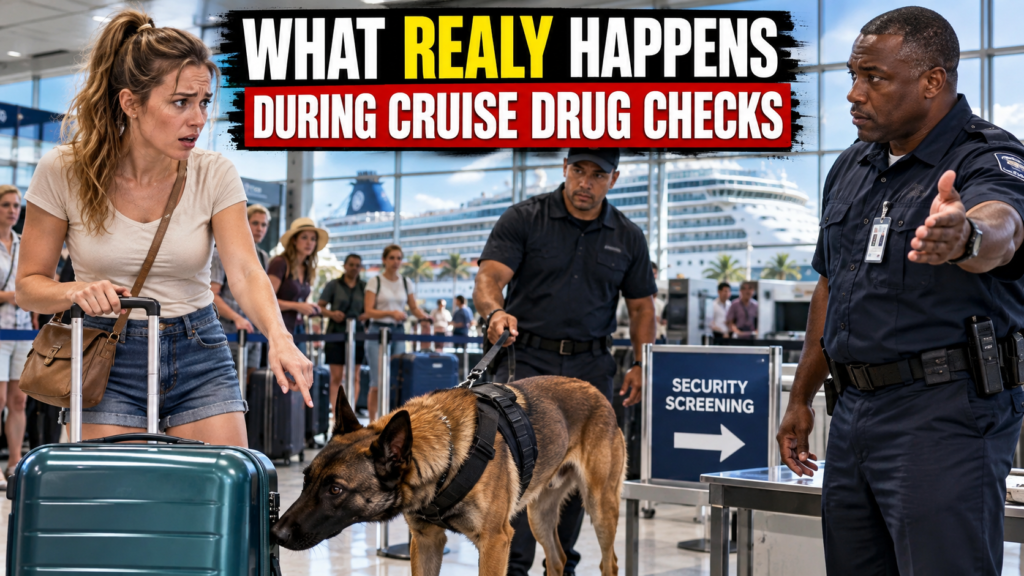
The dog was moving calmly through the cruise terminal when it suddenly stopped.
Right beside one passenger’s suitcase.
The woman froze.
“Wait… why did the dog stop at MY bag?”
A security officer stepped toward her.
“Ma’am, please step over here with your luggage.”
Her expression changed immediately.
“Am I in trouble?”
The officer remained calm.
“Not necessarily. Your bag needs additional screening.”
She looked back toward the security checkpoint.
“But I already went through security!”
“Your belongings can still be subject to additional inspection.”
Now she looked genuinely confused.
“Even before I get on the ship?”
That question gets to the heart of something many first-time cruisers misunderstand.
Cruise security does not necessarily end the moment you pass through the first checkpoint. Cruise lines have prohibited-item policies, baggage can be screened, and depending on the port and circumstances, law-enforcement or customs authorities may also conduct inspections.
And yes—drug-detection dogs can be part of the picture.
But what really happens during cruise drug checks is more complicated than the dramatic videos you may see online.
Do Cruise Lines Really Check Passengers for Drugs? The dog was moving calmly through the cruise terminal when it suddenly stopped.
Yes, drug enforcement and prohibited-item screening are real parts of cruise security.
But that does not mean every passenger receives a personal “drug search” before boarding.
The process can involve baggage screening, inspection of belongings, cruise-line security measures, and inspections conducted by government or law-enforcement authorities.
Policies vary by cruise line, terminal, destination and circumstances.
Carnival Cruise Line currently states that guests and their personal items may be subject to law-enforcement screening. Carnival also says customs and law-enforcement authorities at U.S. homeports and foreign destinations may conduct routine or random inspections with narcotics-sniffing dogs.
Carnival goes even further: it says the cruise line reserves the right to deploy narcotics-sniffing dogs in terminals and onboard its ships.
That makes one thing clear:
Seeing a drug-detection dog at a cruise terminal is not simply something invented for social media.
It can actually happen.
What Happens When You Arrive at the Cruise Terminal? The dog was moving calmly through the cruise terminal when it suddenly stopped.
For most passengers, embarkation is much less dramatic than the opening scene above.
You arrive with your luggage.
You complete the required check-in process.
Your luggage and belongings go through applicable security procedures.
You proceed toward boarding once cleared.
Cruise security is designed to prevent prohibited and dangerous items from being brought aboard.
For example, Carnival says it conducts security screening of luggage and reserves the right to confiscate prohibited items. Royal Caribbean states that during security screenings it may inspect guest belongings and remove prohibited items.
The exact procedure can vary.
That is why passengers should not expect every cruise terminal to look or operate exactly the same way.
But there is a simple rule that applies regardless:
Passing one stage of security does not create a permanent guarantee that your belongings cannot be inspected again.
What If a Detection Dog Stops Near Your Suitcase?
This is where cruise stories often become exaggerated.
Imagine a dog walking along a row of passengers.
It stops beside one suitcase.
Everyone looks at the owner.
The passenger panics.
Social-media narration might immediately say:
“BUSTED!”
That conclusion goes too far.
A dog’s behavior should not be portrayed by a travel article as automatic proof that a passenger possesses illegal drugs.
A realistic version of the scene is much simpler:
The bag may receive additional attention or screening.
Authorities or security personnel determine what happens next.
The passenger follows instructions.
The important distinction is between additional screening and proof of wrongdoing.
A dramatic pause beside a suitcase makes a great video hook.
It should not be turned into a false accusation.
Can Drug-Sniffing Dogs Be Used at Cruise Terminals?
Yes.
This is one of the strongest factual elements behind this story.
Carnival’s current Drug Free Zones policy explicitly discusses narcotics-sniffing dogs. According to Carnival, customs and law-enforcement authorities may use them during routine or random inspections at U.S. homeports and foreign destinations.
Carnival also reserves the right to deploy narcotics-sniffing dogs in cruise terminals and onboard its vessels.
So a scene showing a professionally handled detection dog moving through a terminal can be realistic.
What should not be assumed is that every cruise line uses dogs on every sailing or that every passenger encounters one.
There is no universal “every passenger gets checked by a drug dog” rule.
The Marijuana Question Surprises Many Cruisers
This is probably where the greatest confusion begins.
A passenger may live in a U.S. state where recreational marijuana is permitted under state law.
Another passenger may have authorization to use marijuana for medical purposes.
They may therefore assume:
“It’s legal at home, so why would my cruise care?”
That assumption can cause serious problems.
Major cruise lines publish their own prohibitions.
Carnival states that marijuana—including marijuana for medical purposes—is not allowed onboard.
Royal Caribbean’s current Guest Health, Safety and Conduct Policy says marijuana is prohibited even in medicinal form or for medicinal purposes.
Norwegian Cruise Line likewise states that illegal drugs and substances, including medical marijuana, are not allowed onboard or during specified parts of an NCL vacation.
So “it’s legal where I live” is not a reliable standard for deciding what you can bring on a cruise.
What About CBD?
This is another area where passengers should be careful about making assumptions.
Products marketed as CBD can create confusion because laws, product formulations and cruise-line rules are not identical everywhere.
Carnival’s published prohibited-items information currently includes cannabis-derived products such as CBD among prohibited items.
That means a passenger should not assume that a product is cruise-safe merely because it was legally purchased at a store.
Check the specific cruise line’s current prohibited-item policy before packing.
And because cruise policies can change, check close to departure rather than relying on something you read years ago.
Prescription Medication Is a Different Issue
“Drug check” should not be confused with “all medication is prohibited.”
That would be inaccurate.
Legitimate prescription medication is a separate issue from illegal drugs and prohibited cannabis products.
Carnival, for example, recommends keeping prescription medications in their original packaging and bringing documentation such as a copy of the prescription and a letter from the treating doctor.
Controlled prescription medication can involve additional complications because travelers may encounter restrictions imposed by countries visited, airlines or local port authorities.
That is particularly important on international itineraries.
A medication legally prescribed to you at home does not automatically mean every foreign jurisdiction treats that medication the same way.
If your medication contains a controlled substance, research the applicable rules before traveling.
What Happens If Security Wants to Inspect Your Bag?
The safest response is also the simplest:
Stay calm and follow lawful instructions from authorized personnel.
An additional bag inspection does not automatically mean you are being arrested.
Cruise lines expressly reserve screening and inspection rights in their policies.
Royal Caribbean, for example, says it may inspect guest belongings during security screenings and may remove prohibited items.
The exact process will depend on where you are, who is conducting the screening and what triggered the additional inspection.
A passenger should not turn a routine secondary screening into a confrontation simply because they already passed another checkpoint.
In the opening scene, the officer’s response captures the appropriate tone:
“Not necessarily. Your bag needs additional screening.”
No accusation.
No instant arrest.
No claim that the dog “proved” anything.
Just another security step.
What If Prohibited Drugs Are Actually Found?
Now the situation changes.
Potential consequences can be significant.
Royal Caribbean lists enforcement actions that can include confiscation of prohibited or illegal items, intervention by security or law enforcement, reporting to authorities, denial of boarding and removal from the vessel.
Its policy also warns that illegal drugs can result in arrest and prosecution under the relevant jurisdiction and can prevent a passenger from boarding or re-boarding.
Norwegian Cruise Line states that illegal drugs or substances will be confiscated and that appropriate action may include removal from the ship and involvement of authorities.
Carnival warns that guests found possessing illegal drugs or other prohibited items may face consequences including fines, arrest and denial of boarding without refund or compensation.
The exact outcome is not universal.
It depends on the substance, circumstances, applicable law, location, cruise-line policy and authorities involved.
That is why it would be misleading to say:
“If they find drugs, this exact thing always happens.”
There is no single outcome for every situation.
Can You Be Denied Boarding?
Yes.
Cruise-line policies can permit denial of boarding in connection with prohibited or illegal substances.
That can turn what was supposed to be a vacation into an expensive problem before the ship even leaves port.
A passenger may already have paid for airfare.
Hotels.
Ground transportation.
The cruise itself.
Excursions.
Other vacation expenses.
Being denied boarding can therefore carry consequences beyond simply losing the prohibited item.
And cruise lines may have policies affecting refunds or compensation in these circumstances.
This is why checking prohibited-item rules before packing is far smarter than trying to resolve the issue at the terminal.
Can You Be Removed After the Cruise Has Already Started?
Potentially, yes.
Boarding the vessel does not make cruise-line conduct and prohibited-item policies disappear.
Royal Caribbean’s policy applies to multiple stages and locations of the cruise vacation, including onboard the vessel, terminals, ports of call, shore excursions and private destinations.
NCL similarly extends its prohibition on illegal drugs to onboard use and other portions of the cruise vacation.
Carnival’s policies also provide for possible removal from the ship in relevant circumstances.
So the idea that:
“Once I’m onboard, security can’t do anything”
is false.
Cruise ships have security policies that continue after embarkation.
Could Authorities Become Involved?
Yes.
This is where cruise travel differs from the idea of staying entirely within one familiar local environment.
A cruise can involve:
- the departure port,
- the cruise line,
- the ship,
- multiple foreign ports,
- local authorities,
- customs or law enforcement,
- and different jurisdictions during the voyage.
Royal Caribbean explicitly states that violations involving illegal drugs may be reported to appropriate authorities.
NCL warns that foreign governments at ports of call may have strict laws addressing drug possession.
Carnival similarly warns about law-enforcement involvement.
A passenger should therefore never assume that the rules from their home city or state will determine what happens everywhere during an international cruise.
What About When the Ship Reaches Another Country?
This is particularly important.
A cruise is not a legal bubble floating outside the rest of the world.
When the ship visits another country, local laws matter.
Cruise lines explicitly warn passengers that jurisdictions visited during a voyage may have strict drug laws.
The fact that a product can be purchased legally somewhere in the United States does not guarantee that it can legally enter another country.
That creates two separate questions:
Does my cruise line allow this?
and
Does every relevant jurisdiction on my itinerary allow this?
You should not assume the answer to either question.
Do Cruise Drug Checks Happen Only Before Departure?
No.
The policies make the issue broader than the initial embarkation checkpoint.
Carnival specifically discusses inspections by authorities at U.S. homeports and foreign destinations and reserves the right to deploy narcotics-sniffing dogs in terminals and onboard ships.
Royal Caribbean’s drug prohibition extends across multiple stages of the cruise vacation.
NCL’s policy similarly reaches beyond the moment a passenger initially boards.
So the mental picture of:
“I passed security once, therefore I’m finished with security for the entire vacation”
is too simplistic.
Cruise travel involves ports, re-boarding and international movement.
Security can exist at more than one point.
Are Cruise Drug Checks the Same as Airport TSA Screening?
Not exactly.
The settings may look similar to passengers because both can involve lines, baggage and security equipment.
But they should not be treated as identical systems.
Cruise terminals involve cruise-line security procedures and can also involve port authorities, customs and law-enforcement agencies depending on the location and situation.
That is why content creators should be careful about placing TSA logos or calling every cruise security officer a “TSA agent.”
A generic cruise-terminal security officer is not automatically TSA.
Similarly, cruise-line security staff should not automatically be described as police or customs officers.
Those roles are different.
What Should You Do Before Packing?
The easiest way to avoid problems is to check before you leave home.
First, read your specific cruise line’s current prohibited-items and guest-conduct policies.
Do this even if you have cruised before.
Policies change.
Second, if you take prescription medication—especially controlled medication—keep it properly documented and research any relevant destination requirements.
Third, do not assume recreational or medical marijuana is permitted because it is legal under the laws where you live.
Fourth, be cautious with cannabis-derived products such as CBD. Cruise-line restrictions can be broader than travelers expect.
Finally, if you’re uncertain about a specific legitimate medication or product, obtain authoritative information before traveling rather than relying on a social-media comment.
Five Cruise Drug-Check Myths to Stop Believing
MYTH 1: Every cruise passenger is personally searched for drugs.
No. Security screening exists, but published cruise-line policies do not establish a universal personal drug search of every passenger.
MYTH 2: If a detection dog stops near your bag, you’re automatically guilty.
No. A dog’s behavior can lead to further attention or screening, but a travel story should not present that alone as proof of a crime.
MYTH 3: Medical marijuana is automatically allowed.
No. Major cruise lines including Carnival, Royal Caribbean and NCL publish policies prohibiting medical marijuana.
MYTH 4: If marijuana is legal in your home state, you can take it on the ship.
No. State-level legality at home does not override a cruise line’s published prohibition or laws applicable elsewhere on the itinerary.
MYTH 5: Once you’re onboard, the drug policy no longer matters.
No. Cruise-line policies can apply onboard and throughout other parts of the cruise vacation.
Why Cruise Lines Take This So Seriously
Cruise ships move between jurisdictions.
That alone makes prohibited-substance issues more complicated than many passengers expect.
A voyage can begin in the United States, visit several countries and return days later.
Cruise companies therefore publish rules intended to apply throughout their operations and the passenger’s cruise experience.
The consequences also extend beyond the individual passenger.
Cruise lines have security responsibilities, must operate within applicable laws and interact with authorities in multiple destinations.
From the passenger’s perspective, the simplest strategy is not trying to memorize every possible enforcement scenario.
It is knowing what you are allowed to bring before you arrive.
Back at the Terminal…
The woman looked down at her suitcase.
The detection dog remained beside its handler.
Other passengers were beginning to stare.
“Even before I get on the ship?” she asked.
The officer gestured toward the secondary-screening area.
What happens next depends on what the screening actually reveals.
Maybe nothing prohibited is inside.
Maybe the passenger is cleared and continues boarding.
Or perhaps security finds an item that violates cruise-line policy, in which case the situation can become considerably more serious.
That uncertainty is precisely why the opening moment is so tense.
But there is one thing we should not do.
We should not decide the passenger is guilty before the inspection even begins.
What Really Happens During Cruise Drug Checks?
There is no single dramatic procedure that happens to every passenger.
In reality, cruise drug enforcement can involve several layers.
Your luggage and belongings can be screened.
Additional inspection can occur.
Authorities may conduct routine or random inspections.
Drug-detection dogs may be used in some circumstances.
Cruise lines publish prohibited-substance policies.
Illegal or prohibited substances can be confiscated.
Passengers can potentially be denied boarding or removed from a ship.
Authorities can become involved.
And foreign laws can create consequences that passengers did not expect when they packed at home.
That is much closer to reality than the social-media version where a dog walks past a suitcase and someone is instantly dragged away in handcuffs.
The Rule Every Cruiser Should Remember
There is one line from our terminal scene that summarizes the biggest misunderstanding:
“But I already went through security!”
Passing a checkpoint doesn’t mean cruise-line rules suddenly stop applying.
Nor does boarding the ship.
And the most dangerous assumption may be:
“It’s legal where I live, so it must be okay on my cruise.”
That simply isn’t a safe conclusion.
Before your next cruise, check the current prohibited-items policy for the cruise line you’re actually sailing.
Check the rules for medications you need.
Consider the countries on your itinerary.
And when security personnel legitimately request additional screening, remain calm and follow instructions.
Because the biggest surprise during a cruise drug check may happen before the ship ever leaves the dock.
