
CRUISE TIP
66% OF CRUISERS WANT A BAN ON CHILDREN IN HOT TUBS
Sep
You finally find an open spot near the pool deck, drop your towel on a lounger, and head toward the hot tub expecting twenty peaceful minutes overlooking the ocean.
Then you see it.
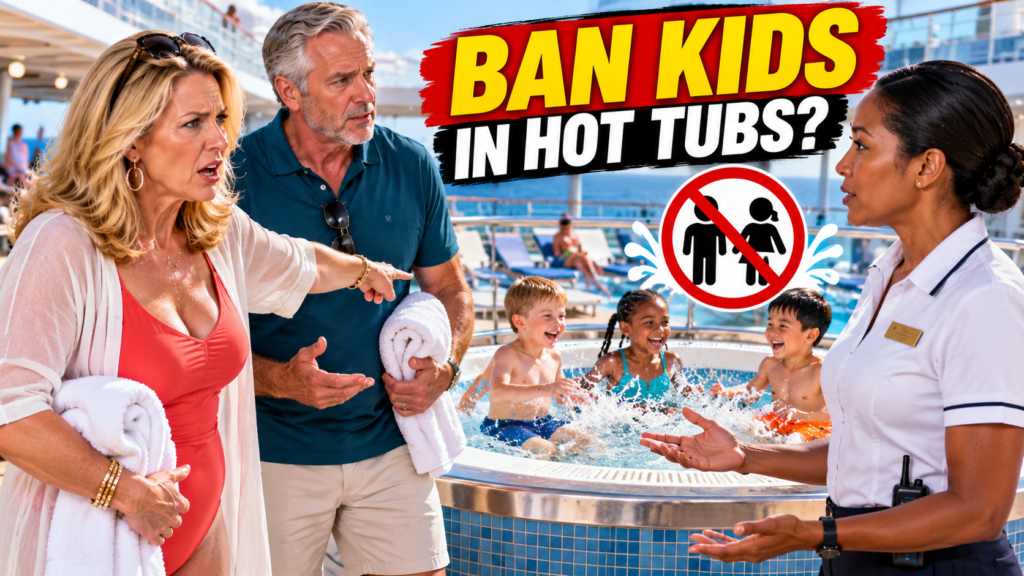
Several children are already inside. They are talking loudly, splashing water, moving from one side to the other, and treating the hot tub more like a miniature swimming pool than a place to sit and relax.
For some passengers, that is simply part of cruising on a family-friendly ship.
For others, it is one of the most frustrating pool-deck experiences at sea.
And according to one cruise-community poll, those frustrated passengers are not a small minority.
Cruise Mummy asked members of its Facebook community whether children should be allowed in cruise ship hot tubs. According to the published results, 66% of respondents said children should be banned from them.
That does not mean 66% of every cruise passenger worldwide supports a ban. This was a community poll rather than a representative industry-wide survey.
But the result reveals something worth discussing:
Why have children in cruise ship hot tubs become such a controversial issue?
And more importantly, would banning children actually solve the problem?
WHERE DOES THE 66% NUMBER COME FROM?
The headline number comes from cruise website Cruise Mummy.
Cruise Mummy published the results of a poll conducted among its Facebook community asking whether children should be allowed in cruise ship hot tubs.
The result was clear: 66% of respondents favored banning children from hot tubs.
The discussion included concerns about crowding, splashing, behavior, hygiene and safety. Other participants opposed a blanket ban and argued that well-behaved, supervised children should still be allowed to enjoy shared facilities.
That distinction matters.
The accurate takeaway is:
66% of respondents to one Cruise Mummy community poll supported a ban.
It should not be interpreted as evidence that exactly 66% of all cruise passengers worldwide hold that opinion.
Still, the poll captures a debate that will sound familiar to many experienced cruisers.
WHY DO SOME CRUISERS WANT CHILDREN OUT OF HOT TUBS?
The frustration usually isn’t simply that children are present.
The bigger issue is how passengers expect a hot tub to be used.
A swimming pool is naturally associated with movement.
People swim.
Children play.
Families splash.
Passengers move in and out.
A hot tub creates a very different expectation.
Most people enter one to sit, soak, talk quietly and relax.
When those two expectations collide, arguments can begin.
1. SOME PASSENGERS WANT HOT TUBS TO REMAIN RELAXING
Imagine returning to the ship after spending six hours walking through a port.
Your feet hurt.
Your shoulders are tired.
You change clothes and head to the pool deck hoping to spend a few minutes relaxing in warm bubbling water.
Then you discover children splashing inside the hot tub.
Nothing necessarily prevents children from being there if that particular facility permits them.
But the experience you expected has changed completely.
This appears repeatedly in discussions surrounding the 66% poll: some adult passengers don’t necessarily object to children cruising. They object to hot tubs becoming play areas.
That distinction is important.
Family-friendly cruise ships are designed for families.
Children will naturally be present at pools, restaurants, entertainment venues and many other public areas.
The real question is whether a hot tub should function like another family recreation space—or like a quieter relaxation amenity.
2. SPLASHING CAN TURN A HOT TUB INTO A MINI SWIMMING POOL
A few children sitting calmly with their parents creates one experience.
Several children kicking, splashing and moving constantly creates another.
This is where behavior becomes more important than age.
Carnival’s current official hot-tub rules specifically prohibit running, horseplay, jumping and diving.
The cruise line also states that parents are responsible for their children.
That tells us something important about this debate:
Being allowed inside a hot tub does not mean every type of behavior is allowed inside it.
A child quietly sitting with a parent and a child jumping or aggressively splashing are not equivalent situations.
That makes a blanket argument about “kids in hot tubs” more complicated than it initially appears.
DO CRUISE LINES ACTUALLY ALLOW CHILDREN IN HOT TUBS?
There is no single rule covering every cruise line, ship and hot tub.
Policies vary.
That is one of the most important facts cruisers should understand before getting into an argument on the pool deck.
A child being inside a cruise ship hot tub does not automatically mean the child is breaking a rule.
CARNIVAL’S CURRENT HOT-TUB POLICY
Carnival provides a useful example because its official rules distinguish between different hot tubs.
Hot tubs in Carnival’s Serenity Adult-Only Retreat and Oasis are for guests 21 and older.
Carnival also states that selected hot tubs in other onboard locations are for passengers 18 and older.
But the policy is different for its remaining hot tubs.
For those, Carnival says children must be accompanied by an adult. It also strongly recommends that children under six not use hot tubs.
That means the same ship can potentially have:
- hot tubs restricted to guests 21+,
- selected hot tubs restricted to guests 18+,
- and other hot tubs where supervised children may be permitted.
This is why passengers should check the rules for the specific hot tub they want to use rather than assuming one rule applies everywhere.
PRINCESS ALSO ALLOWS CHILDREN UNDER SPECIFIC CONDITIONS
Princess Cruises provides another example.
Its current pre-cruise guidance says children who are toilet-trained and accompanied by a parent or guardian may use hot tubs unless otherwise specified.
Princess also states that children who are not toilet-trained are not permitted in hot-tub or pool facilities.
Again, this does not support the idea that cruise ships universally ban children from hot tubs.
Instead, it shows why the debate continues.
Some passengers want a stricter policy than certain cruise lines currently apply.
ADULTS-ONLY HOT TUBS CHANGE THE ARGUMENT
Now imagine a different scenario.
You walk into an area clearly designated for adults.
A hot tub there has an age restriction.
Children are using it anyway.
That is no longer primarily a debate about whether children should be allowed.
It becomes a question of enforcing the existing rule.
Cruise passengers should distinguish these situations carefully.
Situation A:
Children are using a shared hot tub where the cruise line permits supervised children.
They may be allowed to be there.
Situation B:
Children enter an adults-only hot tub where the cruise line specifically prohibits them.
The posted restriction should apply.
Those are fundamentally different situations.
A passenger should not demand that crew remove children from a shared family-accessible hot tub merely because that passenger personally believes hot tubs should be adults-only.
At the same time, passengers can reasonably expect clearly designated adults-only facilities to operate according to their posted rules.
WHY NOT JUST MAKE EVERY HOT TUB ADULTS-ONLY?
This is the simplest solution proposed by some passengers.
Hot tubs become adult relaxation spaces.
Children keep the swimming pools, splash areas and water attractions.
Problem solved.
Except it isn’t quite that simple.
Mainstream cruise ships often market themselves to families.
Parents and children are paying passengers too.
If a ship has only a limited number of hot tubs, turning all of them into adults-only facilities removes the amenity entirely from families with children.
Some cruisers see that as unnecessarily restrictive.
They argue that the real problem isn’t children.
It’s disruptive behavior.
Under that view, a supervised child sitting quietly beside a parent shouldn’t be banned because another child might splash.
That leads to perhaps the most practical compromise.
SHOULD CRUISE SHIPS HAVE MORE ADULTS-ONLY HOT TUBS?
This may be the more useful question.
Instead of banning children from every hot tub, ships can provide clearly separated choices.
Some hot tubs can remain available to families.
Others can be adults-only.
Passengers then know what experience to expect before getting in.
Families aren’t excluded from the amenity.
Adults who want a quieter environment have somewhere to go.
Carnival’s current setup demonstrates one version of this approach by restricting hot tubs in certain adults-only areas while allowing children, with adult accompaniment, in other hot tubs under its rules.
The concept is simple:
Different spaces for different experiences.
And it may generate less conflict than trying to force every passenger into the same environment.
WHAT SHOULD CREW DO WHEN CHILDREN ARE SPLASHING?
Suppose you’re in the exact situation from our opening example.
You approach a hot tub.
Children are splashing.
You’re frustrated.
What should happen?
First, determine whether the children are actually violating a rule.
If the hot tub is adults-only, the situation is relatively straightforward: notify a crew member rather than confronting another passenger’s children yourself.
If children are permitted in that hot tub, the issue becomes behavior rather than presence.
Again, crew members are better positioned to address actual violations of posted rules.
Carnival, for example, prohibits horseplay, jumping and diving in its hot tubs.
The important distinction is:
“I don’t like children being here” is not the same as “these passengers are violating the hot-tub rules.”
That difference can prevent an unnecessary confrontation.
WHY THE CRUISE EMPLOYEE SHOULDN’T SIMPLY REMOVE THE CHILDREN
Imagine a passenger walks up to an employee and says:
“Those kids are splashing everywhere! Aren’t hot tubs supposed to be for adults?”
If that particular hot tub allows children, the employee shouldn’t invent a rule simply to satisfy the complaint.
A more useful response would be:
“This hot tub isn’t adults-only, so children can use it as long as they follow the posted rules.”
Then comes the important part:
offer a solution.
If the ship has an adults-only area, the employee can direct the passengers there.
That solves the immediate problem without treating either side unfairly.
The family can continue using an amenity they’re permitted to use.
The adults seeking quiet can move to a space designed for that experience.
This is often more effective than turning a disagreement between passengers into a confrontation.
WHAT ABOUT SAFETY?
Safety is one of the major arguments raised whenever children and hot tubs are discussed.
But this subject needs careful wording.
It would be inaccurate to say:
“Cruise hot tubs are unsafe for all children.”
Cruise-line policies themselves demonstrate why that statement is too broad.
Carnival permits children in certain hot tubs when accompanied by an adult, although it strongly recommends that children under six not use them.
The cruise line also says special caution should be taken by children, pregnant women and older adults.
Carnival advises checking water temperature before entering and says hot-tub use should not exceed 15 minutes.
It also instructs guests to leave immediately if they experience symptoms such as dizziness, shortness of breath or drowsiness.
Those are meaningful precautions.
But they are not the same as a universal prohibition on every child.
The correct approach is to follow the rules and safety guidance of the cruise line and the specific facility being used.
TOILET TRAINING IS AN IMPORTANT RULE
There is another policy detail parents should know.
Carnival says children in diapers or children who are not toilet-trained cannot use its hot tubs.
Princess similarly says children who are not toilet-trained are not permitted in hot-tub or pool facilities.
That isn’t merely cruise etiquette.
It’s an actual access restriction stated by these cruise lines.
Parents traveling with younger children should check these rules before heading to the pool deck.
Do not assume that a swim diaper makes a child eligible to use every pool or hot tub onboard.
SUPERVISION MAY BE THE BIGGEST PART OF THE SOLUTION
Much of the controversy becomes easier to manage when parents actively supervise their children.
Carnival explicitly states that parents are responsible for their children around its water facilities.
Princess also requires parental or guardian supervision in the circumstances described in its guidance.
Supervision matters because a hot tub isn’t intended to function exactly like a swimming pool.
If children are permitted, parents can help make the shared space work by ensuring they follow the posted rules and respect other passengers.
That includes preventing jumping, diving and horseplay where those behaviors are prohibited.
It also means recognizing that other guests may be trying to relax.
A shared space works best when everyone remembers that it is actually shared.
BUT ADULTS CAN CAUSE HOT-TUB PROBLEMS TOO
There’s another side to this debate that shouldn’t be ignored.
Removing children doesn’t automatically create a peaceful hot tub.
Adults can monopolize limited spaces.
Adults can talk loudly.
Adults can ignore posted rules.
Adults can behave inconsiderately.
And an adults-only hot tub can still become overcrowded.
So although the 66% poll focuses specifically on children, age alone does not determine whether someone behaves respectfully in a shared cruise amenity.
That strengthens the argument for focusing on three things:
clear rules, appropriate supervision and consistent enforcement.
THE CASE FOR A COMPLETE BAN
Passengers who support banning children from all cruise hot tubs generally have several arguments.
First, they see swimming pools and hot tubs as serving different purposes.
Pools are for swimming and playing.
Hot tubs are for sitting and relaxing.
Second, removing children would reduce conflicts involving splashing and play.
Third, adults would have greater access to a limited amenity.
And finally, a simple age restriction is easier to understand than different policies for different hot tubs.
There is a certain logic to that position.
But it comes with a tradeoff.
Families lose access even when their children would otherwise behave appropriately and comply with the cruise line’s rules.
THE CASE AGAINST A COMPLETE BAN
Opponents of a blanket ban argue that family-oriented ships should continue providing amenities families can enjoy together.
If a child is permitted under the cruise line’s rules, accompanied by a parent and behaving appropriately, why should that child automatically be excluded?
They also point toward adults-only areas as the obvious solution for passengers who want a child-free experience.
Under this model, cruise ships don’t need to choose between adults and families.
They need to separate the experiences clearly.
That may be especially effective on larger ships with multiple hot tubs.
THE MIDDLE-GROUND SOLUTION
The debate doesn’t necessarily require choosing between:
“Children everywhere”
and
“No children anywhere.”
There are several middle-ground options cruise lines can use.
Dedicated adults-only hot tubs
Keep some hot tubs exclusively for adults and clearly identify them.
Family-accessible hot tubs
Allow supervised children in designated shared facilities.
Clear age restrictions
Make the rules easy to understand before passengers enter.
Better enforcement
If a facility is adults-only, enforce the restriction.
If a shared hot tub prohibits jumping or horseplay, enforce those rules too.
More hot tubs
On ships where design and capacity allow it, increasing the number of facilities can reduce competition for limited space.
The underlying problem may sometimes be less about children and more about too many passengers competing for too few places to relax.
WHAT SHOULD YOU DO IF CHILDREN ARE IN THE HOT TUB?
Before becoming angry, check the rules.
Don’t assume.
If the hot tub is family-accessible and the children are following the rules, they may have exactly the same right to use it as you do.
If they’re engaging in behavior prohibited by the ship’s rules, speak with a crew member.
If the hot tub is designated adults-only and children are using it, again, let the crew handle enforcement.
Avoid confronting children directly.
And if the ship provides a separate adults-only hot tub, that may be the easiest solution of all.
Sometimes the fastest way to improve your vacation is not winning an argument.
It’s finding the part of the ship designed for the experience you actually want.
CRUISE HOT-TUB ETIQUETTE FOR FAMILIES
If you’re cruising with children and your ship allows them into a particular hot tub, a few simple habits can make the experience better for everyone.
Stay with them when supervision is required.
Follow the posted age and toilet-training requirements.
Don’t allow jumping or diving.
Discourage excessive splashing.
Respect the fact that other passengers may be using the hot tub to relax.
And don’t occupy a crowded hot tub indefinitely when other passengers are waiting.
The goal isn’t to make children invisible.
It’s to make a shared amenity genuinely shareable.
CRUISE HOT-TUB ETIQUETTE FOR ADULTS
Adults have responsibilities too.
Don’t assume every hot tub is adults-only.
Don’t treat families as though they’re breaking a rule when they’re using a facility they’re permitted to use.
Check signage and cruise-line guidance first.
If you want guaranteed separation from children, look for designated adults-only spaces.
And remember that courtesy applies regardless of age.
A peaceful hot tub can be ruined by inconsiderate adults just as easily as by energetic children.
FAQ: CHILDREN IN CRUISE SHIP HOT TUBS
Are children banned from cruise ship hot tubs?
Not universally.
Rules differ by cruise line and by facility. Carnival, for example, restricts certain hot tubs to guests 21+ or 18+, while allowing children in other hot tubs when accompanied by an adult. Princess says toilet-trained children accompanied by a parent or guardian may use hot tubs unless otherwise specified.
Always check the rules for your specific ship and hot tub.
Did 66% of cruisers really say children should be banned?
A Cruise Mummy Facebook community poll found that 66% of respondents supported banning children from cruise ship hot tubs.
However, this should not be presented as a statistically representative survey of every cruiser worldwide.
It reflects the respondents to that particular community poll.
Can children use Carnival cruise hot tubs?
It depends on the hot tub.
Carnival currently says hot tubs in Serenity Adult-Only Retreat and Oasis are for guests 21+, while selected other hot tubs are 18+. For other hot tubs, children must be accompanied by an adult.
Carnival strongly recommends that children under six not use hot tubs.
Can children use Princess cruise hot tubs?
Princess currently states that children who are toilet-trained and accompanied by a parent or guardian may use hot tubs unless otherwise specified.
Children who are not toilet-trained are not permitted in hot-tub or pool facilities.
Can children in swim diapers use cruise hot tubs?
Do not assume so.
Carnival specifically prohibits children in diapers or children who are not toilet-trained from using hot tubs.
Princess likewise says children who are not toilet-trained cannot use hot-tub or pool facilities.
Check the policy of your specific cruise line before sailing.
Should passengers confront children who are breaking hot-tub rules?
It’s usually better to speak with a crew member.
Crew members can determine whether an actual rule is being violated and handle the situation according to the ship’s policy.
This also avoids turning a pool-deck annoyance into a confrontation between passengers.
What if I don’t want children around while I’m using a hot tub?
Look for a designated adults-only area or adults-only hot tub where your ship provides one.
That’s different from expecting children to leave a shared hot tub where they’re permitted under the ship’s rules.
SO, SHOULD CHILDREN BE BANNED FROM CRUISE SHIP HOT TUBS?
The 66% result tells us something important.
A substantial majority of respondents in one cruise community would prefer hot tubs without children.
Their frustration isn’t difficult to understand.
Hot tubs are often limited.
They’re associated with relaxation.
And splashing, jumping or overcrowding can completely change the experience.
But cruise-line policies demonstrate why a universal ban isn’t currently the reality.
Some hot tubs are adults-only.
Others aren’t.
Some permit supervised children under specific conditions.
That leaves cruise lines with a balancing act between passengers seeking quiet and families who also want to enjoy the amenities they’ve paid for.
Perhaps the most practical solution isn’t banning children from every hot tub.
It may be creating clearer separation between family hot tubs and adults-only hot tubs, then consistently enforcing the rules for both.
That gives families somewhere to go.
It gives adults somewhere quiet to relax.
And it gives crew members a clear policy to enforce when disagreements happen.
The next time you walk onto a cruise pool deck and find children inside a bubbling hot tub, the first question shouldn’t necessarily be:
“Why are those kids allowed in there?”
It should be:
“What are the rules for this hot tub?”
And after that comes the question that cruisers may continue debating for years:
Should cruise lines make MORE hot tubs adults-only?
