
CRUISE TIP
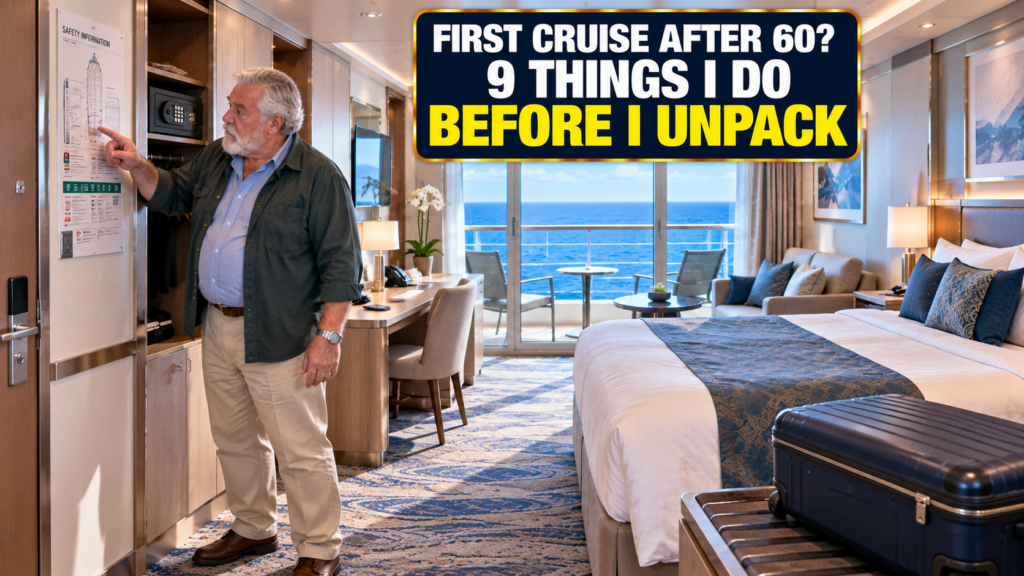
First Cruise After 60? 9 Things I ALWAYS Do Before I Unpack My Cabin
Sep
The first thing I do when I walk into my cruise cabin?
I don’t unpack.
I know that sounds strange. After traveling to the port, checking in, boarding the ship and finally finding my cabin, opening that suitcase feels like the obvious next step.
But I leave mine closed for a little longer.
Those first few minutes are the easiest time to learn the cabin, notice anything that needs attention and get organized before clothes, chargers, toiletries and everything else start appearing around the room.
Here are the nine things I do first—especially when I’m settling into a cabin I haven’t sailed in before.
1. I Photograph the Cabin Before I Touch Anything
Before my suitcase opens, my phone comes out.
I take a few quick photographs of the cabin as I found it.
I’m not conducting an investigation, and I’m certainly not assuming something will be wrong.
I simply want a record of the room while it’s still untouched.
I usually photograph the overall cabin, desk and storage area, bathroom and balcony area if my cabin has one.
It takes less than a minute.
Once you’ve unpacked, the cabin changes remarkably quickly.
A jacket lands on a chair. Toiletries appear in the bathroom. Chargers get plugged in. Shoes end up near the closet.
If I later notice something unusual or can’t remember how an area looked when I arrived, I have those original photos.
Then I move on.
My suitcase is still closed.
2. I Find My Muster Information
Next, I want to know something far more important than where I’m going for dinner:
Where do I need to go for muster and what safety steps apply to this sailing?
I locate the safety and muster information provided for my cabin and follow the cruise line’s instructions for completing the required safety process.
I don’t wait for an emergency to start wondering where I would need to go.
Modern ships and cruise lines may handle parts of the muster process differently, so I don’t assume that what happened on my previous cruise will happen exactly the same way this time.
I follow the instructions for the ship I’m actually aboard.
It’s a small task, but once it’s handled, I can stop thinking about it and enjoy the cruise.
3. I Step Outside and Check the Cabin Door
This one takes only seconds.
Before leaving valuables in the cabin, I step into the corridor and allow the door to close completely behind me.
Then I give the exterior handle one normal test.
That’s it.
I’m not yanking on the door repeatedly or trying to defeat the lock. I simply want to confirm that the door has closed and latched as expected.
If something doesn’t seem right, I’d rather notice shortly after boarding than several hours later.
I also pay attention to the simple habit that matters for the rest of the trip:
Don’t assume the door closed properly just because you heard it move behind you.
Whenever I leave the cabin, I make sure it actually closes.
Then I move to the next check.
And yes—my suitcase is still closed.
4. I Test the Safe While It’s Empty
A cabin safe isn’t something I want to learn how to operate after putting important belongings inside it.
So while it’s empty, I test it.
I read the provided instructions.
I lock it.
I unlock it.
I open it again.
Now I know how that particular safe operates before I decide what appropriate valuables to place inside.
If I don’t understand the controls or the safe doesn’t behave as expected, I can ask for assistance while there’s nothing important trapped inside.
That’s much less stressful than standing in front of a locked safe later with something you need urgently inside it.
Only after I understand how it works do I consider using it.
5. I Check the Bathroom Before My Belongings Take Over
Next comes a quick bathroom check.
The word quick matters.
I’m not inspecting every square inch of the room looking for something to complain about.
I simply want to know that the things I’m likely to need appear ready for use.
I look at the sink, toilet and shower.
I check the towels and obvious fixtures.
If something clearly needs attention, this is an easy time to notice it.
Why do this before unpacking?
Because twenty minutes later, the bathroom may contain my toiletries, grooming items and other personal belongings.
If I need crew assistance, I’d rather discover the issue while the space is still clear and easy to access.
If everything looks fine, I’m finished in less than a minute.
6. I Find the Power Outlets Before Plugging Everything In
This habit has become more useful as I’ve gotten older because I travel with more things that may need power.
There’s the phone, perhaps a watch or tablet, and potentially other permitted personal devices.
So before deciding where everything belongs, I locate the cabin’s available outlets and USB ports, if provided.
Then I can organize around the power that actually exists.
For example, if the most convenient charging point is near the desk rather than the bed, I want to know that before arranging the cabin.
One warning here:
I never assume that a power strip, extension device or adapter I used elsewhere is automatically permitted aboard my current ship.
Cruise lines maintain prohibited-item and electrical-device rules, and those rules can differ.
I check my cruise line’s current requirements before packing those items.
Improvising with something prohibited isn’t worth it.
7. I Check the Temperature Before Bedtime
This may be the easiest cabin check to postpone.
It’s also one I don’t want to leave until 11:30 at night.
Soon after entering the cabin, I locate the temperature controls and make a reasonable adjustment if necessary.
Then I give the cabin time to respond.
I’m not expecting an instant temperature change.
The point is to understand how the controls work and notice earlier in the day if something doesn’t appear to be functioning as expected.
If I need assistance, I’d much rather deal with it while I’m awake, dressed and getting settled.
Waiting until I’m exhausted and ready to sleep turns a small inconvenience into a much more annoying one.
So I check early.
Then I leave it alone and see how the cabin feels later.
8. I Create One Easy-to-Reach “Night Station”
Once I’ve learned the physical cabin, I start thinking about how I’ll actually use it.
One of the first areas I organize is the place where I’ll keep the permitted personal essentials I may want within easy reach at night.
For me, the principle is simple:
I don’t want to search through luggage in the dark.
Glasses might have a designated spot.
My phone might have one.
Other appropriate personal essentials can have their own consistent location.
For medication, I follow its storage instructions and my own requirements rather than assuming every medicine belongs on a bedside table. Anything requiring particular temperature, security or handling conditions needs to be treated accordingly.
The goal isn’t to cover the bedside table with belongings.
It’s the opposite.
I want a small, predictable area where I know exactly where important everyday items are.
That’s particularly useful in an unfamiliar cabin when you wake up during the night and haven’t yet developed a mental map of the room.
9. I Learn How Cabin Service Works on This Sailing
Finally, I want to understand the service routine for my cabin.
If I naturally meet my cabin attendant, I introduce myself and find out anything relevant about how service works on that sailing.
If I have a reasonable cabin-related need, I’d rather communicate it clearly and early than wait until it becomes frustrating.
But I don’t expect an attendant to magically appear the moment I enter the room.
And I don’t begin the cruise by handing someone a giant list of demands.
Service arrangements can differ between cruise lines, ships, cabin categories and sailings.
So I don’t assume:
“This is exactly how my last cruise worked.”
I learn how this cruise works.
A short, friendly conversation can prevent a surprising amount of confusion later.
And Only Then Do I Unpack
Now I return to the suitcase.
The cabin has been photographed.
I know my muster information and safety responsibilities.
I’ve checked the door.
I understand the safe.
I’ve looked over the bathroom.
I know where the usable power is.
I’ve checked the temperature controls.
I’ve thought about where my nighttime essentials belong.
And I understand the cabin-service routine as far as I need to.
Now I unzip the suitcase.
The entire process doesn’t need to become some hour-long inspection.
That’s not the point.
These are simply small things that are easiest to handle while the cabin is still clean, quiet and uncluttered.
For a first-time cruiser, there’s another benefit.
Doing them forces you to slow down for a few minutes and actually learn the space you’ll be living in.
Then the suitcase can open.
The clothes can go away.
And I can finally stop checking things and start enjoying the ship.
So on your first cruise, remember the routine:
Cabin first. Suitcase second.
Those first few minutes can make the next several days a lot easier.
