
CRUISE TIP
SHOULD CRUISE CABINS HAVE ALARM CLOCKS?
Sep
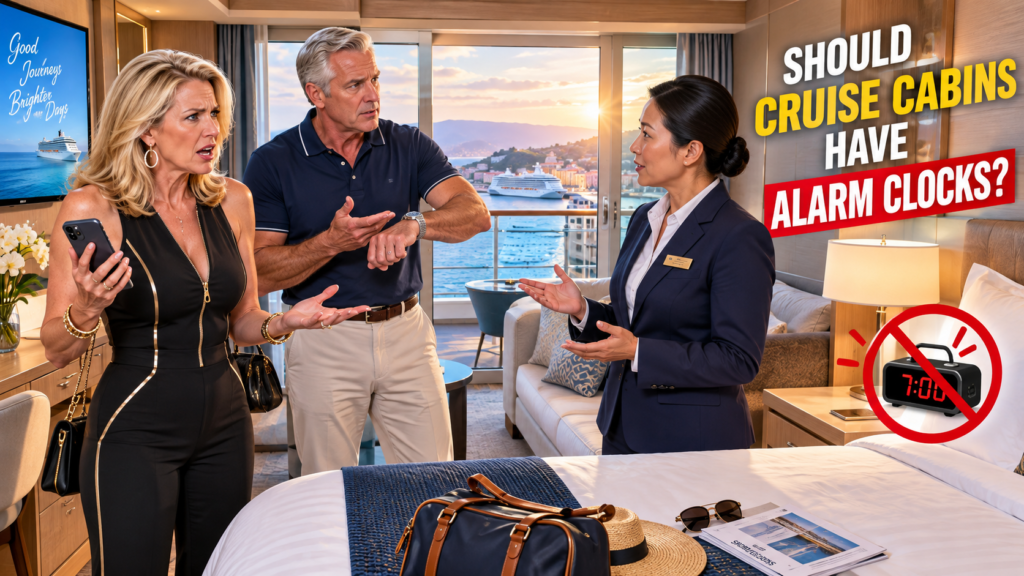
You wake up, reach for your phone, and suddenly realize something is wrong.
Your shore excursion leaves soon.
You were supposed to be awake much earlier.
Now you’re rushing around the cabin, trying to get dressed, find your excursion documents, grab breakfast, and make it to the meeting point before your group leaves without you.
Then you look at the nightstand and wonder:
Why isn’t there simply an alarm clock beside the bed?
It’s a surprisingly interesting cruise-cabin debate.
At home, millions of travelers have replaced traditional alarm clocks with smartphones, smartwatches and other devices. But a cruise vacation isn’t exactly like being at home. Port days can start early, shore excursions can have strict meeting times, and passengers may deliberately be trying to spend less time staring at their phones.
Princess Cruises even lists a travel alarm clock among the gadgets passengers may consider packing, while noting that wake-up calls can be scheduled through the stateroom.
So should cruise cabins simply have alarm clocks?
There are good arguments on both sides.
Why This Tiny Cabin Detail Matters More Than You Might Think
An alarm clock sounds trivial compared with the things passengers normally consider when choosing a cruise cabin.
Balcony or interior?
Forward or aft?
Near the elevators or far away?
High deck or low deck?
But once you’re actually aboard, time becomes surprisingly important.
Cruise vacations may be relaxing, but they’re also full of scheduled activities.
A port day could mean meeting an excursion group early in the morning. Dinner reservations, entertainment and onboard activities can also happen at specific times.
That’s why the alarm-clock question isn’t really about whether passengers know what time it is.
It’s about how easily passengers can manage time inside their cabin without depending entirely on another device.
And that’s where the debate gets interesting.
The Case FOR Alarm Clocks in Cruise Cabins
1. Port Days Can Start Very Early
Sea days and port days can feel like two completely different vacations.
On a sea day, sleeping late may be exactly what you planned.
On a port day, oversleeping can become stressful.
You may need time to shower, dress, eat breakfast, prepare your day bag and get to the correct meeting point before an excursion.
Princess advises passengers to research ports and shore excursions during cruise planning and notes that popular tours may be worth booking ahead.
Once you’ve paid for an excursion, waking up on time becomes more important.
A simple bedside alarm clock would give passengers another way to protect against oversleeping.
Even if they also set their phone alarm, having a second alarm could provide reassurance.
2. Not Everyone Wants Their Phone Beside the Bed
Phones have become the obvious replacement for alarm clocks.
Set an alarm.
Put the phone on the nightstand.
Problem solved.
Except some passengers deliberately want to disconnect while cruising.
Vacation may be one of the few times they don’t want to wake up and immediately see notifications, messages, emails or social media.
Princess’s current guidance demonstrates just how central phones have become to cruising: its packing list recommends bringing a smartphone for the Princess app, communication and photos.
Princess also explains that passengers can use cellular service or onboard Wi-Fi, while warning that cellular data at sea or in certain ports can generate carrier charges.
A passenger can still use a phone alarm without cellular service, of course.
But that’s not the point.
Some cruisers simply don’t want their smartphone to be the first object they touch every morning.
A traditional alarm clock would give them another choice.
3. A Clock Lets You Check the Time Without Touching Anything
Picture waking up in the middle of the night.
The cabin is dark.
You have no idea whether it’s 2:00 a.m. or 6:30 a.m.
With a visible bedside clock, you glance across the room and immediately know.
With a phone, you generally have to find it and wake the screen.
That’s hardly a major inconvenience.
But convenience is exactly what cabin amenities are supposed to provide.
Cruise cabins contain many small features that aren’t essential to survival but make the experience easier.
For passengers who frequently wake during the night, a visible clock can be one of those tiny conveniences that becomes unexpectedly useful.
4. Interior Cabins Can Make Time Feel Different
A balcony cabin gives you an obvious clue that morning has arrived.
Sunlight.
An interior cabin doesn’t.
With no exterior window, a dark cabin can remain extremely dark regardless of whether it’s midnight or morning.
For many passengers, that’s actually one of the advantages of an interior cabin.
It can be excellent for sleeping.
But that also makes a reliable alarm more important if you have somewhere to be.
A bedside clock could provide a simple visual reference without requiring passengers to reach for another device.
5. A Physical Alarm Can Be a Useful Backup
Technology fails.
A phone battery dies.
Someone accidentally lowers the alarm volume.
A charger isn’t connected properly.
An alarm gets set for the wrong time.
The passenger turns it off while half asleep.
A standalone clock wouldn’t eliminate human error, but it could provide another layer of redundancy.
This is especially useful before an important early excursion.
The smartest approach may not be choosing between a phone and an alarm clock.
It may be using more than one method when waking up on time really matters.
6. Older Travelers May Prefer Something Familiar
Not every passenger interacts with technology the same way.
Some people are completely comfortable controlling nearly everything through a smartphone.
Others prefer physical controls.
Neither approach is inherently better.
A familiar bedside clock could make the cabin more intuitive for passengers who don’t want to navigate another screen simply to check the time or set an alarm.
Cruise ships serve passengers across a broad range of ages and technological comfort levels.
That alone makes the question worth discussing.
But Do Cruise Cabins Actually Need Alarm Clocks?
Now we reach the other side.
Because although a bedside clock sounds convenient, there’s an obvious question:
How many passengers would actually use it?
7. Almost Everyone Already Has a Clock
Your phone has a clock.
Your smartwatch has a clock.
Your tablet has a clock.
Many passengers are already carrying multiple devices capable of displaying the time and sounding alarms.
From that perspective, placing another electronic device in every cabin may feel redundant.
Princess’s own packing guidance reflects the modern reality: smartphones are recommended travel devices, and the cruise line’s app plays a significant role in the onboard experience.
For a passenger who already sleeps beside a phone every night, a cabin alarm clock may simply become another object taking up limited nightstand space.
8. Wake-Up Calls Can Solve the Same Problem
This may be the strongest argument against making physical alarm clocks universal.
At least some cruise lines provide another solution.
Princess specifically states in its current packing guidance that a travel alarm clock can be useful, while also noting that wake-up calls can be scheduled through the stateroom.
That’s important.
It means the choice doesn’t necessarily have to be:
alarm clock or phone.
A passenger may have multiple options.
For example, before an important port morning, a Princess passenger could use a phone alarm and schedule a stateroom wake-up call.
Someone who prefers a dedicated physical clock can bring a small travel alarm as well.
However, travelers shouldn’t automatically assume that every cruise line, every ship and every cabin uses the same wake-up-call system.
Check the arrangements for your specific sailing.
9. Cabin Space Is Valuable
Cruise cabins aren’t famous for unlimited surface space.
Nightstands can already be occupied by phones, glasses, books, water and charging cables.
Adding another permanent device creates one more object to clean around, maintain and replace if damaged.
A clock is small.
But cruise-ship design involves thousands of small decisions exactly like this.
If most passengers already have phones, cruise lines may see greater value in providing charging access and digital services rather than adding another standalone electronic device.
Whether passengers agree is another question.
Accessibility Makes the Alarm Question More Complicated
There’s another important dimension to this discussion:
Not every passenger can rely on a conventional audible alarm.
Royal Caribbean states that guests who are deaf or hard of hearing can request a portable room kit for their stateroom. That kit includes a visual-tactile alert system covering door knocking, telephone ringing, an alarm clock and the smoke detector.
Norwegian Cruise Line similarly says that on vessels where rooms aren’t hardwired for the relevant accessibility features, a portable kit can be requested that provides visual-tactile alerts for door knocking, telephone ringing, alarm ringing and smoke detection.
This is an important reminder that the phrase “just use an alarm” doesn’t cover everyone’s needs.
Accessible alert systems may require light, vibration or other tactile/visual signals rather than sound alone.
Passengers who need these accommodations should review the cruise line’s current accessibility information and make arrangements in advance rather than assuming a standard cabin setup will meet their needs.
So What Should You Do If Your Cruise Cabin Doesn’t Have an Alarm Clock?
The easiest solution is preparation.
Before sailing, decide how important waking up at an exact time will be.
If you have several early excursions, you may want more than one wake-up method.
Option 1: Use Your Phone Alarm
For most travelers, this will be the easiest option.
Set the alarm before going to sleep.
Double-check the volume.
Make sure the battery has enough charge.
If possible, plug the phone in overnight.
And most importantly, confirm that you’ve set the alarm for the correct time.
Cruise travel can involve time-zone changes, so always pay attention to the ship’s current time and official onboard instructions.
Don’t casually assume your device has interpreted every time change exactly the way you intended.
Option 2: Use a Wake-Up Call Where Available
If your ship offers stateroom wake-up calls, this can be a useful backup.
Princess explicitly confirms this option in its current cruise packing guidance.
If you’re unsure how the system works on your ship, ask Guest Services or your stateroom attendant rather than guessing.
And for an especially important morning, you may still want a second alarm.
Option 3: Bring a Small Travel Alarm Clock
This is one of the simplest solutions—and it’s specifically suggested in Princess’s current packing list.
A compact battery-powered travel clock takes up relatively little luggage space.
It can also let you check the time without reaching for your phone.
For cruisers who intentionally keep phones away from the bed, it may be worth packing.
Option 4: Use More Than One Alarm Before Important Excursions
If missing something would seriously affect your vacation, redundancy makes sense.
Set your phone alarm.
Use an available wake-up-call service.
If you brought a travel clock, set that too.
You probably don’t need three alarms every morning.
But before an expensive excursion with an early departure?
A backup is hardly excessive.
What You Should NOT Assume
Cruise advice often becomes misleading when information from one ship gets presented as an industry-wide rule.
Avoid these assumptions:
“Cruise cabins never have alarm clocks.”
That is too broad.
Cabin configurations, accessibility features and ship equipment vary.
“Every cruise line offers wake-up calls.”
We have direct current confirmation from Princess that wake-up calls can be scheduled through its stateroom setup, but that shouldn’t be automatically generalized to every cruise ship in the world.
“Everyone can just use a phone.”
Technically, many passengers can.
But preference and accessibility matter.
“An alarm clock is only useful for older passengers.”
Also false as a generalization.
Anyone who wants a visible clock or independent alarm can find one useful.
“Accessibility alarm equipment means every standard cabin has the same alarm system.”
No.
Royal Caribbean describes its portable room kit as available upon request, and Norwegian similarly discusses specialized systems and portable kits for Deaf or Low Hearing guests.
That’s different from saying every ordinary cabin comes equipped the same way.
SHOULD CRUISE CABINS HAVE ALARM CLOCKS? — The Best Argument for YES
The strongest case for alarm clocks is simplicity.
Passengers shouldn’t necessarily need to pick up a phone just to know whether it’s 3:00 a.m. or 7:00 a.m.
A small bedside clock would be easy to understand.
It would help before early port days.
It could provide a backup alarm.
And it would be especially convenient in dark interior cabins.
The cost and space required for one small clock may seem minor compared with the convenience it provides.
For travelers who want to disconnect from their phones, the idea becomes even more attractive.
The Best Argument for NO
The strongest counterargument is redundancy.
Modern passengers already carry devices capable of displaying time and creating multiple alarms.
Some cruise operations also provide alternatives such as wake-up calls.
Passengers who strongly prefer a physical alarm can pack an inexpensive travel version—and Princess actually recommends considering one.
From that perspective, installing, cleaning, maintaining and eventually replacing clocks across thousands of cabins may solve a problem many passengers don’t actually have.
A Better Solution Might Be Choice
Perhaps this debate doesn’t need an all-or-nothing answer.
Cruise lines could focus on making wake-up options obvious.
Passengers could be told clearly whether their cabin has:
- a physical clock,
- a telephone wake-up-call function,
- an app-based option,
- an accessibility alert system upon request,
- or another supported wake-up method.
That information could appear in the cruise line’s app or cabin information.
Passengers who want a traditional clock could then know before sailing whether they should pack one.
This would preserve cabin simplicity while giving travelers the information needed to prepare.
FAQ: Cruise Cabin Alarm Clocks
Do all cruise cabins have alarm clocks?
No universal industry-wide rule should be assumed. Cabin amenities vary by cruise line, ship and cabin type, while specialized accessibility equipment can also differ from standard cabin amenities.
Check your specific ship before sailing if having a physical clock is important to you.
Can I request a wake-up call on a cruise?
It depends on the cruise line and ship.
Princess currently states that wake-up calls can be scheduled through the stateroom.
For another cruise line, verify the current onboard procedure rather than assuming it works identically.
Should I bring a travel alarm clock on a cruise?
It can be useful if you don’t want to rely entirely on your smartphone.
Princess specifically includes a travel alarm clock among the additional gadgets passengers may consider bringing.
A small clock can be especially convenient for early port days or passengers who prefer seeing the time without reaching for their phone.
Can I just use my phone alarm on a cruise ship?
Yes, a smartphone alarm is the simplest option for many passengers.
Just make sure the phone has power and that you’ve set the alarm based on the correct ship time.
Don’t let assumptions about automatic time-zone changes cause you to miss an important meeting time.
What if I’m Deaf or hard of hearing?
Contact the cruise line’s accessibility department before sailing.
Royal Caribbean says portable stateroom kits are available upon request with visual-tactile alerts that include an alarm-clock alert. Norwegian also describes hardwired or portable visual-tactile alert systems for Deaf or Low Hearing guests depending on the vessel.
Accessibility arrangements can differ, so make the request directly with your cruise line.
What’s the safest way to avoid missing an early shore excursion?
Use a backup.
For an important morning, set your normal alarm and use another available method, such as a supported stateroom wake-up call.
Prepare your clothes, excursion documents and day bag the night before as well.
The goal isn’t merely waking up.
It’s waking up with enough time that your port morning doesn’t begin in panic.
Final Thoughts
So, should cruise cabins have alarm clocks?
There’s a surprisingly strong case for them.
A physical clock is simple, familiar and doesn’t require passengers to reach for their phones. It could be particularly useful during early port mornings, inside dark interior cabins, or for travelers trying to disconnect from their devices.
But there is also a reasonable argument that the traditional alarm clock has become redundant.
Smartphones already handle the job for many passengers. Some cruise operations provide wake-up calls, and passengers who strongly prefer a separate device can pack a compact travel alarm.
The most important takeaway isn’t that every cruise cabin must—or must not—have an alarm clock.
It’s that passengers should know their options before an important morning arrives.
If you’ve paid for a shore excursion that starts early, don’t wait until bedtime to figure out how you’re going to wake up.
Check your ship’s options.
Set your phone.
Arrange a wake-up call if your ship supports one.
Bring a travel alarm if you prefer having a physical clock.
And if cruise lines eventually decide that a small clock deserves a permanent place beside every cruise bed?
Plenty of passengers may wonder why it wasn’t there already.
