
AIRPORT TIPS
These 10 Airport Crew “Codes” Are Happening Right in Front of You
Sep
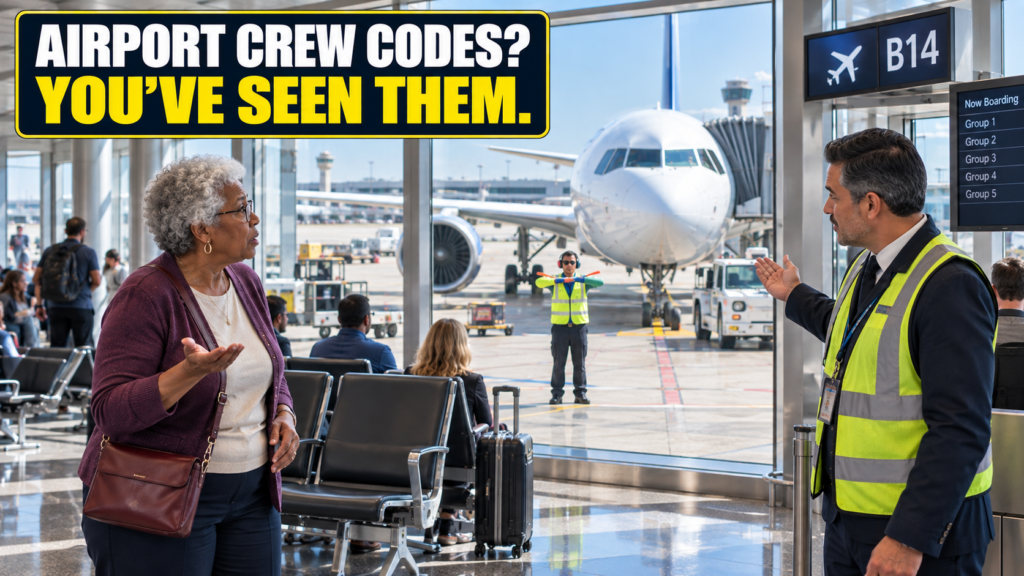
If you’ve ever sat near an airport window and watched the activity outside, you’ve probably seen it.
A ground worker raises both arms. Another makes a sharp motion across the front of the body. Someone near the aircraft gives a signal, and a few seconds later, something changes.
The airplane stops.
An engine shuts down.
Wheel chocks are moved.
Or the aircraft begins moving again.
To passengers, some of these gestures can look mysterious. A few can even look alarming if you have no idea what they mean.
But they aren’t random.
Airports depend on multiple forms of visual communication. Ground personnel can use standardized marshalling signals to communicate with pilots. Air traffic controllers can use colored light signals when radio communication cannot be established. Aircraft rescue and firefighting personnel even have emergency hand signals for communicating with flight and cabin crews.
They’re not really “secret codes.”
They’re aviation signals that most passengers were simply never taught to recognize.
And once you know a few of them, looking out an airport window becomes much more interesting.
Here are 10 signals you may have been seeing for years without realizing what they mean.
1. That Dramatic “Cut” Motion Can Mean CUT ENGINES
This may be one of the most surprising signals to see from inside an airport terminal.
Imagine you’re watching an aircraft at the gate. A ground marshaller is positioned where the cockpit crew can see him. Suddenly, he makes a deliberate cutting motion.
To an uninformed passenger, the gesture can look dramatic.
But it has a practical purpose.
Aircraft marshalling guidance includes a specific CUT ENGINES signal.
The marshaller isn’t making a threatening gesture, and the movement by itself doesn’t mean passengers are facing an emergency. It’s part of the visual communication used during aircraft ground operations.
This distinction matters.
Airport ramps can be noisy environments. Aircraft engines, service vehicles and other equipment make clear visual communication valuable when personnel are guiding an aircraft.
So if you happen to see this gesture while looking through the terminal windows, don’t assume something frightening has happened.
You may simply be watching a normal operational instruction being passed to the cockpit.
And this is a useful rule for nearly every signal on this list:
A gesture that looks dramatic to a passenger may be completely routine to the professionals using it.
2. Two Moving Arms Can Tell an Aircraft to SLOW DOWN
Ground marshalling isn’t just about telling an aircraft where to stop.
The signals can also communicate how the aircraft should move.
One of the recognizable instructions is SLOW DOWN.
This can be especially interesting to watch from a terminal because passengers often see a marshaller moving both arms and assume the person is simply trying to become more visible to the pilot.
But those movements can carry specific instructions.
The important thing isn’t for passengers to memorize every possible arm position. What matters is understanding that a marshaller’s movements are deliberate.
A pilot looking toward the marshaller isn’t just watching someone wave.
The marshaller may be communicating direction, speed or another ground-handling instruction.
There is another important caveat: don’t assume that every hand movement you see on every ramp has exactly one universal meaning. Operators and airports can have procedures that supplement standard guidance.
That’s one reason passengers shouldn’t try to interpret an airport operation from a single gesture alone.
3. Those Hand Movements Can Be About the Wheel Chocks
Look closely around an aircraft parked at a gate and you may notice small blocks positioned around its wheels.
Those are wheel chocks.
They may not look impressive, but they play an important role in ground operations.
There are marshalling signals associated with CHOCKS INSERTED and CHOCKS REMOVED.
That means some of the hand communication you’re watching may have nothing to do with steering the aircraft at all.
It may be coordinating whether the aircraft’s wheels have been secured or whether the chocks are being removed as part of the next stage of the operation.
This is also a good reminder of how carefully sequenced airport ground operations can be.
From the terminal, passengers may see bags being loaded, vehicles arriving and departing, doors closing and ground workers moving around the aircraft.
It can look like dozens of unrelated activities.
They’re not.
Many actions must occur in the proper sequence before an aircraft can safely depart.
So a small gesture between crew members can represent one completed step in a much larger process.
4. A Gesture That Looks Like “Everything’s Fine” May Actually Mean ALL CLEAR
Here’s another signal that’s easy to misunderstand.
Some marshalling guidance includes an AFFIRMATIVE/ALL CLEAR signal.
From a distance, a passenger could easily interpret certain ground-crew movements as a casual wave or acknowledgment.
But professional ground communication has defined signals for specific purposes.
This is why watching the ramp can be deceptive.
Passengers naturally interpret gestures using everyday body language.
A wave looks like hello.
Crossed arms may look negative.
A dramatic cutting motion may look alarming.
But aviation communication is based on operational meaning rather than what a gesture happens to resemble in ordinary conversation.
There is also an important limitation here.
FAA aircraft-ground-handling guidance is just that: guidance. It specifically notes that its general information is not all-inclusive and does not override local variations or additional procedures.
So think of these signals as a window into how aircraft ground communication works—not as a passenger’s universal dictionary for interpreting every movement at every airport.
And the communication gets even more interesting when you stop watching the ground crew and look toward the control tower.
5. A STEADY RED Light From the Tower Can Mean STOP
Most travelers know pilots communicate with air traffic control by radio.
But what happens when radio contact can’t be established?
Air traffic control has another tool available: light gun signals.
A controller can direct an intense, narrow beam of colored light toward an aircraft.
For an aircraft on the ground, a steady red signal means:
STOP.
That sounds simple, but there’s an important lesson hidden in it.
The meaning of a light signal depends on the situation.
A steady red signal directed at an aircraft in flight does not mean exactly the same thing as steady red directed at an aircraft on the ground.
That’s why viral lists that say something like “red airport light means X” can be misleading.
Context matters.
The recipient matters.
And whether the aircraft is on the ground or in flight matters.
For passengers, the interesting takeaway is that an airport control tower can communicate visually with an aircraft when normal radio contact cannot be established.
You could potentially be watching that communication without realizing it.
6. FLASHING GREEN Can Mean CLEARED TO TAXI
Now change the tower signal from steady red to flashing green.
For an aircraft on the ground, flashing green means:
CLEARED TO TAXI.
Again, context is essential.
For an aircraft in flight, flashing green carries a different instruction.
This illustrates why these signals shouldn’t be treated like simplistic color codes.
The same color can mean different things depending on whether it is steady or flashing and whether the aircraft receiving it is on the ground or in flight.
Think about what that means from a passenger’s perspective.
You might be sitting in an aircraft wondering why nothing seems to be happening.
Meanwhile, outside your window, the pilots and controllers may be dealing with communications and movement instructions you cannot hear or see clearly.
Airports often look slow from a passenger seat because we see only a tiny part of the process.
Behind that apparent inactivity can be a highly structured sequence of instructions.
7. FLASHING RED Has a Very Different Meaning
Here’s where the tower light system becomes particularly interesting.
For an aircraft on the ground, a flashing red signal means:
TAXI CLEAR OF THE RUNWAY IN USE.
But if an aircraft is in flight, flashing red means:
AIRPORT UNSAFE — DO NOT LAND.
Same color.
Same flashing pattern.
Very different instruction depending on the aircraft’s situation.
This is one of the best examples of why passengers should be cautious about interpreting aviation signals without context.
Seeing a particular light doesn’t automatically tell you the whole story.
And it certainly doesn’t mean that everyone in the terminal needs to worry.
These signals are designed for specific operational communication between air traffic control and the people operating the aircraft.
For travelers, they’re fascinating to learn about.
But they aren’t a substitute for listening to official instructions from airline, airport or emergency personnel.
8. Alternating RED and GREEN Means EXERCISE EXTREME CAUTION
Of all the tower signals on this list, this may be the one that sounds most like a warning.
Alternating red and green means:
EXERCISE EXTREME CAUTION.
Unlike some other light gun signals, this general warning applies to aircraft on the ground, aircraft in flight, and relevant vehicles, equipment or personnel receiving the signal.
But don’t turn that into a scary viral claim.
It doesn’t mean that passengers who happen to notice red and green somewhere around an airport should immediately assume their aircraft is in danger.
Airports contain enormous numbers of ordinary red, green and white lights.
We’re talking specifically about an air traffic control light gun signal directed toward its intended recipient.
That’s a very different thing from simply spotting colored airport lighting.
The larger lesson is more interesting anyway:
Radio isn’t the only way air traffic control can communicate.
Visual signaling remains part of the system.
And the final two signals take us from routine airport operations into a much more specialized environment.
9. An Emergency Responder’s Beckoning Motion Can Recommend EVACUATION
Aircraft Rescue and Fire Fighting personnel—often shortened to ARFF—have standardized emergency hand signals for circumstances in which electronic communications cannot be maintained with the flight crew.
One of those signals is:
RECOMMEND EVACUATION.
The signal involves an extended arm and a beckoning motion.
Unlike the earlier marshalling examples, this is not something you should expect to see as part of ordinary gate activity.
It belongs to emergency communication.
FAA guidance says these emergency hand signals are intended to be known and understood by cockpit and cabin aircrew as well as ARFF firefighters.
That distinction is important.
A ground marshaller giving routine aircraft movement instructions and an ARFF firefighter communicating during an emergency are not doing the same job.
Putting every airport gesture into one bucket labeled “secret crew codes” would miss that difference.
But the existence of these emergency signals shows why standardized visual communication can matter so much.
When ordinary electronic communication isn’t available, a gesture may need to communicate an urgent recommendation clearly and quickly.
10. Crossed Arms Can Mean RECOMMEND STOP
The final signal may look especially dramatic.
In the standardized ARFF emergency hand signals, a responder can cross the arms at the wrists in front of the head.
The meaning is:
RECOMMEND STOP.
Depending on the situation, this can mean recommending that an evacuation already in progress be halted, that aircraft movement stop, or that another activity in progress stop.
Again, this is an emergency-response signal—not something passengers should expect to see during an ordinary boarding process.
And that context completely changes its significance.
Imagine how easy it would be to create a misleading social-media post from a photograph of that gesture.
“Airport worker crosses arms—here’s the terrifying meaning!”
That would leave out the information that matters most: who is giving the signal, who is receiving it, and under what circumstances.
Understanding aviation communication requires context, not just recognizing a pose.
Why Airports Still Use Visual Signals
After learning these signals, you might wonder why aviation still needs hand gestures and colored lights in an era of sophisticated radios, headsets and digital systems.
The answer is partly practical.
Aircraft ground operations require people in different physical locations to coordinate clearly. Noise, distance, aircraft positioning and operational circumstances can make visual communication valuable.
And systems need alternatives.
FAA procedures for tower light signals specifically address situations involving aircraft, vehicles, equipment or personnel without radio or when radio contact cannot be established.
Emergency hand signals provide another backup when electronic communication between ARFF personnel and flight crews cannot be maintained.
In other words, the visual signal isn’t necessarily primitive.
It can be redundancy.
And redundancy matters in aviation.
What Passengers Should—and Shouldn’t—Do With This Information
Learning these signals can make your next airport visit more interesting.
Sit near a terminal window and you may begin noticing things you ignored before.
You’ll see ground workers positioning themselves where pilots can see them.
You’ll notice deliberate arm movements.
You’ll understand that the activity around a parked aircraft isn’t random.
But there is one thing you should not do:
Don’t try to diagnose an airport situation from one gesture.
A signal without context can be misleading. Local procedures can vary. A gesture seen from the wrong angle may not even be the signal you think it is.
And passengers normally won’t have access to the full operational picture.
If airport or airline personnel give you instructions, follow those instructions rather than relying on something you believe you saw outside the window.
The point of learning these signals isn’t to turn passengers into ground controllers.
It’s to understand a little more about the extraordinary amount of communication happening around every flight.
They’re Not Really Secret Codes
That’s the biggest surprise.
The workers weren’t hiding these signals from you.
Many of them have been happening in plain sight.
The reason they feel secret is simply that most passengers don’t know the vocabulary.
A movement that looks strange may tell a pilot to cut the engines.
Another can concern wheel chocks.
A colored beam from the tower can tell an aircraft to stop or taxi.
And in the unusual event that normal electronic communication isn’t available during an emergency, specialized hand signals can help responders communicate with the people aboard the aircraft.
So the next time you’re waiting at the gate, look through the window.
Don’t interfere. Don’t assume something is wrong. And don’t panic because you recognize a dramatic-looking gesture.
Just watch.
You may suddenly realize that the airport has been “talking” right in front of you the entire time.
