
AIRPORT TIPS
Over 60? 8 Flight Attendant Secrets Most Passengers Learn Too Late
Sep
Flying after 60 can feel very different from flying in your 30s or 40s.
A heavy carry-on is harder to lift. A long boarding process can be more tiring. Medication and identification become more important to keep close. And in an emergency, the few decisions you make before takeoff can matter far more than most passengers realize.
Flight attendants see these situations every day.
That doesn’t mean they are hiding eight literal “secrets” from passengers. Rather, there are practical realities of air travel that many people don’t think about until they encounter them personally.
Some are simple comfort tips. Others come directly from federal aviation safety guidance.
Here are eight worth knowing before your next flight.
1. Bring Wipes—but Don’t Believe Every Airplane Bathroom Myth
Airplane bathrooms have inspired an extraordinary number of internet warnings.
You’ll find posts telling travelers never to touch certain surfaces, never use the toilet paper, or follow complicated hygiene routines supposedly known only by flight attendants.
Be careful with claims like these.
Bringing a small pack of wipes can certainly be useful. You may want them for your hands or frequently touched surfaces during a long travel day.
But that is different from claiming that every passenger should automatically avoid airplane toilet paper.
There isn’t a general FAA rule telling passengers not to use the toilet paper supplied in an aircraft lavatory.
For travelers over 60, the better lesson is much simpler: carry a small personal hygiene kit containing the items that make you comfortable rather than depending on a viral airplane “hack.”
Keep it compact and easy to reach.
And remember that anything you bring through a U.S. security checkpoint still needs to comply with applicable TSA screening requirements.
The useful secret isn’t that the bathroom contains some hidden danger.
It’s that a little preparation can make an uncomfortable part of flying much easier.
2. Don’t Pack a Carry-On You Can’t Safely Handle
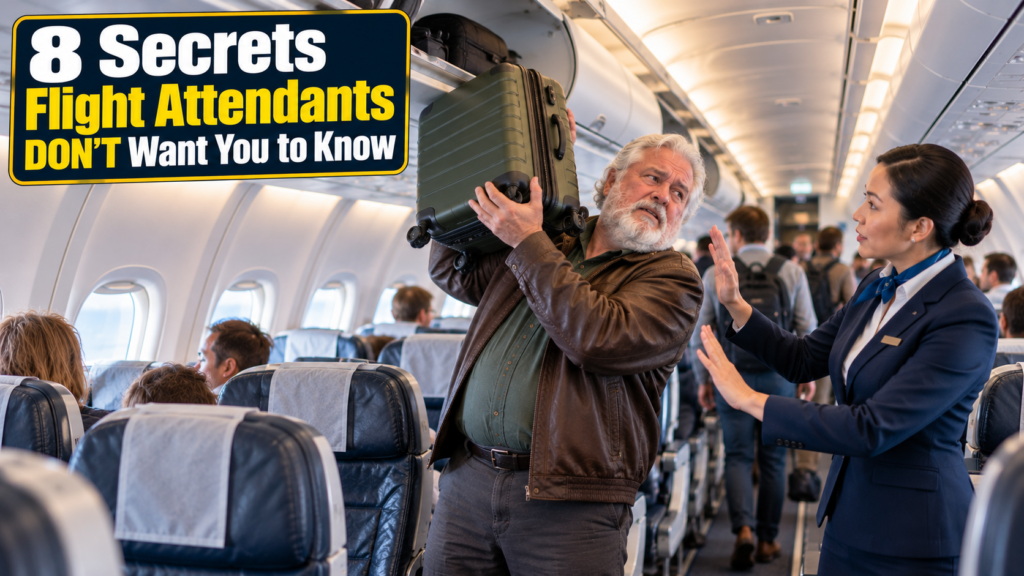
Imagine reaching your row during boarding.
People are waiting behind you. The overhead bin is open. You grab your suitcase with both hands, raise it toward your chest—and suddenly realize it’s much heavier than it felt at home.
You turn to the flight attendant.
“Could you lift this into the bin for me?”
This is where many travelers make the wrong assumption.
You should not build your packing strategy around expecting a crew member to lift a heavy suitcase for you. Assistance practices and individual circumstances can differ, so sweeping statements such as “flight attendants aren’t paid to lift bags” aren’t reliable rules.
Instead, plan around what you can safely manage and your airline’s baggage requirements.
That may mean using a smaller carry-on, reducing unnecessary items, checking a larger bag, or keeping the heaviest appropriate items somewhere easier to access.
There’s another reason to think twice before putting something very heavy overhead.
The FAA warns that carry-on items falling from overhead bins can injure passengers. Its passenger guidance specifically advises travelers to stow heavy items under the seat in front rather than overhead when appropriate.
Also avoid stacking items in an overhead bin and tuck away loose straps that could create a tripping hazard.
For an older traveler, this isn’t about proving whether you’re strong enough to lift a suitcase.
It’s about avoiding an unnecessary lifting problem in a crowded aisle.
A useful test is simple: before leaving home, ask yourself whether you can comfortably control your carry-on throughout the journey.
Not just roll it through the terminal.
Can you maneuver it through a narrow aircraft aisle? Can you control it without losing your balance? Have you packed it in a way that avoids an awkward overhead lift?
If the answer is no, change the packing plan before you board.
3. Keep Your Seat Belt Fastened Even When the Sign Is Off
The seat-belt sign turns off.
You may assume that means your seat belt is no longer useful.
That’s not what the FAA recommends.
FAA passenger safety guidance advises travelers to wear their seat belts at all times while seated. The reason becomes obvious when you consider turbulence.
Turbulence isn’t always preceded by a long warning. It can occur unexpectedly, including when conditions appear relatively calm.
An unrestrained passenger can be thrown from a seat during unexpected turbulence.
So when you’re sitting down, leaving the belt fastened is one of the easiest safety habits available to you.
You don’t need to make it painfully tight.
FAA guidance says the belt should sit low and tight across the hips rather than the abdomen.
For travelers over 60, there’s no need to turn this into an age-specific rule. The guidance applies broadly to passengers.
But older travelers may find the habit especially worth remembering if an unexpected jolt or fall could make the rest of a trip considerably more difficult.
The easiest strategy?
Sit down. Buckle up. Leave it buckled while seated.
Don’t wait for a rough patch of air to remind you.
4. Count the Rows to the Nearest Exit
Most passengers know that airplanes have emergency exits.
Far fewer actually identify where those exits are relative to their own seats.
Before takeoff, look around.
Find the closest usable exits in front of and behind your seat.
Then count the rows between you and those exits.
Why count?
Because an emergency cabin may not look anything like the cabin you saw during boarding. Visibility can be reduced, people may be standing, and your normal visual references may become harder to use.
Knowing that an exit is approximately four rows behind you is much more useful than vaguely remembering seeing an EXIT sign somewhere.
FAA evacuation guidance specifically tells passengers to locate the nearest exits and count the rows between their seats and the closest exits in front of and behind them.
And remember something that seems obvious but is easily forgotten:
The nearest safe exit may be behind you.
Don’t automatically assume you should move toward the front of the aircraft.
This little exercise takes perhaps a few seconds.
Sit down.
Look forward.
Look behind you.
Count.
That’s it.
It’s one of those pieces of safety information that you hope you’ll never need—but you won’t regret knowing.
5. Keep Truly Essential Items Close
Many experienced travelers have a beautifully organized carry-on.
Medication in one pouch.
Identification in another.
Phone in an outside compartment.
Keys somewhere inside.
That works well during normal travel.
An evacuation isn’t normal travel.
FAA guidance tells passengers to leave carry-on bags behind during an emergency evacuation. The agency also recommends, where possible, keeping essentials such as medications, identification, keys or a phone in a pocket rather than buried inside carry-on luggage.
That doesn’t mean stuffing every valuable you own into your clothing.
It means thinking carefully about the small number of things you would genuinely need if you suddenly had to walk away from your bag.
For a traveler who relies on important medication, this deserves particular thought.
Your luggage organization system should make everyday travel convenient without creating unnecessary dependence on a bag that you might have to abandon during an emergency.
The same principle applies to identification and a phone.
Keep essential items organized and accessible without creating bulky pockets or another mobility problem.
This is a perfect example of why smart packing isn’t simply about fitting more into a suitcase.
Accessibility matters too.
6. Gate-Checking Your Carry-On Can Change the Battery Rules
Here’s a scenario that catches travelers by surprise.
You carefully pack everything into your carry-on.
Then, at the gate, you’re told the bag must be checked.
Before handing it over, stop and think about what’s inside.
FAA guidance says spare lithium batteries and power banks must be carried in the cabin, not in checked baggage. If a carry-on is checked at the gate or planeside, those items must be removed and kept with the passenger in the aircraft cabin.
This includes the power bank many travelers keep in their suitcase for charging a phone.
As of the FAA’s August 2026 guidance, spare lithium batteries and power banks remain carry-on-only items, subject to applicable battery-size requirements and airline restrictions.
Battery terminals also need protection against short circuits.
For most ordinary travelers, the easiest approach is to give battery-powered items their own preflight check rather than waiting until a gate agent asks for the suitcase.
Know where your power bank is.
Know where your spare batteries are.
Don’t bury them underneath a week’s worth of clothes.
Also remember that battery requirements become more detailed for larger batteries, mobility devices, damaged or recalled batteries, and some specialized equipment.
Airlines can have additional restrictions, particularly for international travel.
If you’re uncertain about a specific battery, check before you leave home.
The five minutes you spend doing that are much easier than opening a carefully packed suitcase on the boarding bridge.
7. If an Evacuation Is Ordered, Leave the Bag
This may be the most important item on the entire list.
If the crew orders an emergency evacuation, don’t retrieve your carry-on.
Leave it.
The FAA’s current passenger evacuation campaign is explicit about this because bags can do more than cost a few seconds.
They can obstruct aisles.
They can interfere with other passengers trying to leave.
They can damage an evacuation slide.
And they can increase the risk of injury.
The FAA reports that more than 40 injuries have been reported during aircraft emergency evacuations since January 1, 2023.
An evacuation is not the time to decide that your suitcase is too valuable to abandon.
Don’t open the overhead bin.
Don’t stop to pull out your roller bag.
Don’t turn around for another item.
Follow crew instructions and move toward the nearest safe exit.
This is also why the advice in the previous sections works together.
If your essential items are sensibly organized and the most critical small items are kept on you where appropriate, you have less reason to think about your suitcase when seconds matter.
The flight attendant’s instructions take priority over your luggage.
Your bag is replaceable.
The time lost trying to retrieve it isn’t.
8. The Safety Demonstration Isn’t Background Entertainment
You’ve probably heard the safety demonstration many times.
Seat belt.
Exits.
Oxygen masks.
Life vest.
After enough flights, it’s tempting to tune it out.
Don’t.
FAA passenger guidance tells travelers to pay attention to the flight attendant safety briefing and read the safety information card.
There’s a practical reason.
The information card contains aircraft-specific emergency information.
Your seat may be different from the one you had on your last trip. Your nearest exit may have changed. The aircraft type may be different. If you’re seated in an exit row, additional responsibilities and requirements apply.
So rather than thinking, “I’ve flown a hundred times; I know this,” use the briefing as a quick orientation to this particular flight.
Locate the exits.
Count the rows.
Check the card.
Listen to the crew.
Keep your seat belt fastened while seated.
Then rel
