
CRUISE TIP
9 Cruise Rules That Frustrate Passengers Over 60 — Should They Change?
Sep
Cruise ships need rules.
Put thousands of people together on a floating resort, and rules about safety, smoking, alcohol, dining, shared spaces, and reservations are inevitable.
But that doesn’t mean passengers agree with every rule—or with the way every rule is enforced.
And for travelers over 60, some policies can feel especially frustrating when they affect comfort, mobility, meal planning, technology, or simply the way you want to spend your vacation.
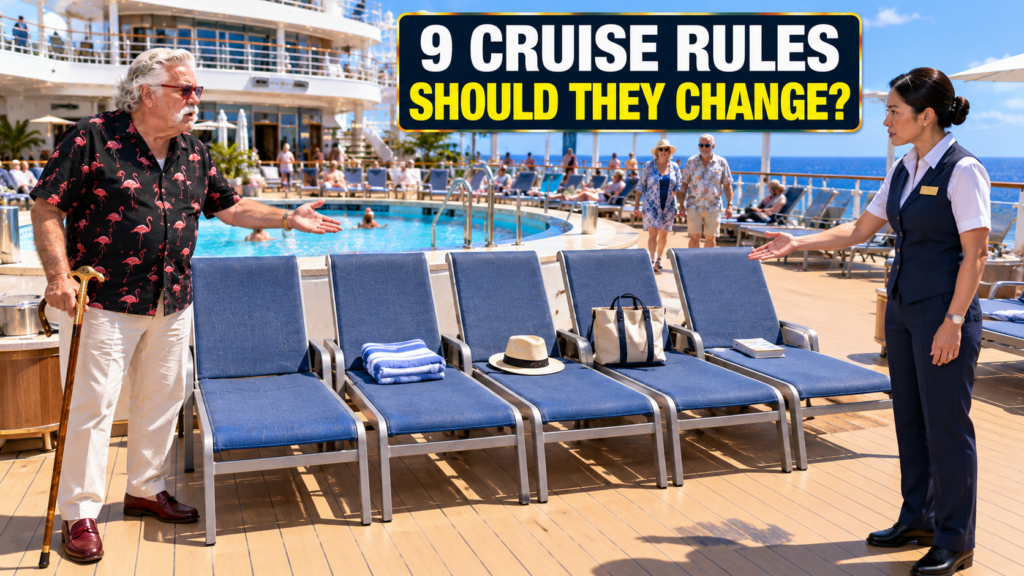
Imagine 73-year-old Wally settling onto the pool deck early in the morning.
He takes one lounge chair for himself. A towel goes on the second. His Panama hat claims the third. His tote bag occupies the fourth. A paperback book guards the fifth.
His friends are “coming.”
Twenty minutes later, they’re still nowhere to be seen.
Meanwhile, other passengers are walking around looking for somewhere to sit.
A crew member finally approaches.
Wally isn’t pleased.
And that brings us to one of the most argued-about cruise rules of all.
1. You Can’t Simply Save Pool Chairs
The infamous “chair hog” debate may never disappear.
Some passengers believe they should be able to save nearby chairs while their spouse gets breakfast, changes clothes, or takes a quick swim.
Others see an empty chair covered by a towel for an extended period and think: nobody is using it, so why should it remain unavailable?
Some cruise lines explicitly prohibit reserving pool or deck chairs. Royal Caribbean, for example, says pool chairs are first-come, first-served and currently states that belongings may be removed when a chair has been unattended for more than 30 minutes with no indication the guest is returning.
Norwegian’s guest conduct policy also says pool, deck, and theater chairs may not be reserved.
The reason is understandable: deck space is shared space.
But the difficult question is enforcement.
What happens when someone goes swimming?
What if a passenger needs a few minutes to get medication from the cabin?
What about a spouse getting lunch?
Passengers with disabilities may also have different needs; Royal Caribbean’s broader conduct policy specifically notes an exception regarding chair reservation in cases of disability.
Perhaps the argument isn’t really about whether chair hogging should be allowed.
It’s about where cruise lines should draw the line between temporarily leaving a chair and effectively claiming it for hours.
Would you keep the current rule—or change how it’s enforced?
2. Adults-Only Areas Aren’t Much Use Without Consistent Enforcement
Many passengers deliberately seek out quieter spaces onboard.
That can matter even more to travelers who aren’t interested in waterslides, children’s activities, loud games, or crowded family areas.
An adults-only or age-restricted space sounds like the solution.
Until it isn’t enforced.
This creates an unusual cruise-rule debate because many passengers aren’t asking for the rule to disappear. They’re asking for it to mean what it says.
Cruise lines have legitimate reasons for offering different spaces to different groups of passengers. Families need places designed for children, while adults may value designated quieter areas.
Problems arise when expectations and onboard enforcement don’t match.
Before assuming a particular deck, lounge, pool, or relaxation area will be adults-only, check the actual rules for your ship. Age requirements and restrictions can vary by venue and cruise line.
The change some passengers want may therefore be simple:
If an area is advertised as age-restricted, should the rule be enforced more consistently?
3. Do We Still Need Traditional Main Dining Room Dress Expectations?
This one can divide a dining room very quickly.
One passenger says:
“It’s dinner on a beautiful ship. Dress up a little.”
Another says:
“I paid for a vacation. Why should anyone care what pants I’m wearing?”
Cruise dining has changed substantially from the days when ocean travel meant formal clothing every evening.
Many modern cruise experiences are considerably more relaxed, but individual cruise lines and venues can still publish dress guidelines, and expectations may differ between casual venues, main dining rooms, and specialty restaurants.
There’s also a difference between asking passengers to dress neatly and requiring traditional formalwear.
For many older travelers, comfort isn’t necessarily about refusing to dress well. Shoes, braces, swelling, limited mobility, temperature sensitivity, or other practical considerations can affect what feels comfortable for several hours.
That doesn’t mean dress expectations should automatically disappear.
Restaurants may want to preserve a particular atmosphere, and plenty of passengers actively enjoy dressing up.
The better question might be:
Should cruise dining focus more on neat, appropriate clothing and less on traditional definitions of formalwear?
4. Bringing Your Own Drinks Onboard Can Be Surprisingly Complicated
Here’s a mistake experienced cruisers still make:
They remember the beverage rules from their last cruise and assume the next cruise will be the same.
That can backfire.
Cruise lines can have very different policies regarding wine, champagne, liquor, soda, water, containers, quantities, embarkation-day allowances, and beverages purchased in port.
For example, Royal Caribbean currently permits each guest of drinking age to bring one sealed 750 ml bottle of wine or champagne on embarkation day under its stated policy.
Norwegian’s published policy permits wine and champagne subject to its conditions, while generally prohibiting guests from bringing other beverages onboard, with specified exceptions.
The rules can also change.
That’s why this isn’t a policy you should learn once and assume you’ll remember forever.
Some passengers would prefer a simpler industry-wide approach.
But until that exists, the safest strategy is much less exciting:
Check your specific cruise line’s current beverage policy shortly before sailing.
Don’t rely on what happened on another cruise.
And don’t rely on what your friend was allowed to bring three years ago.
5. Why Can’t You Share Your Beverage Package?
This sounds simple from the passenger’s perspective.
“My wife doesn’t drink much. Why can’t she just have one of mine?”
Because an unlimited or bundled beverage package is generally sold for individual use, and cruise lines can impose restrictions designed to prevent one passenger from supplying drinks to people who haven’t purchased the package.
Carnival’s current CHEERS! terms, for example, say the package is non-transferable, sharing isn’t permitted, and qualifying adults assigned to the same stateroom must purchase the program under its applicable rules.
From the cruise line’s perspective, the logic is obvious.
If unlimited packages could freely be shared, one package could potentially supply multiple passengers.
From the passenger’s perspective, the frustration is equally easy to understand.
Two people sharing a cabin may consume dramatically different amounts.
One may enjoy several eligible drinks throughout the day. The other may have only an occasional beverage.
That can make the package math feel unfavorable for some couples.
So don’t buy a beverage package simply because “everyone gets one.”
Calculate what you realistically expect to consume, read the current package conditions, and compare that with paying individually.
Would you prefer cruise lines to offer more flexible package combinations for couples with very different drinking habits?
6. Specialty Dining Reservations Can Come With a Clock
You’ve planned the perfect evening.
Then the show runs late.
Someone needs to return to the cabin.
You arrive at the restaurant much later than expected.
And your table may no longer be waiting.
Specialty restaurants have limited seating, so cruise lines have an obvious reason to manage reservations carefully.
Norwegian, for example, currently says dinner reservations are held for 15 minutes. Its published information also warns that charges or loss of prepaid value can apply in specified circumstances involving unclaimed reservations.
That’s understandable operationally.
An empty table represents space another passenger might have used.
But travelers sometimes argue for more flexibility because cruise vacations aren’t always predictable. Excursions run late. Shows change. People get tired. Mobility can make moving from one end of a large ship to the other slower than expected.
The practical lesson is straightforward:
Don’t assume a specialty-dining reservation works like a casual restaurant where arriving whenever you want will be fine.
Check the cancellation and late-arrival policy when you reserve.
If your plans change, modify or cancel the reservation as early as possible.
Should cruise lines offer a larger grace period—or would that make reservations harder for everyone else?
7. Smoking Rules — Especially Around Casinos — Remain Divisive
Few onboard issues produce reactions as immediate as cigarette smoke.
Many passengers want indoor cruise spaces completely smoke-free.
Others argue that ships already provide limited designated smoking areas and that those spaces should remain available.
Casino policies make the debate even more complicated.
Royal Caribbean’s current policy generally prohibits smoking across interior public spaces but allows designated smoking areas and notes casino smoking arrangements on itineraries where it is permitted.
Norwegian says public areas are generally smoke-free, smoking is limited to designated locations, and casino smoking is restricted under its stated rules.
Policies can differ by ship and itinerary.
For travelers sensitive to smoke, this is worth researching before booking—not after discovering that a favorite entertainment area is close to a permitted smoking location.
And that leads to the larger debate:
Should cruise ships move toward completely smoke-free indoor casinos, or are designated smoking sections a reasonable compromise?
8. Wi-Fi Should Be Easier to Understand
You buy Wi-Fi.
Your phone connects.
Then you want to use your tablet.
Or your spouse wants to connect.
Suddenly you’re trying to understand devices, users, plans, switching, streaming access, and package limitations while you’re supposed to be relaxing.
For someone who uses this technology every day, that’s probably manageable.
For a passenger who just wants to message the family, check email, or make an internet-based call, it can become unnecessarily confusing.
And “Wi-Fi included” doesn’t always answer the questions that actually matter:
How many users?
How many devices at once?
Can devices be switched?
Does the plan support streaming?
What apps or functions work?
Does coverage change at sea?
The solution isn’t to assume every cruise line should provide unlimited connectivity to every device.
Satellite internet at sea has operational constraints, and packages vary.
But passengers would benefit from clearer explanations before purchase.
For travelers over 60 who don’t enjoy troubleshooting technology, this is particularly important.
Before buying, ask one simple question:
“Exactly what can I do with this plan, and on how many devices at the same time?”
That question can prevent a lot of frustration onboard.
9. Could Disembarkation Be More Comfortable for Passengers With Mobility Needs?
The last morning of a cruise can feel nothing like the rest of the vacation.
Cabins are being cleared.
Passengers are waiting with bags.
Announcements are happening.
Thousands of people may be trying to leave within a relatively short period.
For a healthy traveler who can comfortably stand, walk long corridors, handle luggage, and wait in lines, that’s mostly an inconvenience.
For someone with limited mobility, it can be much more difficult.
The important distinction is that accessibility assistance already exists in various forms across cruise lines and terminals, but procedures, availability, meeting locations, and advance-notice requirements can differ.
So the answer isn’t simply “remove the rules.”
Disembarkation involves immigration, customs, port operations, luggage handling, transportation, security, and thousands of passengers. Cruise lines can’t necessarily allow everyone to leave whenever they choose.
But there is room for a useful question:
Could the process be communicated and organized more clearly for passengers who need additional assistance?
If mobility is a concern, don’t wait until the final morning.
Ask Guest Services or the cruise line’s accessibility team in advance what assistance may be available, where you need to meet, whether advance notice is required, and what happens to your luggage.
So, Do These 9 Cruise Rules Really Need to Change?
Maybe some do.
Maybe some don’t.
And some of the biggest frustrations aren’t actually caused by the existence of a rule—they’re caused by confusing communication, inconsistent expectations, or passengers discovering the restriction too late.
Pool-chair limits help keep shared deck space available.
Beverage-package restrictions help prevent one package from being used by multiple people.
Dining reservation rules help restaurants manage limited tables.
Smoking restrictions balance competing passenger preferences and safety considerations.
Disembarkation procedures help move thousands of people through a complicated process.
There’s usually another side to the rule.
But cruise lines are also competing for passengers, and expectations change. A policy that worked well years ago may deserve another look as travelers’ habits and needs evolve.
For passengers over 60, the smartest approach isn’t to memorize every cruise rule.
It’s to know which rules can materially affect your vacation and check them before you pay, pack, reserve, or board.
And now it’s your turn:
Which cruise rule would you change first—and which one should cruise lines never change?
