
CRUISE NEW
WOULD YOU BOOK A REPOSITIONING CRUISE JUST FOR THE PRICE?
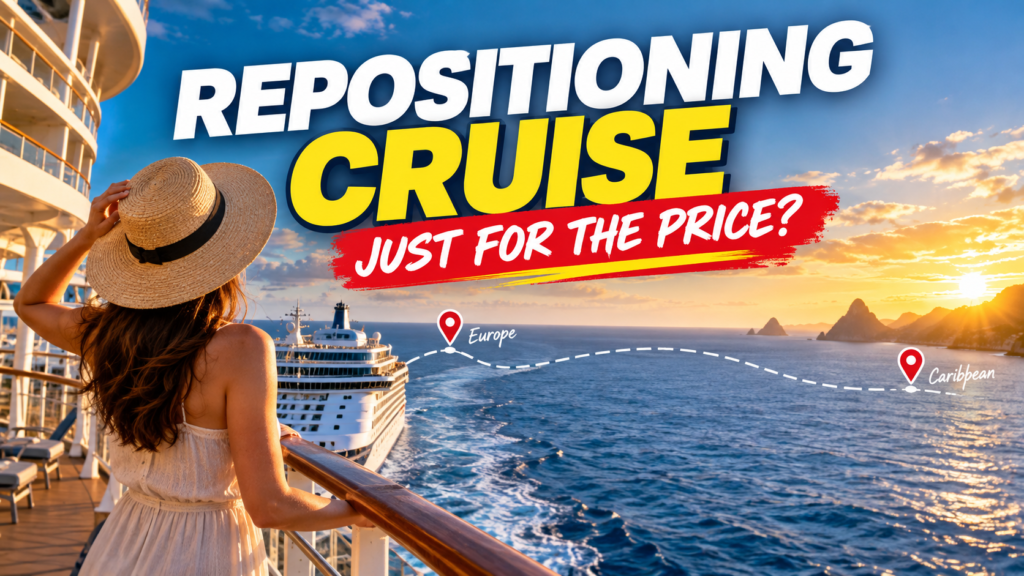
Sep
You’re scrolling through cruise deals when one fare suddenly makes you stop.
The itinerary is much longer than the vacation you were originally considering. You’ll have days to enjoy the ship, cross a huge stretch of ocean, and potentially visit destinations you might never combine on an ordinary cruise.
Then you look at the advertised cruise fare.
It seems almost too good to ignore.
Your first reaction might be simple:
“At that price, why wouldn’t I book it?”
But then you open the itinerary.
The ship leaves from one port—and never comes back.
Welcome to the world of repositioning cruises, one of the most interesting types of voyages in cruising and potentially an attractive option for travelers who love long days at sea.
But before booking one because the cruise fare looks cheap, there is one important question to answer:
What will the entire trip actually cost?
That question can completely change how you look at the deal.
WHAT IS A REPOSITIONING CRUISE?
A repositioning cruise happens when a cruise ship moves from one sailing region to another, usually as cruising seasons change.
Celebrity Cruises describes repositioning cruises as one-way itineraries that begin in one major cruise destination and finish in another.
For example, a ship operating in Europe during the summer might need to move toward the Caribbean for the winter season.
Rather than sailing across the ocean without paying passengers, the cruise line can sell that journey as a repositioning voyage.
That creates unusual itineraries that aren’t necessarily available during the rest of the year.
And despite what the name might suggest, repositioning doesn’t automatically mean transatlantic.
A ship might cross the Atlantic.
It might cross the Pacific.
It might sail through the Panama Canal.
It could reposition between Asia and Alaska or between other seasonal cruising regions.
The defining characteristic is that the ship is moving from one cruising region to another.
WHY CAN REPOSITIONING CRUISES LOOK SO CHEAP?
This is where repositioning cruises become especially interesting for bargain hunters.
Celebrity Cruises notes in its cruise-deal guidance that repositioning cruises are often available at discounted prices.
That’s an important word:
Often.
Not always.
Cruise pricing changes constantly based on demand, sailing date, ship, cabin category, promotions and other factors.
So you should never assume that every repositioning cruise will automatically be cheaper than every conventional cruise.
But attractive fares absolutely can exist.
And because these voyages may be considerably longer than a typical weeklong vacation, the advertised fare can look especially compelling when you consider how many nights you’re getting onboard.
That’s the moment when some travelers make a mistake.
They compare the cruise fare.
They don’t compare the total trip cost.
Those are two very different numbers.
THE BIG CATCH: YOUR SHIP MAY NOT BRING YOU BACK
Suppose you normally book a seven-night Caribbean cruise.
You drive or fly to the embarkation city.
The ship leaves.
Seven days later, the ship returns to the same general place.
That makes transportation planning relatively straightforward.
A repositioning cruise works differently.
Because the ship itself is moving to another cruising region, you may board in one city—or even one continent—and finish somewhere completely different.
Royal Caribbean, for example, currently advertises extended 13- and 14-night repositioning transatlantic voyages operating one-way between Barcelona and Fort Lauderdale.
That’s part of the appeal.
You’re actually traveling from one side of the Atlantic to another.
But it’s also something you must plan around.
If you live near Fort Lauderdale and your cruise begins in Barcelona, you need to get to Barcelona.
If you’re sailing in the opposite direction, you’ll eventually need transportation home from Barcelona.
So before you press the booking button, ask:
Where does this cruise actually end?
THE CHEAP CRUISE FARE IS ONLY ONE PART OF THE EQUATION
Imagine finding a repositioning cruise with an advertised fare that looks substantially better than another vacation you’ve been considering.
You get excited.
You choose your cabin.
Then you start planning everything around it.
That’s when additional expenses can appear.
Depending on your itinerary and where you live, your overall vacation budget could include:
- airfare to the embarkation city,
- airfare home from the final destination,
- pre-cruise hotel accommodation,
- post-cruise hotel accommodation,
- airport transfers,
- port transportation,
- meals before or after the cruise,
- baggage charges,
- and other normal travel expenses.
Not every passenger will incur every one of these costs.
Someone living near one endpoint may have much simpler logistics.
Another passenger may already be planning an extended European vacation and actually find the repositioning cruise extremely convenient.
That’s why there isn’t one universal answer.
The important comparison is:
CRUISE FARE vs. TOTAL VACATION COST.
CHECK THE FLIGHT HOME BEFORE YOU BOOK
This may be the single most useful habit when shopping for a repositioning cruise.
Before paying for the cruise, search the transportation you’ll need at both ends.
Don’t tell yourself:
“I’ll figure out the flight later.”
At least investigate it first.
Celebrity specifically notes that because repositioning voyages depart from one port and finish in another, travelers need to account for one-way air travel associated with their departure and final ports.
That doesn’t automatically make the cruise a bad value.
The airfare could be perfectly reasonable.
You might have airline miles.
You may be able to combine the cruise with another trip.
Or the cruise savings could be large enough that the overall vacation remains attractive.
But you won’t know until you check.
A cruise employee giving good advice wouldn’t necessarily tell you:
“Don’t book this cruise.”
A better response would be:
“Before you book, check the airfare home from the final port.”
That turns an impulsive booking into an informed decision.
REPOSITIONING CRUISES CAN BE LONG
There’s another issue hiding behind the attractive fare:
time.
Celebrity currently says repositioning cruises tend to be longer because ships must cover significant distances, with voyages commonly lasting around 13 to 19 nights.
That’s very different from taking a three-, four- or seven-night cruise.
For retired travelers, remote workers with appropriate arrangements, or passengers with generous vacation time, that can be fantastic.
For someone with one week of annual leave available, it could make the itinerary impractical regardless of price.
The cheapest vacation isn’t a bargain if you don’t have enough time to take it.
So check the number of nights before becoming hypnotized by the fare.
AND THEN THERE ARE THE SEA DAYS
This is where repositioning cruises become either wonderful or completely wrong for you.
Long-distance repositioning itineraries can include significant stretches at sea.
Celebrity says some repositioning itineraries can spend up to 10 nights at sea, while Princess currently advises travelers that its transatlantic voyages can include roughly three to nine consecutive sea days, depending on the itinerary.
Read that again:
Consecutive sea days.
For one cruiser, that sounds like heaven.
Wake up whenever you want.
Have a long breakfast.
Read beside the pool.
Attend a lecture.
Go to the gym.
Try trivia.
Book a spa treatment.
Have another coffee.
Watch the ocean.
Eat dinner.
See a show.
Go to sleep.
Repeat.
For another cruiser, three or four days without stepping onto land may already feel like too much.
Neither reaction is wrong.
The question is whether you actually enjoy being on the ship.
REPOSITIONING CRUISES ARE FOR PEOPLE WHO LOVE THE JOURNEY
On a port-intensive cruise, the ship can sometimes feel like transportation between destinations.
You wake up.
Explore a city.
Return onboard.
Eat dinner.
Sleep.
Wake up somewhere new.
A repositioning cruise can reverse that relationship.
The ship itself becomes a major part of the vacation.
Princess promotes this aspect of transatlantic cruising specifically, highlighting sea days as opportunities for live entertainment, spa time, wine tastings, guest lectures and simply slowing down onboard.
Royal Caribbean similarly markets transatlantic and transpacific sailings around the experience of crossing between continents.
That means you shouldn’t judge a repositioning cruise only by:
“How many ports am I getting?”
You should also ask:
“Would I enjoy spending this much time onboard?”
If the answer is yes, the itinerary becomes much more appealing.
If the answer is no, an attractive fare may not save the vacation.
DON’T CONFUSE “MORE NIGHTS” WITH “MORE DESTINATIONS”
This is another psychological trap.
Suppose you compare:
Cruise A: 7 nights
with
Cruise B: 14 nights
Cruise B may look dramatically better when comparing price per night.
But what exactly happens during those 14 nights?
Perhaps several days are spent crossing open ocean.
That’s not a negative if you love sea days.
But if your priority is exploring a different destination every morning, the longer itinerary may not deliver the kind of value you expect.
Look beyond the number of nights.
Study the actual itinerary day by day.
Count:
Port days.
Then count:
Sea days.
Now ask which number matters more to you.
REPOSITIONING DOESN’T ALWAYS MEAN TRANSATLANTIC
The classic image is a ship leaving Europe and crossing the Atlantic toward Florida.
That’s certainly common.
Royal Caribbean currently markets transatlantic voyages connecting the United States and Europe, as well as transpacific itineraries connecting regions such as Australia or Japan with the United States.
But repositioning is broader than Atlantic crossings.
Celebrity notes that repositioning voyages can include routes such as Hawaii to Sydney or passages through the Panama Canal.
So if you’re interested in the concept but don’t want a traditional Atlantic crossing, keep looking.
There may be a repositioning itinerary that better matches your travel goals.
SPRING AND FALL CAN BE IMPORTANT
Why do these unusual cruises appear at particular times?
Because cruise ships follow seasonal demand.
Princess explains that its transatlantic schedule typically sends ships eastbound in spring as vessels reposition for the European summer season, while fall sailings head west as ships return toward North America and warmer-weather operations.
Celebrity describes a similar seasonal concept.
That’s why repositioning opportunities can feel different from ordinary cruises.
The ship isn’t simply repeating the same itinerary every Saturday.
It’s physically transitioning into another phase of its schedule.
That can create routes you’ll only see during specific parts of the year.
WHO SHOULD SERIOUSLY CONSIDER A REPOSITIONING CRUISE?
These cruises can be particularly attractive for several types of travelers.
Travelers who love sea days
If your favorite cruise moments happen onboard rather than ashore, this format may suit you beautifully.
Travelers with flexible schedules
Long itineraries become much easier when you aren’t trying to squeeze the trip into one week of vacation.
People who enjoy slow travel
Crossing an ocean by ship feels completely different from flying over it in several hours.
The journey becomes part of the experience.
Travelers comfortable arranging one-way logistics
If booking separate flights, hotels and transfers doesn’t bother you, the unusual start and finish points may feel like an opportunity rather than a complication.
Travelers who compare total cost carefully
An attractive cruise fare becomes much more meaningful when you’ve already checked the rest of the trip expenses.
WHO MAY WANT TO THINK TWICE?
A repositioning cruise won’t suit everyone.
Travelers who dislike sea days
If you become restless after one day without a port, several consecutive days at sea could be difficult.
Travelers with limited vacation time
A 13-, 14-, 16- or 19-night voyage requires a completely different schedule from a short cruise.
People who want simple transportation
Round-trip cruises can be easier logistically because you return to your original embarkation area.
Travelers booking solely because of the fare
This is the big one.
If the only reason you’re considering the cruise is:
“It’s cheap!”
stop and calculate the complete trip first.
You may still discover an excellent deal.
But now you’ll know why you’re booking it.
HOW TO CALCULATE THE REAL COST
You don’t need a complicated spreadsheet.
Start with the cruise.
Step 1: Record the actual cruise cost
Include the cabin category and mandatory charges shown during the booking process rather than relying only on the headline fare.
Step 2: Check transportation to the embarkation port
Will you drive?
Fly?
Take a train?
Need a hotel?
Step 3: Check how you’ll get home
This is crucial for one-way repositioning itineraries.
Search flights from the actual disembarkation region before booking.
Step 4: Add accommodation if necessary
Many experienced cruisers prefer arriving before embarkation rather than risking a same-day long-distance arrival.
A distant international embarkation may make a hotel especially relevant.
Step 5: Add normal vacation spending
Consider transfers, meals off the ship, excursions and whatever onboard extras you personally expect to purchase.
Then compare the resulting number with your alternatives.
That’s your more useful price comparison.
PRICE PER NIGHT CAN STILL BE USEFUL
Price per night isn’t meaningless.
It’s simply incomplete.
Suppose two cruises cost similar amounts, but one gives you substantially more nights onboard.
If you genuinely love sea days, that could represent excellent personal value.
But don’t calculate:
Cruise fare ÷ nights
and stop there.
For a repositioning voyage, a more informative mental model is:
Total trip cost ÷ total vacation experience.
That includes the cruise and the logistics needed to make the cruise possible.
DON’T FORGET THE VALUE OF THE SHIP ITSELF
There is another reason a repositioning cruise can make sense even with many sea days.
You have more time to use the ship.
On a port-heavy itinerary, you may leave at 8 a.m. and return at 5 p.m.
You could spend surprisingly little time enjoying the vessel you’ve paid to sail on.
Long sea stretches change that.
Suddenly you have time to explore venues you might normally ignore.
You can sleep late without worrying about missing a shore excursion.
You can actually use the pool.
You can attend daytime entertainment.
You can sit somewhere quiet and watch nothing but ocean.
For passengers who select ships partly because of their onboard experience, this can be a major advantage.
BUT A GREAT SHIP MATTERS MORE WHEN YOU HAVE MANY SEA DAYS
There’s an important consequence.
If your itinerary includes several consecutive sea days, choosing the right ship becomes more important.
Ask yourself:
Does the ship have enough dining options for me?
Will I use its entertainment?
Do I like its outdoor spaces?
Does it have enough quiet areas?
What happens if the weather keeps me indoors?
Would I enjoy this ship after several days without a port?
On a seven-night cruise with six port calls, you might tolerate a ship that doesn’t perfectly match your style.
On a long ocean crossing, you may notice every strength—and every weakness.
SHOULD YOU BOOK THE CHEAPEST CABIN?
This is another decision worth considering carefully.
A long repositioning cruise means more time onboard and potentially more time in your cabin.
An interior cabin may help keep your total cost down.
For some passengers, that’s perfect.
They use the cabin primarily for sleeping and spend almost every waking hour elsewhere on the ship.
Others may value natural light, additional space or a private balcony much more during a long crossing.
There isn’t a universally correct cabin.
The important point is not to let a low entry fare automatically choose your cabin for you.
Think about how you’ll actually live onboard for two weeks or more.
WHAT ABOUT THE WEATHER?
Repositioning itineraries often occur during seasonal transitions.
That’s the entire reason many ships are moving.
Weather conditions vary significantly depending on route, month and region, so avoid assuming that every ocean crossing will deliver uninterrupted pool weather.
Pack for the itinerary rather than the marketing photo.
Check the climates at your embarkation point, ports of call and final destination.
A voyage connecting different continents may expose you to dramatically different temperatures during the same trip.
IS A REPOSITIONING CRUISE ACTUALLY A GOOD DEAL?
Sometimes, absolutely.
But “good deal” needs a definition.
A repositioning cruise may be a great deal if:
you like long cruises,
you enjoy sea days,
you have enough vacation time,
the transportation works,
and the total trip cost fits your budget.
It may be poor value for you if:
you dislike long stretches at sea,
you need expensive or inconvenient flights,
you don’t have enough vacation time,
or you chose it only because the advertised cruise fare looked low.
The same sailing can be fantastic value for one passenger and a bad fit for another.
THE BOOKING-DESK QUESTION THAT CAN SAVE YOU A SURPRISE
Imagine the conversation.
A woman sees the fare and says:
“Look at that price! We should book this repositioning cruise right now!”
Her husband studies the itinerary.
Then he notices something.
“Wait—why doesn’t the ship come back to the same port?”
The cruise employee explains:
“Because it’s a repositioning cruise. You’ll board here, but the cruise ends in a different port.”
The woman isn’t worried.
“So what? At this price, it still sounds like an incredible deal!”
That’s when the employee gives the most useful advice:
“Before you book, check the airfare home from the final port. That can change your total trip cost.”
And suddenly the advertised fare isn’t the only number that matters.
That’s exactly how travelers should approach these cruises.
Not with fear.
Not with the assumption that there’s some hidden scam.
Just with the complete picture.
7 THINGS TO CHECK BEFORE BOOKING A REPOSITIONING CRUISE
Before paying your deposit, verify these seven things:
- Embarkation port — Where exactly do you need to reach?
- Final port — Where will you actually be when the cruise ends?
- Flight costs — What will transportation at both ends cost?
- Cruise length — Do you genuinely have enough time?
- Consecutive sea days — Will you enjoy that many days onboard?
- Ship experience — Is this a ship you’d happily spend long stretches aboard?
- Total vacation cost — Is it still attractive after transportation and other expected travel expenses?
If those answers still look good, the fare becomes much more meaningful.
REPOSITIONING CRUISE FAQ
What is a repositioning cruise?
A repositioning cruise is generally a one-way voyage undertaken as a ship moves from one cruising region to another, commonly around seasonal changes.
For example, ships may move between Europe and North America or between other seasonal cruise markets.
Are repositioning cruises always cheaper?
No.
You shouldn’t assume every repositioning sailing will be cheaper.
However, Celebrity Cruises notes that repositioning cruises are often available at discounted prices.
Always compare the specific sailing you’re considering.
Are repositioning cruises one-way?
Typically, yes.
Celebrity defines them as one-way itineraries beginning in one major cruise destination and ending in another.
That is why transportation planning at both ends is so important.
Do I need a one-way flight?
It depends on where you live and the itinerary.
You may need air transportation to the embarkation port, from the final port home, or both.
Check your specific travel arrangements before booking.
How long are repositioning cruises?
Lengths vary significantly.
Celebrity says repositioning cruises tend to be longer and describes voyages around 13 to 19 nights.
Individual itineraries can differ, so always check the actual sailing.
Do repositioning cruises have lots of sea days?
Many do.
Celebrity notes that some repositioning itineraries can include up to 10 nights at sea, while Princess says its transatlantic cruises can feature approximately three to nine consecutive sea days depending on the itinerary.
Is every transatlantic cruise a repositioning cruise?
Not necessarily in every possible context, although many cruise-line transatlantic sailings are repositioning voyages.
Royal Caribbean explains that transatlantic cruises are most often repositioning sailings as ships move between seasonal regions.
Celebrity also emphasizes that not every repositioning cruise is transatlantic; repositioning can happen across other routes and oceans.
When do transatlantic repositioning cruises usually happen?
Seasonality varies by cruise line and deployment.
Princess currently says its transatlantic ships typically sail eastbound in spring as they reposition toward Europe and westbound in fall toward North America.
Always verify the dates for the specific ship you’re considering.
Are repositioning cruises good for first-time cruisers?
They can be, but a first-time cruiser should think carefully about the number of sea days and overall length.
If you don’t yet know whether you enjoy spending consecutive days onboard, a shorter cruise may provide an easier introduction.
What’s the biggest mistake when booking one?
Looking only at the advertised cruise fare.
The itinerary may be one-way, so check where the ship finishes and investigate your transportation home before booking.
FINAL VERDICT: WOULD YOU BOOK A REPOSITIONING CRUISE JUST FOR THE PRICE?
The price might be what gets your attention.
It shouldn’t be the only reason you book.
Repositioning cruises can offer something genuinely unusual: long voyages, extended sea days, ocean crossings and routes connecting regions that ordinary round-trip cruises cannot easily replicate.
And yes, attractive discounted fares can be part of the appeal.
But the real decision starts after you see the price.
Look at the map.
Check the final port.
Count the sea days.
Check your available vacation time.
Price the flights.
Consider whether you genuinely want to spend that much time onboard.
Then calculate the whole vacation.
You may discover that the repositioning cruise is still an outstanding deal.
Or you may discover that the cheap fare was only the first piece of a much larger travel budget.
Either result is useful—because you found out before you booked.
So when a repositioning cruise suddenly appears on your screen with a fare that seems impossible to ignore, don’t ask only:
“How can this cruise be so cheap?”
Ask the question that matters more:
“Is the cheap cruise still cheap once I figure out how I’m getting home?”
