
AIRPORT TIPS
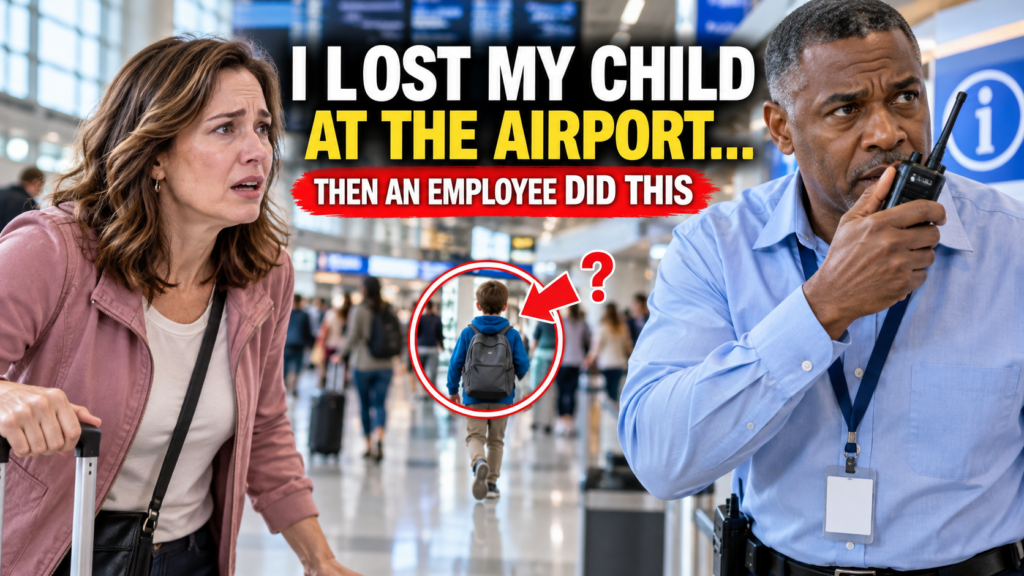
I LOST MY CHILD AT THE AIRPORT… THEN AN EMPLOYEE DID THIS
Sep
A Few Seconds Were All It Took
One moment, her eight-year-old son was standing beside her.
The next, he was gone.
The airport terminal was packed. Travelers pulled suitcases in every direction. Boarding announcements echoed overhead. Families hurried toward their gates while passengers flowed around restaurants, information screens, and long corridors.
The mother turned around expecting to see the familiar royal-blue hoodie and gray backpack immediately behind her.
Nothing.
She looked to the left.
Then to the right.
Still nothing.
Her first instinct was exactly what many parents would probably feel in that moment: run.
Search every corridor. Check every gate. Push through the crowd and keep moving until she found him.
Instead, she spotted an airport employee near an information counter and rushed toward him.
“My son is gone! He was right beside me, and now I can’t find him!”
The employee did not panic with her.
He focused.
“Stay with me. How old is he, and what is he wearing?”
“He’s eight! Blue hoodie, gray backpack—please, you have to find him!”
“Okay. Stay right here and don’t leave this area.”
The mother stared at him in disbelief.
“What are you going to do? We’re wasting time!”
The employee reached for his radio.
“I’m alerting Airport Police and mobilizing the search team right now.”
That scenario is fictionalized, but the basic idea behind it is very real: when a child cannot be located in a crowded airport, the situation should be treated seriously and responsible airport personnel or law enforcement should be alerted quickly.
And there is an important reason the employee in this story does not simply tell the parent, “Go look around.”
A busy airport is not one room.
It is a network of checkpoints, gates, trains, escalators, restaurants, restrooms, baggage areas, corridors and thousands of moving passengers.
When a child disappears from sight, organized communication can matter far more than frantic movement.
What Should You Do If You Lose Your Child at an Airport?
The most important principle is simple:
Act immediately.
The National Center for Missing & Exploited Children (NCMEC) advises families to immediately contact local law enforcement when they believe a child is missing. Its current guidance also says parents should be prepared to provide identifying information including the child’s name, date of birth, description, last known location and clothing.
At an airport, that means you should quickly alert an appropriate employee, airport security or Airport Police rather than spending an extended period searching alone.
For a serious emergency, follow the airport’s emergency procedure or call 911 in the United States.
For example, current official information from Los Angeles International Airport says life-threatening emergencies should be reported to 911 and provides dedicated contact information for its Airport Police Division. LAX’s crisis guidance also tells people how to contact Airport Police Dispatch to report an emergency or crime.
Procedures are not necessarily identical at every U.S. airport, however.
That distinction matters.
There is no reason for a parent to spend precious time trying to determine the exact organizational structure of the airport before asking for help. Find an identifiable employee or law-enforcement/security representative and clearly state that you cannot locate your child.
What Information Should You Give Airport Personnel?
Imagine trying to locate one child among thousands of passengers.
Saying:
“I can’t find my son.”
communicates the emergency.
But it does not provide enough information to distinguish him from everyone else in the terminal.
Specific information is much more useful.
NCMEC’s current missing-child guidance says parents reporting a missing child should be prepared to provide information such as the child’s name, date of birth, physical description, last known location and what the child was wearing.
In an airport situation, useful details may therefore include:
- Child’s name and age
- Clothing color and type
- Backpack, jacket or other distinctive item
- Hair color and physical description
- Exact place the child was last seen
- Approximate time you last saw the child
- Direction the child may have walked
- A recent photograph, if available
Think about the difference.
Instead of:
“My eight-year-old is missing.”
you can say:
“My eight-year-old son was last beside me near this concourse. He has light-brown hair, a royal-blue hoodie and a gray backpack.”
That gives responders something concrete to work with.
A Real Airport Case Shows Why Fast Communication Matters
This is not merely a hypothetical principle.
Hartsfield-Jackson Atlanta International Airport has publicly documented a case involving a child who could not find her mother.
According to ATL’s account, Officer Simpson recognized the seriousness of the situation, approached the frightened child, reassured her and remained with her while assistance was coordinated.
A call was made to the Atlanta Police Department with the child’s location and description, and TSA leadership was contacted for additional support. Another TSA supervisor responded and assisted until the child’s mother arrived.
The child was ultimately reunited safely with her mother.
That real case illustrates several valuable principles:
Notice the problem. Keep the child safe. Communicate useful information. Coordinate with the appropriate authorities.
It is also why a realistic airport story does not need an exaggerated “airport lockdown” to be dramatic.
The real response—people communicating quickly and professionally—is compelling enough.
Should You Run Through the Airport Looking for Your Child?
The emotional instinct to run is completely understandable.
But there is a practical problem.
If both parent and child are moving continuously through a huge terminal, they can potentially keep missing each other.
Suppose your child walks back toward the place where you became separated.
At the same time, you have run three concourses away looking for them.
Now both of you are searching from different locations.
For that reason, once airport personnel or police become involved, follow their instructions about where you should remain and what they want you to do.
This is different from claiming that every airport has a universal rule requiring parents to remain in one exact place. Procedures can differ by airport and situation.
The important point is coordination.
Do not disappear from the responders who are trying to help you.
Make sure they know where you are and how to reach you.
Don’t Confuse a Missing Child With Airport Lost & Found
This distinction is especially important.
If you lose a suitcase, phone, wallet or jacket, Lost & Found may be exactly where you need to go.
A missing child is different.
For example, LAX states that its Airport Police Lost and Found unit handles lost property found in public airport areas, including places such as ticketing, baggage claim, gates, restaurants, curbside and airport parking lots. Its official page separately explains how police reports and emergencies are handled.
So if your child cannot be found, do not treat the situation like a missing suitcase and simply submit an online Lost & Found claim.
Tell a person immediately.
Be explicit:
“I cannot find my child.”
That wording makes the nature of the situation unmistakable.
What If Your Child Disappears Near a TSA Checkpoint?
Airport responsibilities can overlap, which sometimes confuses travelers.
TSA’s primary airport role involves passenger and property security screening. Airports themselves may have their own police departments, local law-enforcement partners, operations personnel and customer-service employees.
The Atlanta case demonstrates how multiple organizations can become involved: the airport’s account says APD was contacted with the child’s location and description while TSA leadership also provided support.
If separation happens at or immediately around a security checkpoint, alert a TSA officer or another identifiable employee immediately.
Do not waste time debating which organization technically “owns” the problem.
Let personnel coordinate with the appropriate responders.
Why Clothing Details Matter More Than Parents Realize
Before entering a busy airport, look at what your child is wearing.
It sounds trivial until you imagine having to describe that clothing under extreme stress.
What color is the shirt?
What color are the shoes?
Was the backpack black, gray or navy?
Was your child wearing the jacket or carrying it?
Stress can make surprisingly simple details difficult to recall.
One easy precaution is to take a quick photograph of your child on the day of travel.
It gives you an immediate visual record of their current hairstyle and clothing.
A photo should not replace a verbal description, but it can give you another useful reference to have available if responders ask for one.
NCMEC specifically emphasizes providing a child’s description and clothing when reporting a missing child to law enforcement.
Teach Your Child What to Do Before You Enter the Airport
Airport safety should begin before anyone becomes separated.
A child old enough to understand simple instructions can be given a clear plan:
If you can’t see me, stop moving and ask an identifiable airport or airline employee for help.
The instructions should be simple enough to remember under stress.
You can also teach children not to leave the airport area with an unknown person merely because that person offers to help.
For younger children, complicated emergency plans are usually less useful than one or two simple rules repeated before the trip.
For example:
“If we get separated, don’t leave the airport. Find an employee and tell them you can’t find me.”
Families can also choose an obvious meeting location after arriving at the terminal, particularly when traveling with older children.
Take a “Travel-Day Photo”
One of the easiest family travel habits requires only a few seconds.
Before entering the airport—or immediately after arriving—take a photograph of your child.
Not a portrait.
Not a vacation photo session.
Just a clear full-body photograph showing what the child looks like that day.
If a separation occurs, you will not have to reconstruct every detail from memory while frightened.
You can still immediately provide a verbal description while having a recent image available if law enforcement or appropriate personnel request it.
Delete it later if you do not want to keep it.
The value is simply having an accurate reference during the travel day.
Give Older Children Essential Contact Information
Depending on a child’s age, consider making sure they know:
- Their full name
- Parent or guardian’s full name
- A parent’s mobile number
- What to tell an employee if separated
Younger children may not reliably remember a phone number under stress.
Parents sometimes use a contact card placed securely in a child’s backpack or another age-appropriate method of keeping contact information available.
Be thoughtful about privacy: you do not need to display a child’s personal information publicly on the outside of their clothing or luggage.
What About Airport Security Cameras?
Modern airports may have extensive security systems, but travelers should not assume that an employee at an information counter can instantly access every camera.
Avoid approaching the situation as though airport staff can simply press a button, activate facial recognition and immediately locate a child.
Access to surveillance systems and investigative tools depends on the airport, agency, personnel and circumstances.
Your job as a parent is much simpler:
Report the separation quickly and provide accurate information.
Let the responsible authorities determine which resources should be used.
Will an Airport Shut Down Because a Child Is Missing?
Do not assume so.
There is no universal rule under which every parent-child separation automatically causes an entire U.S. airport to shut down.
Airports are complex environments, and responses depend on circumstances and local procedures.
A routine separation in which a child wandered toward another gate is very different from information suggesting an abduction or immediate threat.
If you have any reason to suspect that someone intentionally took your child, say so clearly when speaking to law enforcement.
Do not minimize that information.
NCMEC’s guidance is unequivocal that parents who believe a child is missing should contact local law enforcement immediately.
What If You Think Your Child Was Taken?
This changes the seriousness of the information you need to communicate.
If you witnessed suspicious behavior, saw someone leave with your child, received a threatening message or have another concrete reason to suspect an abduction, tell law enforcement immediately.
Provide factual observations rather than guesses.
For example:
“I saw my child walking toward that exit with an adult I do not know.”
is much more useful than:
“I think somebody probably took him.”
Describe what you actually observed:
Where?
When?
What did the person look like?
Which direction did they go?
What was the child wearing?
In the United States, an emergency can be reported through 911. Individual airports may also maintain their own police or emergency dispatch systems. LAX, for example, publishes dedicated Airport Police emergency and dispatch information on its official site.
What Parents Should Know About TSA and Children
Families often associate every airport security issue with TSA, but TSA is specifically responsible for transportation security and screening functions.
For domestic U.S. travel, TSA currently states that children under 18 generally do not need to provide identification at the security checkpoint, although airlines can have their own requirements for travelers under 18.
TSA also publishes special screening information for families traveling with baby food, formula, breast milk and other child-related necessities.
Those rules are useful for family travel planning, but they should not be confused with a universal missing-child protocol.
If your child disappears, the priority is not figuring out whether the situation belongs to TSA, an airline, airport operations or Airport Police.
Get the attention of responsible personnel immediately.
They can route the emergency appropriately.
The Most Dangerous Mistake May Be Losing Time
Parents sometimes hesitate because they believe:
“He must be nearby.”
“She probably went to the restroom.”
“I don’t want to overreact.”
But if you genuinely cannot locate your child, early reporting gives responders information sooner.
NCMEC’s guidance begins with a direct instruction to act immediately when you believe your child is missing.
You do not need to create panic.
You do need to communicate urgency.
There is a major difference between those two things.
Panic creates confusion.
Urgency creates action.
A Simple Airport Family Safety Plan
Before your next family trip, spend two minutes establishing a plan.
First, tell children what to do if they lose sight of you.
Second, choose an obvious meeting point when appropriate for their age.
Third, take a current travel-day photo.
Fourth, make sure older children know a parent’s phone number.
Fifth, pay extra attention during transition points.
Those transition points are where families are often doing several things simultaneously:
Removing items at security.
Collecting bags after screening.
Checking departure boards.
Buying food.
Boarding airport trains.
Using escalators.
Entering restrooms.
Repacking luggage.
Presenting boarding passes.
It takes only a brief distraction for one person to continue walking while another stops.
If Separation Happens, Remember These Five Things
1. Act immediately.
Do not spend an extended period searching alone before alerting someone.
2. Find responsible personnel.
Alert an airport or airline employee, security personnel or Airport Police as appropriate.
3. Give a precise description.
Name, age, clothing, physical description and last known location can all be important. NCMEC specifically recommends providing identifying and last-known-location information to law enforcement.
4. Stay coordinated.
Follow responders’ instructions and make sure they know where you are rather than continuously changing locations without telling them.
5. Escalate immediately if you suspect danger or abduction.
Tell law enforcement exactly what you observed. In an emergency in the United States, call 911.
Why the Airport Employee in This Story Matters
Return to the mother standing at the information counter.
She wants to run.
Her instincts are screaming:
Move. Search. Do something.
But the employee’s response transforms panic into usable information.
“How old is he?”
Eight.
“What is he wearing?”
Blue hoodie. Gray backpack.
“Where did you last see him?”
Now there is a description.
Now there is a last known location.
Now the appropriate personnel can be alerted.
That is what makes the employee’s role important.
He is not performing a miracle.
He is organizing the first moments of a frightening situation.
A real example from Atlanta’s airport demonstrates the same basic value. When an employee encountered a separated child, the airport’s account describes reassurance, communication of the child’s location and description, coordination with APD and TSA leadership, and ultimately a safe reunion.
Sometimes the most useful person in a crisis is simply the person who knows what information to collect and whom to contact.
Frequently Asked Questions
What should I do first if I lose my child at an airport?
Alert responsible airport personnel or law enforcement immediately and clearly state that you cannot locate your child. NCMEC advises parents who believe a child is missing to immediately contact local law enforcement.
What information should I provide?
Be prepared to provide the child’s name, age/date of birth, physical description, clothing, last known location and any other distinguishing details. A recent photograph may also be useful to have available. NCMEC specifically lists identifying details, description, clothing and last known location among information parents should provide.
Should I go to Airport Lost & Found?
Not as though you were reporting a lost suitcase. Airport Lost & Found services generally deal with property. LAX, for example, explicitly describes its Airport Police Lost and Found service in terms of items found in airport public areas. A missing child should be brought immediately to the attention of responsible personnel or law enforcement.
Should I keep searching by myself?
Do not become disconnected from personnel who are coordinating the response. Follow the instructions given by airport personnel or law enforcement and make sure responders know your location.
Should I call 911?
If there is an emergency, suspected abduction, immediate danger, or authorities instruct you to do so, call 911 in the United States. Airports can also have dedicated police contacts; LAX, for example, publishes Airport Police emergency and dispatch information.
Does every U.S. airport follow the same missing-child procedure?
No universal procedure should be assumed. Airports differ in layout, organization, police arrangements and operational procedures. Follow instructions from the personnel and law-enforcement authorities at the airport where the separation occurs.
Can TSA help if the separation happens at security?
If you are at a TSA checkpoint, immediately tell a TSA officer or another identifiable employee. The responsible personnel can coordinate with airport police or other airport authorities as necessary. ATL has documented a real separated-child response involving both APD and TSA leadership.
Do children need identification at TSA checkpoints?
For domestic U.S. travel, TSA says children under 18 generally do not need to provide identification, although airlines may have their own requirements.
Final Takeaway
Losing sight of a child in an airport is one of those situations every parent hopes never happens.
But preparation matters.
Before traveling, know what your child is wearing. Consider taking a quick current photo. Teach children what to do if they become separated. Make sure age-appropriate children know how to identify an employee and how to provide a parent’s contact information.
And if separation does happen, act immediately.
Alert responsible personnel.
Give a clear description.
Identify the last known location.
Follow instructions from airport personnel or law enforcement.
And if there is any indication of an abduction or immediate danger, contact law enforcement without delay.
The fictional mother at the beginning wanted to run into the crowd.
Instead, one employee stopped, listened and turned her panic into information that responders could use.
And sometimes, in a terminal filled with thousands of moving people, that organized first response can be exactly what a frightened family needs.
Official & Authoritative Resources
Hartsfield-Jackson Atlanta International Airport — documented separated-child response
Los Angeles International Airport — Airport Police and emergency information
LAX Airport Police Lost & Found — distinction for lost property
Transportation Security Administration — acceptable identification and children
National Center for Missing & Exploited Children — Is Your Child Missing?
Editorial note: Airport procedures vary. This article provides general family-travel safety information and should not replace instructions from airport personnel, emergency services or law enforcement during an actual incident.
