
CRUISE TIP
10 Cruise Foods That Look Worth It — But Can Waste Your Money
Sep
Food is one of the easiest parts of a cruise to get excited about. Your fare may already include access to several dining venues, yet everywhere you turn there can be another tempting option: specialty restaurants, premium steaks, sushi, specialty coffee, room service, desserts, bottled drinks and dining experiences that promise something a little more memorable.
And sometimes paying extra is absolutely worth it.
The overlooked problem is assuming that something must be worth buying simply because it is labeled “premium,” appears in an upscale venue or costs extra.
A specialty dinner can still have separately priced selections. A coffee that looks like part of breakfast may be an additional purchase. Room service may have different inclusions from food served elsewhere. A dining package may cover some restaurants or menu items but not every possible upgrade. Even a relatively small charge can become significant when it is repeated several times over a week-long sailing.
None of this means cruise lines are secretly overcharging passengers, nor does it mean the 10 categories below should always be avoided. Cruise dining varies enormously by cruise line, ship, fare, package, loyalty benefits and venue. Something that is poor value for one passenger may be a highlight of the vacation for another.
The money-saving opportunity comes from knowing what is already included and what you are actually getting for the extra charge before you order.
That matters most before the purchase. Once you’ve eaten the premium entrée, opened the bottle or completed the dining experience, discovering that you misunderstood the price or inclusion doesn’t give you the same choices you had five minutes earlier.
Here are 10 cruise food purchases that can look worth the upgrade—but deserve a quick value check first.
1. Premium Entrées Inside a Specialty Restaurant
Paying for a specialty restaurant can create a very reasonable expectation: “I paid for dinner, so dinner is included.”
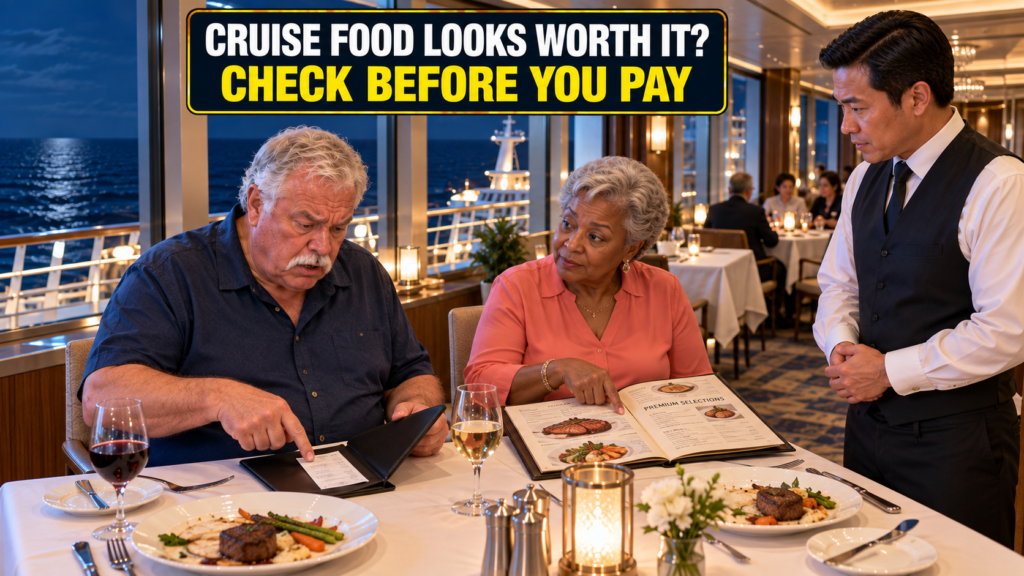
But depending on the restaurant and cruise line, the base specialty-dining charge or package may not necessarily cover every premium selection available on the menu.
A particularly expensive steak, seafood selection or other premium item may carry an additional charge.
Why it matters
This is where passengers can confuse two separate purchases.
The specialty dining charge gets you whatever that restaurant or package says it includes. A separately priced premium selection can be an additional decision.
For someone watching a vacation budget, the question isn’t whether the premium food is “good.” It’s whether the upgrade gives you enough additional value over an already-included selection.
What to ask
- Is this specific entrée included in my restaurant charge or dining package?
- Does it have an additional surcharge?
- Are there similar entrées already included?
- Is the displayed price the total additional amount?
Important limitation
Specialty-dining policies differ substantially. Do not assume every specialty restaurant has premium surcharges, and do not assume every dining package covers the same items.
Read the current menu and package terms for the restaurant you are actually visiting.
2. Premium Steak or Lobster Upgrades
A premium steak or lobster can feel like the obvious vacation splurge—especially when you’re celebrating an anniversary, birthday or long-awaited cruise.
It can also be an easy purchase to make before comparing it with what’s already available.
Why it matters
If your main dining room, specialty restaurant or package already provides an entrée you’re happy with, paying another charge solely because one option sounds more luxurious may add less value than expected.
For a couple, two upgrades can also double what initially looked like a modest splurge.
What to ask
- What steak or seafood options are already included?
- How much extra is this particular upgrade?
- Is the portion or preparation meaningfully different?
- Am I buying it because I genuinely want it—or because “premium” sounds better?
Important limitation
This is a value decision, not a recommendation to avoid steak or lobster.
For a special occasion, the upgraded entrée may be exactly where you want to spend your vacation budget. The goal is to make that choice knowingly.
3. À-La-Carte Sushi
Sushi can be deceptive from a budgeting perspective because individual prices may look small.
One roll doesn’t seem expensive. Neither does one appetizer.
Then you order several items.
Why it matters
At an à-la-carte venue, the final cost depends on how many individually priced items you select. A couple ordering multiple rolls, appetizers and drinks can spend much more than the price of any single menu item suggests.
This matters particularly when there are already included lunch or dinner options elsewhere on the ship.
What to ask
- Is this venue à la carte or covered by my dining package?
- Which items, if any, does my package include?
- What would my complete meal likely cost?
- Is there an included alternative I would enjoy just as much?
Important limitation
Some passengers specifically cruise for specialty dining and may consider premium sushi excellent value.
The potential money mistake is not eating sushi. It is ordering item after item without noticing how the pricing structure works.
4. Specialty Coffee You Assume Is Included
Morning coffee can become a daily habit almost immediately.
The complication is that “coffee is available onboard” does not necessarily mean every espresso, latte or specialty drink from every venue is included in your fare.
Why it matters
A single paid coffee may have little impact on your budget.
Buy one or two every day over a longer sailing and the total changes.
For couples, repeated purchases multiply again.
What to ask
- Which coffee is complimentary?
- Which drinks are considered specialty coffee?
- Does my beverage package include this drink?
- Is the pastry beside it included even if the coffee isn’t—or vice versa?
Important limitation
Coffee inclusions vary by cruise line, venue and beverage package.
Do not assume the coffee served in an included dining venue and a handcrafted drink from a specialty café have identical pricing.
5. Fresh-Squeezed Juice and Premium Bottled Drinks
Breakfast can look almost entirely included, which makes beverages an easy area for assumptions.
Juice may be available, but a particular fresh-squeezed product, premium bottled beverage or specialty drink can fall under different pricing.
Why it matters
The distinction matters because passengers often make beverage purchases repeatedly.
A drink that seems inexpensive once can become a meaningful expense when it turns into a seven-day routine.
What to ask
- Which breakfast beverages are included?
- Is fresh-squeezed juice treated differently?
- Does my beverage package cover this exact drink?
- Are there quantity, venue or package restrictions?
Important limitation
Never generalize from one cruise line or beverage package to another.
Check the current package terms and the price shown at the venue before ordering.
6. Room-Service Food You Could Get Elsewhere
Ordering food to your cabin can be one of the most enjoyable cruise conveniences.
Breakfast on the balcony, a quiet meal after a long port day or a late-night snack without leaving the cabin can easily justify an extra cost for some passengers.
But convenience is what you’re evaluating—not simply the food.
Why it matters
Depending on the cruise line, time of day and menu, room service may involve delivery charges, item charges or different inclusions.
Meanwhile, similar food may be available at an included venue elsewhere on the ship.
What to ask
- Is there a room-service delivery charge?
- Are individual menu items additionally priced?
- Is breakfast treated differently from later orders?
- Is similar food available at an included venue?
Important limitation
Room service can still be excellent value for passengers with mobility limitations, fatigue, a balcony they want to enjoy or simply a strong preference for privacy.
Saving money is not automatically more important than convenience.
Compare both.
7. Late-Night Food You Buy Before Checking Included Options
It’s late. You’re hungry. The buffet may be closed or operating limited hours.
The first food venue you see can suddenly look very attractive.
Before paying, check what else is still open.
Why it matters
Ships can have different late-night food options, and some may be included while others carry an additional charge.
A few minutes checking the cruise app, daily schedule or venue information can prevent paying for food simply because you didn’t know another option existed.
What to ask
- Which included venues are still open?
- Is this late-night venue complimentary or extra?
- Is room service available, and what does it cost?
- When does the next included venue close?
Important limitation
Late-night dining availability varies widely by ship.
Do not assume that every cruise has a free 24-hour food venue—or that every late-night option costs extra.
Check your sailing.
8. Prepackaged Snacks From Onboard Shops
Chips, candy, packaged snacks and similar convenience purchases can seem harmless.
But remember where you are: on a ship that may already offer substantial included food throughout the day.
Why it matters
You’re often paying for convenience, portability or a specific branded product—not because there is no food available.
That may still be worth it if you want a snack in your cabin or something specific.
The mistake is buying automatically before considering what your fare already provides.
What to ask
- Is there an included snack available nearby?
- Do I specifically want this packaged product?
- Am I buying it for convenience later?
- Can I take food from an included venue to my cabin where permitted?
Important limitation
Food-removal and food-import rules can matter, particularly when going ashore.
Do not assume that because food is available onboard you may carry it into every port. Agricultural and customs restrictions can apply at destinations.
9. Dining Packages You Don’t Use Enough
This is bigger than one meal.
A dining package can offer attractive value for someone who genuinely plans to use the covered restaurants.
But a discount isn’t valuable if you purchase more specialty dining than you actually want.
Why it matters
Passengers sometimes focus on the theoretical per-meal savings without asking a more basic question:
“How many specialty meals do I actually want on this cruise?”
If you enjoy the included dining room and buffet, buying a large package can pressure you to eat specialty meals simply because you’ve already paid for them.
What to ask
- How many meals does the package include?
- Which restaurants participate?
- Are premium menu items excluded?
- Are reservations subject to availability?
- How many specialty dinners would I buy without the package?
Important limitation
Packages and booking conditions vary by cruise line and sailing.
A package can be excellent value for one passenger and unnecessary spending for another. Compare it with your actual dining plans, not just the advertised discount.
10. Food Experiences You Book Because They Sound “Exclusive”
Chef’s-table dinners, tasting menus, culinary demonstrations and other premium experiences can be memorable parts of a cruise.
They can also carry some of the highest food-related additional charges onboard.
The word “exclusive” should therefore trigger a question—not an automatic purchase.
Why it matters
You’re often paying for more than calories.
The price may reflect service, presentation, limited seating, pairings, atmosphere or access to an experience you cannot get in the main dining room.
If those things matter to you, the experience may be worth every dollar.
If all you want is a good dinner, an included venue may already satisfy you.
What to ask
- What exactly does the experience include?
- Are beverages or pairings included?
- How long does it last?
- What is the cancellation policy?
- Is this experience meaningfully different from dining already included in my fare?
Important limitation
Do not judge premium food experiences solely by portion size.
Their value can come from the experience itself. Decide whether that experience matters to you before paying for it.
The 60-Second Check Before You Order
You don’t need to avoid every extra-charge food item to save money on a cruise.
You need to stop treating “extra” as synonymous with “better.”
Before ordering, ask four simple questions:
Is it included?
If not, exactly how much extra is it?
What included alternative do I already have?
Would I still choose this if it weren’t labeled premium?
For travelers over 60, there is another useful question: Am I paying for convenience that genuinely improves my trip?
Room service after an exhausting port day may be money well spent. A quiet specialty dinner may be one of your favorite cruise memories. A coffee you genuinely enjoy every morning may deserve a place in your budget.
Saving money doesn’t mean refusing every upgrade.
It means spending intentionally.
And that’s the real danger with cruise food purchases that “look worth it”: individually, many of them seem small. But specialty entrées, daily coffees, premium drinks, snacks and dining packages can accumulate across an entire sailing.
Check what’s included first. Compare the alternative. Then spend your cruise-food budget on the upgrades you’ll actually remember.
