
CRUISE TIP
SHOULD CRUISE LINES STRICTLY ENFORCE ADULTS-ONLY AREAS?
Sep
You finally find it.
After a loud breakfast, a crowded elevator ride, and a walk across a busy pool deck, you step into one of the quietest places on the ship: an adults-only retreat.
The loungers are peaceful. The pool is calm. Nobody is splashing beside you. Nobody is yelling across the deck.
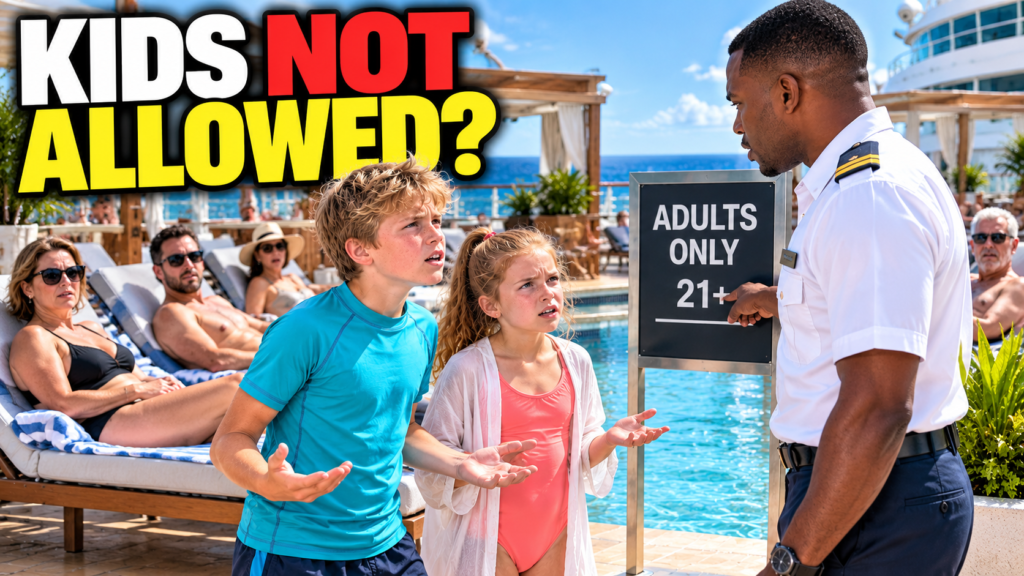
Then two kids walk in.
Within minutes, they’re standing beside the pool, talking loudly and getting ready to swim.
One passenger looks up from his lounger.
Another puts down her book.
Then a cruise employee walks over.
“Sorry, guys. This is an adults-only area.”
One of the kids points toward the nearly empty pool.
“Why can’t we stay here? The pool is EMPTY!”
The other immediately joins in.
“Yeah! We’re not bothering anyone!”
And suddenly, a simple age restriction becomes one of cruising’s most divisive questions:
If a cruise line advertises an area as adults-only, should the crew enforce that rule every single time?
For many cruisers, the answer is obvious.
For others, it is much more complicated.
Adults-Only Does Not Mean the Same Age on Every Cruise Line
Before getting into the debate, there is one important fact every cruiser should understand.
There is no single universal age that defines an “adults-only” area across the entire cruise industry.
Different cruise lines — and even different venues — can set different age restrictions.
For example, Royal Caribbean currently describes its Solarium as an adults-only retreat and lists an age restriction of 18+ for the venue.
Carnival Cruise Line uses a different threshold for its Serenity Adult-Only Retreat. Carnival’s published onboard age restrictions state that guests must be 21 or older to enter Serenity.
That distinction matters.
You should not assume that every adults-only pool, deck or retreat begins at 18.
And you definitely should not assume that the rules from one cruise line automatically apply to another.
The safest approach is simple:
Check the published rules for your specific ship and venue.
Why Do Adults-Only Cruise Areas Exist? SHOULD CRUISE LINES STRICTLY
Cruise ships are designed to serve many different types of travelers at the same time.
Families may want waterslides, splash zones, kids clubs, games and energetic pool decks.
Teenagers may have dedicated hangout spaces.
Adults may want bars, entertainment venues and quieter places to relax.
Adults-only retreats exist because some passengers specifically want an environment separated from family-oriented activity.
That does not mean children are “bad.”
It does not mean families are unwelcome on cruise ships.
It simply means different areas of the ship are designed for different experiences.
A family pool serves one purpose.
A kids club serves another.
An adults-only retreat serves another.
The controversy begins when those boundaries stop being respected.
“But The Pool Is Empty!”
That is the argument from the first child in our scenario.
“Why can’t we stay here? The pool is EMPTY!”
It sounds reasonable at first.
If nobody is using the pool, what difference could two kids possibly make?
But passengers who support strict enforcement would argue that occupancy is irrelevant.
The area is not adults-only only when it becomes crowded.
It is adults-only because the cruise line designated it that way.
Imagine reserving a quiet venue specifically because of what was advertised, only to discover that the rule changes whenever someone decides the space looks empty.
That makes the designation much less meaningful.
For passengers on this side of the debate, the question is not:
“Are the kids bothering anyone right now?”
It is:
“Is this actually an adults-only area or not?”
“We’re Not Bothering Anyone!”
The second child makes an even stronger argument:
“Yeah! We’re not bothering anyone!”
And this is where opinions can become heated.
Some passengers believe well-behaved children should occasionally be allowed to remain if they are quiet, supervised and respectful.
Others completely disagree.
Their argument is that adults-only rules should not depend on a crew member making subjective judgments about which children are quiet enough.
What happens when one family is allowed in because their children are behaving?
Does the next family get the same exception?
What happens when five families arrive?
When does the quiet retreat stop being adults-only?
Strict enforcement eliminates that ambiguity.
If the venue is 18+, guests under 18 do not use it.
If the venue is 21+, guests under 21 do not use it.
Simple.
Passengers May Have Specifically Chosen That Space
This is an important part of the debate that can get lost.
Many adults are not asking for an entire cruise ship without children.
They booked a mainstream cruise knowing families would be onboard.
They may happily eat next to families at breakfast, watch shows with children in the theater and share elevators with guests of every age.
But when the cruise line specifically provides an adults-only retreat, they expect that particular space to operate as advertised.
For some guests, that quiet hour by the pool might be one of the reasons they enjoy the ship.
Parents traveling without their children may want a break.
Couples may want a quieter afternoon.
Solo travelers may want somewhere to read.
Older passengers may simply prefer a calmer environment.
The issue is therefore less about disliking children and more about preserving the purpose of a designated venue.
But Families Paid For The Cruise Too
Then comes one of the most common objections:
“We paid to be on this ship too!”
That statement is true.
Families are paying passengers.
But paying for a cruise does not necessarily mean every guest has access to every venue at every time.
Cruise ships commonly operate spaces or activities with eligibility requirements.
Some are based on age.
Some require reservations.
Some are associated with particular accommodations or packages.
Some may carry additional charges.
So the fact that someone paid a cruise fare does not, by itself, eliminate the published conditions attached to a particular venue.
The more useful question is whether the cruise line clearly disclosed those conditions and provides appropriate alternatives.
In our scenario, there is a family pool elsewhere on the ship.
The employee is not telling the children they cannot swim anywhere.
He is telling them they cannot swim there.
That is a major difference.
What Should Cruise Staff Actually Do?
Suppose an employee discovers two children inside a clearly designated adults-only area.
The best first response does not need to be dramatic.
No shouting.
No public humiliation.
No threats.
The employee can simply explain the rule.
“Sorry, guys. This is an adults-only area.”
If the venue is 21+, the employee can clarify:
“This area is only for guests 21 and older.”
And then direct them toward an appropriate alternative, such as a family pool.
This gives the children and their parents an opportunity to comply without turning the incident into a confrontation.
In many cases, that should be the end of the story.
What Happens When The Kids Refuse?
Our fictional scenario becomes more interesting when one child responds:
“So you’re actually KICKING US OUT?”
Then the other asks:
“And what if we DON’T?”
Now the issue is no longer simply confusion about the rules.
The employee has explained the restriction, and the children are openly challenging it.
At that point, involving the parent or guardian makes sense.
The employee answers:
“Then go get your mother. I need to speak with her.”
The child responds:
“Fine! We’ll go tell MOM!”
That is a believable escalation without turning a minor pool-deck dispute into an unrealistic law-enforcement event.
The parent can then discuss the venue policy directly with crew.
Should Cruise Lines Fine Parents?
This is where social-media versions of cruise disputes often become unreliable.
A viral story might claim:
“Mom fined $500 after children entered adults-only pool!”
Or:
“Family charged $5,000 for breaking adults-only rule!”
Those numbers make excellent rage bait.
But they should not be presented as fact without an actual published policy or verified incident supporting them.
There is no universal cruise-industry fine that automatically applies whenever a child enters an adults-only area.
That is important.
Cruise lines have guest conduct policies and can respond to repeated or serious misconduct, but a specific adults-only age restriction should not automatically be transformed into a fictional monetary penalty.
If a story uses a made-up $250 or $500 charge for dramatic entertainment, it needs to be clearly understood as dramatization — not reported as an actual Carnival, Royal Caribbean or industry-wide policy.
The real debate is strong enough without inventing a fine.
Carnival Provides A Clear Real-World Example
Carnival’s Serenity Adult-Only Retreat provides a useful example because Carnival publishes a specific age requirement.
According to Carnival’s current onboard age restrictions, guests must be 21 or older to enter Serenity.
That is straightforward.
A 15-year-old may be mature.
A 17-year-old may sit quietly.
A 20-year-old may behave more calmly than some 40-year-olds.
But if the venue’s published eligibility is 21+, those arguments do not change the stated threshold.
That is precisely why clear rules can be useful.
Crew members do not need to decide whether an individual younger guest “acts adult enough.”
There is an objective age requirement.
Royal Caribbean Shows Why You Must Check The Specific Venue
Royal Caribbean demonstrates the other important lesson.
Its Solarium currently lists an age restriction of 18+.
That is different from Carnival Serenity’s 21+ threshold.
So a social-media post claiming:
“Cruise adults-only areas are legally 21+.”
would be wrong.
Likewise, saying:
“Adults-only always means 18+.”
would also be inaccurate.
There is no single number that should be copied across every ship.
Policies can differ by cruise line and venue, and travelers should verify the current rules for their sailing.
The Strongest Argument For Strict Enforcement: Consistency
If cruise lines are going to advertise adults-only areas, consistency may be the strongest argument for enforcing them.
Passengers become frustrated when they see a rule enforced one day and ignored the next.
Imagine this:
On Monday, an employee tells a family their children cannot enter.
On Tuesday, another employee ignores three children in the same space.
On Wednesday, passengers start confronting one another because nobody knows whether the rule actually matters.
That is worse for everyone.
Clear and consistent enforcement takes passengers out of the role of policing each other.
Instead of one guest shouting:
“Your kids aren’t allowed here!”
the crew handles the venue according to its published policy.
That can reduce passenger-to-passenger conflict.
The Strongest Argument Against Overly Aggressive Enforcement
Strict does not have to mean hostile.
That distinction matters.
A child might enter accidentally.
A family may misunderstand a sign.
A passenger may genuinely be unaware of the age requirement.
Immediately treating those people as deliberate rule-breakers would be unnecessary.
Good enforcement can be both consistent and courteous.
Explain the restriction.
Point out the sign.
Offer an alternative.
Give the guest a reasonable opportunity to leave.
Escalation should be reserved for situations where passengers refuse to cooperate or create a broader conduct problem.
That is very different from humiliating a family because a child walked five feet into the wrong pool deck.
Parents Have A Role Too
Cruise staff should not have to spend their entire day chasing children out of restricted spaces.
Parents and guardians have responsibilities as well.
Before the cruise, families can look at deck plans and activity information.
Once onboard, they can identify family pools, kids clubs and age-appropriate venues.
If a sign says adults-only, parents should not encourage children to ignore it because the area looks nicer or less crowded.
And perhaps most importantly, parents should not put children in the position of having to argue with crew.
If there is a disagreement about a policy, the adult should handle it.
That is why the ending of our fictional confrontation works:
“Go get your mother. I need to speak with her.”
The argument moves away from children challenging an employee and toward the responsible adult discussing the rule.
Adults-Only Spaces Can Benefit Parents Too
There is another side of this discussion that is often overlooked.
Parents can enjoy adults-only spaces.
A couple traveling with children might drop them at an age-appropriate youth program and spend an hour relaxing somewhere quieter.
Parents celebrating an anniversary might want a peaceful afternoon.
A multigenerational family might split up for a few hours, with grandparents relaxing in one area while younger family members enjoy the main pool.
Adults-only spaces are not necessarily anti-family.
They can be part of what makes a family-oriented ship work for different generations simultaneously.
Everyone does not have to do everything together all day.
What About Teenagers?
Teenagers create one of the more complicated edge cases.
A mature 17-year-old sitting quietly with a book may appear far less disruptive than a loud group of adults.
But an age restriction is not normally based on how disruptive someone looks.
If the venue is designated 18+, a 17-year-old is below that threshold.
If it is 21+, a 20-year-old is below it.
Cruise lines can certainly design different spaces for older teenagers, young adults and families.
But once a particular venue has a published age restriction, selectively ignoring it creates confusion.
Again, consistency becomes the issue.
Adults Can Ruin Adults-Only Areas Too
There is an irony worth acknowledging.
Removing children does not guarantee silence.
Adults can blast music.
Adults can shout across the pool.
Adults can become intoxicated.
Adults can save loungers for hours.
Adults can have loud conversations.
Adults can be inconsiderate.
An adults-only label is an age restriction, not a guarantee that every person inside will behave perfectly.
Cruise lines still need reasonable conduct expectations for adults.
And passengers should not use “adults-only” as an excuse to treat families elsewhere on the ship disrespectfully.
The goal is not to create a battle between adults and children.
It is to give different groups appropriate spaces.
What Cruisers Should Do Instead Of Confronting Families
Suppose you are relaxing in an adults-only retreat and notice children entering.
Should you immediately confront them?
Probably not.
The easiest approach is to notify a crew member.
Why?
Because the employee can verify the venue’s actual restriction.
The employee knows the ship’s procedures.
And most importantly, it prevents a simple policy issue from becoming a personal argument between passengers.
There is no need for:
“GET YOUR KIDS OUT OF HERE!”
when a calm conversation with crew may solve the problem in thirty seconds.
Passengers should not have to become unofficial security guards.
Cruise Lines Need To Make The Rules Obvious
Enforcement works best when signage is clear.
If an area is 18+, say 18+.
If it is 21+, say 21+.
If certain hours have different access rules, explain them.
Passengers should not need to hunt through multiple pages of an app just to discover whether their teenager can use a particular pool.
Clear signage protects everyone.
Families know where they can go.
Adults know what environment they are entering.
Crew members have something concrete to point toward when explaining the restriction.
A visible sign can prevent an argument before it begins.
So, Should Cruise Lines Strictly Enforce Adults-Only Areas?
Yes — if they are going to advertise a venue as adults-only, the published age restriction should generally be enforced consistently.
But “strictly” should not mean aggressively.
A good policy would look something like this:
Make the age requirement obvious.
Apply it consistently.
Politely inform guests who enter by mistake.
Direct families toward appropriate alternatives.
Speak with parents or guardians when children refuse to leave.
Use stronger guest-conduct procedures only when circumstances genuinely justify escalation.
That approach protects the adults-only experience without treating families like enemies.
The Question Every Cruiser Has To Answer
Return to our opening scene.
Two kids are standing beside a nearly empty adults-only pool.
They are not destroying anything.
They are not fighting.
They just want to swim.
The employee points toward the sign.
ADULTS ONLY — 21+.
The boy looks at the empty water and asks:
“Why can’t we stay here?”
And that is the entire debate in one sentence.
Should the rule bend because nobody appears to be affected at that exact moment?
Or should an adults-only area remain adults-only precisely because passengers were promised that experience?
For many cruisers, the answer is simple:
If the sign says adults-only, cruise lines should mean it.
Now the question is yours:
SHOULD CRUISE LINES STRICTLY ENFORCE ADULTS-ONLY AREAS?
