
AIRPORT TIPS
Over 60? 7 STUPID Mistakes That Could Cost You Money at the Airport
Sep
Traveling after 60 often comes with one big advantage: experience.
You know to arrive early. You know to keep your identification accessible. You know that airports can be unpredictable.
But there is another kind of airport mistake that can catch even experienced travelers.
It happens when you assume something about the price before asking.
And sometimes, you do not discover the mistake until the bill is already sitting in front of you.
“WAIT—I’M PAYING FOR ALL OF THIS?”
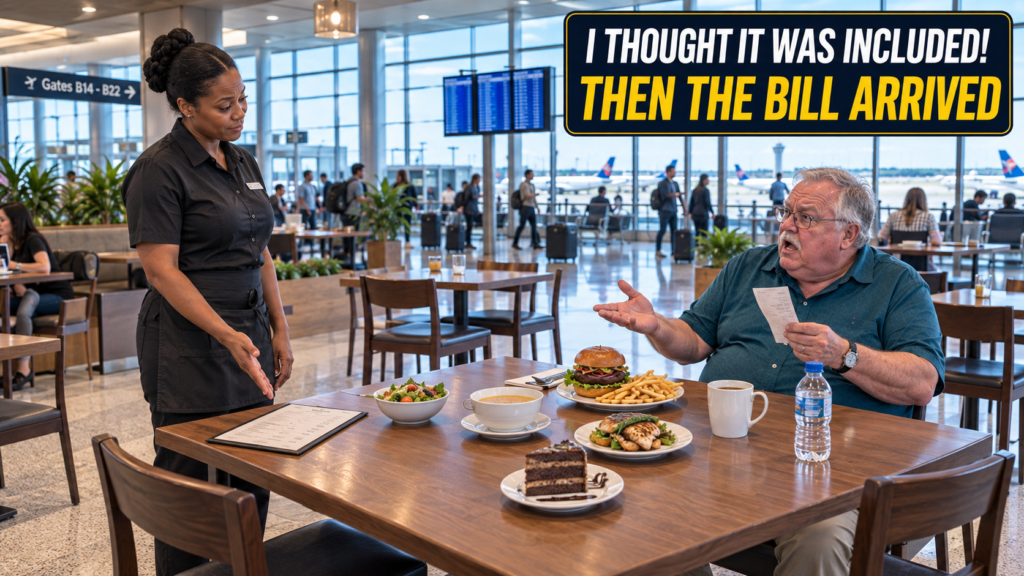
Imagine a 72-year-old traveler sitting inside an airport restaurant before his flight.
He has plenty of time, so he decides to have a proper meal.
First comes a burger and fries.
Then another sandwich.
Soup.
A side salad.
Coffee.
Water.
And finally, dessert.
By the time everything arrives, his table looks more like dinner for a small group than a quick airport meal.
He seems perfectly happy with that.
Then the server places the bill on the table.
His expression changes immediately.
He reads it once.
Then again.
Then he looks across all the food.
“Wait—I’m paying for all of this? I thought it was included!”
The employee remains calm.
“These were separate orders, sir. The prices are listed on the menu.”
Now he is irritated.
“Nobody told me I’d be charged for every single thing!”
Except there is one problem.
The prices were available before he ordered.
He simply never checked.
That is what makes this such a useful travel lesson.
The expensive mistake did not happen when the bill arrived.
It happened when he made an assumption before ordering.
And food is far from the only place where that can happen.
Here are seven mistakes that could leave travelers spending money they never expected to spend.

#7 — Paying an Overweight Bag Charge Before Checking Your Options
The suitcase goes onto the scale.
The number appears.
Then you hear the words you did not want to hear:
Your bag is overweight.
For some passengers, the immediate reaction is to reach for a credit card.
But before paying, make sure you understand what options actually apply to your baggage and booking.
Airline baggage allowances and charges can vary based on the carrier, route, fare, cabin, loyalty benefits and other factors.
That means there is no single solution that works for every passenger.
Depending on the circumstances and applicable baggage rules, you might be able to reorganize your belongings or use another permitted baggage option.
Or the charge may indeed be the appropriate option.
The point is not to argue with the employee about a legitimate fee.
The point is to avoid assuming that you understand all your choices before you have even asked.
A better question is:
“What options do I have with this bag before I pay the charge?”
Then listen to the answer before opening your wallet.
#6 — Paying for a Seat Without Checking What You Already Bought
Seat selection can become surprisingly confusing.
A traveler sees a seat map during booking or while managing a reservation.
There is an aisle seat available.
Perfect.
They click it.
Then comes an additional price.
Some travelers pay immediately because they assume choosing any specific seat must cost extra.
Others make the opposite mistake and assume seat selection must be included.
Neither assumption is particularly useful.
What matters is your actual fare and the specific seat you are selecting.
Before paying, check what your booking already includes.
A particular seat may have different conditions or pricing from another seat, and airline policies vary.
Also ask yourself whether the paid option is actually valuable to you.
If you strongly prefer an aisle seat because getting up is easier, paying for a particular seat might be worthwhile.
But make that decision knowingly.
Do not confuse “available to select” with “included at no additional charge.”

#5 — Buying Airport Extras Without Checking the Price First
Now we return to our hungry traveler and his enormous meal.
His mistake sounds ridiculous when viewed from the outside.
How could someone order that much food without checking what it costs?
Yet travelers make smaller versions of this mistake all the time.
They assume.
Maybe they assume a drink comes with something else.
Maybe they think an item or service is included with access they already purchased.
Maybe they see something convenient and say yes before checking the price.
The safest solution is remarkably simple.
Ask first.
“Is this included, or is there an extra charge?”
Or:
“How much is this before I order it?”
This becomes especially important anywhere the distinction between included and separately charged items may not be obvious to you.
Do not assume something is complimentary because nobody immediately asks you for payment.
And do not assume something costs extra when you have not checked either.
Look at the menu, posted price or applicable terms.
Ask when you are uncertain.
The goal is not to avoid spending money.
It is to know what you are agreeing to before you agree to it.
Our hungry passenger could have avoided his entire argument with a few seconds of checking.
Instead, the bill became the first moment when he seriously thought about the price.
That is too late.

#4 — Missing an Important Flight Update Because You Stopped Checking
You arrived early.
You cleared security.
You found the gate listed on your information.
You sit down, relax and stop paying attention.
That can be a mistake.
Flight information can change.
One important example is a gate change.
If you continue waiting based only on information you saw earlier, you could eventually discover that other passengers are boarding somewhere else.
At best, you get an unexpected walk through the terminal.
At worst, failing to keep track of relevant flight information could contribute to a missed boarding situation.
And once a trip is disrupted, costs can become complicated.
Do not assume that every missed flight automatically means you must buy an entirely new ticket.
But do not assume every situation will be solved for free either.
What happens next can depend on why the problem occurred, your ticket, the airline and the specific circumstances.
The easier strategy is prevention.
Continue checking your flight information as departure approaches, and pay attention to relevant announcements and airline updates.
Finding your gate once does not mean you never need to check again.
#3 — Buying Something Your Booking May Already Include
Here is another easy way to spend unnecessarily.
You see an option during your trip and purchase it without first reviewing what you already bought.
Perhaps you have forgotten the details of your fare.
Perhaps someone else made the original reservation.
Perhaps the booking was made months ago.
Before purchasing an additional travel service, take a moment to review your reservation and relevant benefits.
Depending on your booking, some things may already be included while others may require an additional payment.
There is no universal list that applies to every ticket.
That is exactly why checking matters.
Look at your confirmation.
Look at the fare conditions that apply to your reservation.
If something remains unclear, ask.
The question is:
“Does my booking already include this?”
Five seconds spent checking can be much easier than trying to untangle an unnecessary purchase afterward.
#2 — Assuming an “Upgrade Offer” Automatically Means a Great Deal
There is something psychologically powerful about the word:
UPGRADE.
It sounds better.
More comfortable.
More exclusive.
And when the offer looks temporary, passengers may feel pressure to act quickly.
But an upgrade being available does not automatically mean it is a bargain.
Nor does it mean it is a bad deal.
You need another piece of information:
What exactly are you getting for the additional money?
Maybe the offer provides something you genuinely value.
Maybe it does not.
Look at the actual benefits that apply to the offer.
That could include differences in seating, space, baggage, onboard service, flexibility or other features, depending on the airline and product involved.
Then compare those benefits with the additional price.
For one traveler, extra comfort might easily justify the cost.
For another, it might add little value.
The mistake is not purchasing an upgrade.
The mistake is purchasing the word “upgrade” without understanding what the word buys you.
#1 — Paying First Because You Think You Have No Other Choice
This may be the most expensive assumption on the list.
Something goes wrong.
Perhaps there is a baggage issue.
Perhaps something about your reservation is not what you expected.
Perhaps your travel plans have been disrupted.
You become stressed.
And stress encourages quick decisions.
So you tell yourself:
“I guess I just have to pay.”
Sometimes paying may indeed be the option you choose.
But when circumstances and time allow, ask what alternatives are available before assuming the most expensive-looking solution is your only choice.
Try:
“What options are available to me?”
Or:
“Before I pay for this, is there another option?”
This is not a magic phrase that makes charges disappear.
It does not mean an airline, airport or restaurant must provide something for free.
Available options can depend on the provider, ticket, circumstances and reason for the problem.
But asking gives you information.
And information is much more useful before you make a purchase than afterward.
5 QUESTIONS WORTH ASKING BEFORE YOU SPEND
There is a pattern running through all seven mistakes.
The passenger assumes.
They assume the bag charge is their only choice.
They assume a seat is included—or assume it is not.
They assume the food is complimentary.
They assume an upgrade must be a bargain.
They assume they have no other option.
Instead, make these five questions part of your travel vocabulary:
1. “Is this included, or is there an extra charge?”
2. “What does my fare already include?”
3. “What options do I have before I pay this fee?”
4. “What exactly do I get with this upgrade?”
5. “Can you show me the price before I agree?”
You do not need to ask all five every time you spend money.
The habit that matters is simple:
Know what you are buying before you buy it.
THE ARGUMENT THAT NEVER NEEDED TO HAPPEN
Back at the airport restaurant, our traveler is still staring at his bill.
The burger is still there.
So are the fries, soup, sandwich, salad, dessert, coffee and water.
The employee has already explained that they were separate orders and that the prices were listed.
He can continue arguing.
But arguing does not change the mistake that happened several minutes earlier.
He ordered first.
He checked later.
That same sequence can cause trouble with far more than airport food.
When you are dealing with baggage, seats, upgrades or other travel purchases, reverse the order.
Check first.
Ask second.
Understand what you are getting.
Then decide whether to pay.
Because at an airport, one question asked before you agree can be worth far more than an argument after the bill arrives.
