
CRUISE TIP
7 magor reasons to choose buffet freedom over main dining room
Sep
For many cruise passengers, dinner in the Main Dining Room is part of the classic cruise experience. You dress up, sit at a beautifully prepared table, order from a menu, and let the servers take care of everything.
But not every cruiser wants every meal to work that way.
Sometimes you have a show starting soon. Sometimes the pool is too good to leave. Sometimes everyone in your family wants something different. And sometimes you simply don’t want dinner to become the main event of your evening.
That’s when the cruise buffet can become one of the most useful places on the entire ship.
Modern cruise buffets are not necessarily just emergency alternatives for passengers who missed dinner. Depending on the ship, they can offer international dishes, salads, desserts, carving stations, made-to-order selections, casual seating, and service across multiple meals.
More importantly, they give passengers something that can be extremely valuable on vacation:
Freedom.
Freedom to choose what you want.
Freedom to eat at your own pace.
And freedom to get back to enjoying the ship when you’re ready.
The Main Dining Room still has plenty of advantages, and many passengers love it. But if flexibility matters more to you than a traditional sit-down experience, here are 12 major reasons you might find yourself choosing buffet freedom more often on your next cruise.
1. You Control the Pace of Your Meal
This may be the biggest reason some passengers prefer the buffet.
In a Main Dining Room, dinner is usually structured around table service. You are seated, menus are presented, orders are taken, dishes are prepared and delivered, plates are cleared, and additional courses follow.
That’s part of the experience.
On an evening when you want a relaxed dinner, it can be wonderful.
But what happens when your evening isn’t relaxed?
Imagine that you’ve booked a show and realize you don’t have much time before it begins.
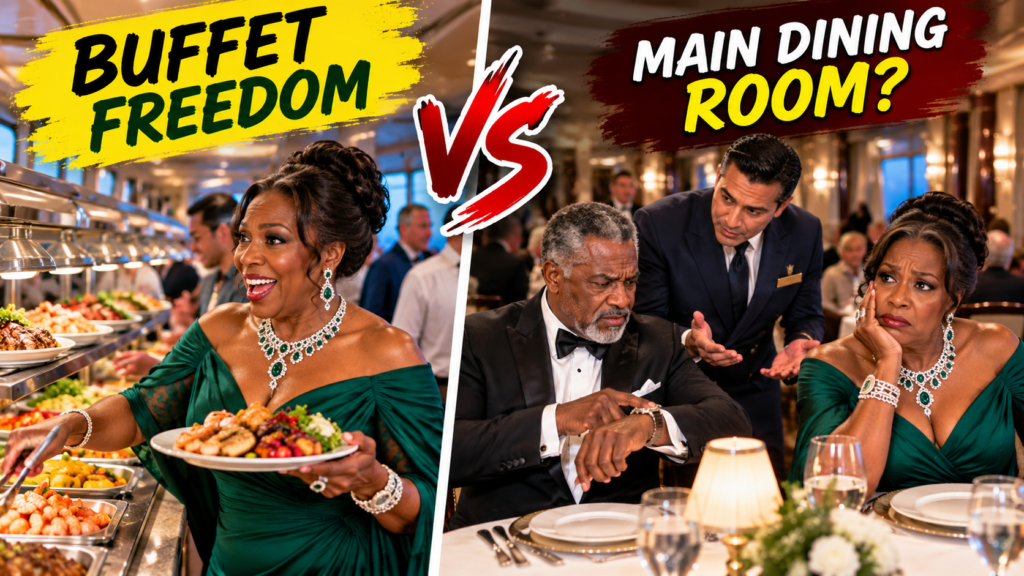
You’re sitting at the table checking your watch.
Your spouse is getting frustrated.
You don’t necessarily want to rush the dining-room staff, but you also don’t want to spend your evening worrying about whether dessert will arrive before you need to leave.
At the buffet, the dynamic changes.
You select your food, sit down, eat, and decide when you’re finished.
If you want to spend an hour enjoying dinner, you can.
If you only want a relatively quick meal before your next activity, the buffet may fit that particular evening much better.
That doesn’t mean buffet dining is always faster. Crowds, queues, ship design, and meal periods can all affect timing.
The advantage is control over your own pace.
For passengers who dislike building their evening around dinner service, that freedom can be extremely valuable.
2. You Can See the Food Before You Choose It
A menu requires imagination.
A buffet gives you a preview.
That’s a surprisingly important difference.
You can walk past the available dishes and see what appeals to you before putting anything on your plate.
Maybe the pasta looks better than you expected.
Maybe you suddenly want a salad.
Maybe you see a side dish you would never have ordered from a menu.
Or perhaps something that sounded appealing when described doesn’t look like what you want tonight.
Royal Caribbean describes Windjammer Marketplace as its main self-service buffet, while cruise lines such as Carnival and Princess similarly promote buffet venues featuring numerous categories of food.
For an indecisive eater, visually seeing the choices can make dinner easier.
It’s also useful for people who don’t want to commit to one culinary direction before they know what is available.
At a buffet, your eyes can help make the decision.
3. Everyone Can Eat Something Different
This advantage becomes especially noticeable when you’re traveling with a group.
One person wants pasta.
Another wants meat.
Someone else wants salad.
A teenager wants something familiar.
Another passenger wants to experiment with something completely different.
Getting everyone to agree on dinner can become an event by itself.
Buffet venues are designed around variety.
Carnival’s Lido Marketplace, for example, promotes a range of options that can include deli selections, salads and various food stations. Princess’s World Fresh Marketplace highlights international dishes, salads, meats, poultry, desserts and regional selections.
Specific offerings vary by ship and itinerary, but the basic buffet concept makes mixed preferences easier to manage.
Nobody necessarily has to convince everyone else to eat what they want.
Each person can build a different plate.
For families and groups with dramatically different tastes, that can remove a surprising amount of friction from a meal.
4. You Can Sample Several Foods Without Building Your Meal Around One Entrée
One of the pleasures of cruising is trying food you might not normally order at home.
The buffet makes experimentation particularly easy.
Suppose three dishes look interesting.
You don’t necessarily need to make one of them the centerpiece of dinner.
You can take a small portion of each.
If you love one, you can return for more.
If something isn’t for you, you haven’t structured your entire meal around it.
This is particularly appealing when a buffet includes regional or international dishes that passengers haven’t tried before.
It can turn dinner into exploration.
A little pasta.
A small serving of something unfamiliar.
A salad.
A carving-station selection.
A dessert you weren’t planning to eat until you walked past it.
The ability to create an unconventional plate is part of what makes buffet dining feel so unrestricted.
5. You Don’t Have to Make Dinner the Center of Your Evening
There are nights when dinner should be the event.
Formal or elegant evenings are an obvious example.
You dress up, enjoy the atmosphere, order multiple courses, talk with your companions, and let the meal unfold slowly.
But cruise ships have a lot competing for your time.
Production shows.
Comedy.
Live music.
Trivia.
Deck parties.
Casinos.
Sunsets.
Movies.
Bars and lounges.
Activities with limited schedules.
You may discover that spending a substantial portion of your evening on a formal meal isn’t what you want that particular night.
The buffet gives you another option.
Eat first.
Then get back to the ship.
For cruisers who prioritize entertainment and activities, that flexibility can completely change how an evening feels.
Instead of thinking, “What can we fit around dinner?”
You can think, “Where does dinner fit into what we want to do?”
That’s buffet freedom.
6. The Atmosphere Is Usually More Casual
Sometimes you simply don’t want another formal-feeling meal.
You’ve spent the day swimming.
You’ve been walking around a port for six hours.
You’re tired.
You want food, not an event.
Buffet venues generally provide a more casual dining environment than the traditional Main Dining Room experience.
Princess, for example, classifies World Fresh Marketplace as a casual dining option.
That difference matters.
The Main Dining Room can provide attentive service and an elegant atmosphere, which is exactly what many cruisers want.
The buffet serves a different purpose.
You can often make the meal as simple as you want it to be.
Get your food.
Find a table.
Enjoy the view.
Move on with your vacation.
There is value in both styles.
The advantage of having both onboard is that you don’t need to choose one philosophy for the entire cruise.
7. Going Back for Something Else Is Easy
Have you ever ordered something and immediately noticed another person’s meal looked better?
Buffet dining reduces that problem.
You aren’t necessarily locked into your first decision.
If you finish something and decide you want a little more, you can return to the available selections.
If your first plate was savory and you suddenly want fruit or dessert, you can change direction.
If you discover a dish you really enjoy, you may be able to have another portion while it remains available.
The key word again is freedom.
However, passengers should still avoid waste.
Buffet freedom doesn’t mean piling enormous quantities of food onto a plate just because it’s available.
Take reasonable portions.
Try them.
Return for more if you actually want more.
That approach gives you the flexibility of a buffet without unnecessarily wasting food.
8. Breakfast, Lunch and Dinner Can Feel Simpler
The buffet isn’t just about dinner.
On many cruise ships, buffet venues operate across multiple meal periods.
Carnival’s Lido Marketplace lists breakfast, lunch and dinner service. Norwegian’s Garden Café is similarly positioned as a buffet option across major meals, while Princess promotes World Fresh Marketplace for breakfast, lunch, dinner and, depending on the venue and schedule, later food options.
This makes the buffet one of the easiest dining venues for passengers to understand.
Wake up hungry?
Buffet.
Come back from a morning activity and want lunch?
Buffet.
Don’t feel like a sit-down dinner?
Buffet again.
Of course, actual opening hours and food offerings vary by ship and itinerary, so passengers should always check the daily schedule.
But having one familiar casual venue available across different parts of the day can make dining feel much less complicated.
That’s particularly useful on your first day aboard when you’re still figuring out where everything is.
9. Made-to-Order Stations Can Add More Choice Than People Expect
Some passengers hear the word “buffet” and imagine trays of identical food sitting under heat lamps.
Modern cruise buffets can be more varied than that stereotype suggests.
Norwegian Cruise Line, for example, describes buffet offerings that can include made-to-order omelets and pasta along with carving stations.
Other cruise ships may offer different live or made-to-order stations depending on the vessel and meal period.
This is why it’s worth walking through the entire buffet before filling your plate.
A common cruise mistake is grabbing the first familiar food you see.
Then you reach the other side and discover the station you actually wanted.
Take a quick lap first.
Look at what’s available.
Then decide.
The specific stations will vary, but that variety is part of the buffet’s appeal.
10. It Can Be Easier for Families With Different Schedules
Family cruising introduces another challenge:
Not everyone gets hungry at the same time.
Maybe the children want to eat before an evening activity.
Maybe one parent wants to stay by the pool longer.
Maybe someone came back late from an excursion.
Maybe one member of the family wants to attend an event while everyone else is ready for dinner.
A traditional sit-down meal works beautifully when everyone wants to eat together.
But when schedules begin pulling people in different directions, a flexible dining venue can be easier.
The buffet allows family members to build meals around the day’s activities rather than requiring every meal to become a coordinated event.
This can also reduce pressure on parents.
A child who wants a familiar food may find something straightforward, while adults can explore other options.
Everyone can still sit together.
They simply don’t have to eat exactly the same way.
11. You Can Decide at the Last Minute
Cruise days don’t always go according to plan.
Maybe you expected to be hungry at 6:00 p.m. but had a late lunch.
Maybe an afternoon nap lasted longer than expected.
Maybe you met new friends at the pool.
Maybe you discovered live music you didn’t want to leave.
Or maybe you walked back into your cabin after a long port day and suddenly decided:
There is absolutely no way I’m turning dinner into a production tonight.
That’s where casual buffet dining shines.
It gives passengers another layer of flexibility when their plans change.
This point does require an important clarification.
Modern Main Dining Room systems can also be flexible.
Royal Caribbean offers My Time Dining in addition to traditional dining arrangements. Princess has introduced flexible dining approaches that can include traditional, reservable, and walk-in options. Norwegian is particularly known for its Freestyle Dining concept without traditional fixed dining times or pre-assigned seating.
So it would be inaccurate to say:
“The buffet is flexible and the Main Dining Room isn’t.”
The real difference is the style of flexibility.
A buffet typically gives passengers direct control over selecting food and pacing the meal.
Flexible MDR programs give passengers more control over when they enjoy a traditional table-service experience.
Those are not the same thing.
And different passengers will prefer different versions of freedom.
12. Sometimes You Just Don’t Want Table Service
This may be the simplest reason of all.
There doesn’t have to be a problem with the Main Dining Room.
The food doesn’t have to be bad.
The service doesn’t have to be slow.
You don’t need to dislike dressing up.
You may simply wake up one day and decide you don’t want a sit-down meal tonight.
That’s enough.
A cruise vacation is supposed to offer choices.
For one passenger, the perfect evening might include dressing beautifully, ordering several courses, enjoying wine, and spending a relaxed evening in the Main Dining Room.
For another, the perfect evening might be grabbing exactly what looks good at the buffet, eating while looking at the ocean, and heading straight to a show.
And the same passenger may want both experiences on different nights.
That may actually be the strongest argument for buffet freedom.
You don’t have to commit to it.
You just have to know it’s there when you want it.
Buffet vs Main Dining Room: Which Is Actually Better?
Neither option is universally better.
They provide different experiences.
The Main Dining Room is attractive when you want table service, a more structured meal, multiple courses, attentive service, and a traditional cruise-dining atmosphere.
The buffet is attractive when you prioritize flexibility, visual choice, variety, casual dining, and greater control over your meal’s pace.
Your preference can even change from day to day.
After a relaxing sea day, you might look forward to dressing up for the Main Dining Room.
After spending eight hours exploring a port, the idea of immediately sitting through a leisurely dinner may be less appealing.
Use the venue that fits the day you’re actually having—not the vacation schedule you imagined before boarding.
Is the Cruise Buffet Always Faster Than the Main Dining Room?
No.
This is an important misconception.
A buffet gives you more direct control over the process, but that does not guarantee a faster meal.
At peak times, the buffet can be crowded.
Popular stations may develop queues.
Finding a table may take time.
The ship’s layout can also affect how quickly you get your food.
Meanwhile, a Main Dining Room may provide efficient service depending on the ship, time and passenger load.
So the more accurate benefit is not:
“Buffets are always faster.”
It’s:
“Buffets can give you more control over how long you choose to spend eating.”
That distinction matters.
Do You Have to Eat in the Main Dining Room on a Cruise?
Generally, no.
Cruise ships typically offer multiple dining venues, and passengers can choose among available options subject to each venue’s schedule, capacity, reservation requirements and whether it carries an additional charge.
If you have traditional dining arrangements, that doesn’t necessarily mean you must eat in the Main Dining Room every evening.
You might choose the buffet one night, a specialty restaurant another night, and return to the Main Dining Room later.
Check your specific cruise line’s current dining arrangements because policies and systems vary.
Is the Cruise Buffet Included in Your Fare?
On many mainstream cruise lines, the primary buffet venue is included in the cruise fare.
Royal Caribbean identifies Windjammer as its main self-service buffet. Carnival’s Lido Marketplace and Princess’s World Fresh Marketplace are likewise core casual dining venues, while Norwegian promotes complimentary dining that includes buffet options.
However, not every food venue aboard a ship is complimentary.
Ships may contain specialty restaurants and other dining experiences that cost extra.
Always check the information for your specific vessel rather than assuming every restaurant is included.
Can You Eat Both Buffet and Main Dining Room on the Same Cruise?
Absolutely—and that’s often the best way to approach cruise dining.
This isn’t a competition where passengers have to join Team Buffet or Team Main Dining Room.
Use both.
Try the Main Dining Room when you want a traditional sit-down meal.
Use the buffet when your schedule is packed.
Try specialty dining if something interests you.
Grab casual food when you want simplicity.
One of the benefits of cruising is having several dining styles within walking distance of your cabin.
There’s little reason to limit yourself unnecessarily.
When Does the Main Dining Room Make More Sense?
Buffet freedom isn’t automatically the right choice.
There are plenty of occasions when the Main Dining Room may be exactly what you want.
Choose it when you want to slow down.
Choose it when the meal itself is part of your evening e
