
AIRPORT TIPS
Over 60? 12 Customs & Immigration Questions At Airport You May MISS in 2026
Sep
You have landed the airport after a long international flight.
You collect your belongings, follow the signs toward U.S. Customs and immigration, and eventually find yourself standing in front of an officer.
Your passport is ready. Your hotel is booked. You know why you came to the United States.
Then the questions begin.
For many travelers over 60, this part of an international trip can feel more stressful than the flight itself. The officer may ask something that seems surprisingly simple: Why are you here? Where are you staying? How long will you stay? Are you carrying food?
The key is not memorizing a perfect script.
There is no universal list of 12 questions that every traveler will receive. What an officer asks can depend on your immigration status, documents, itinerary, declarations and circumstances.
What you can do is arrive prepared to answer common questions clearly and truthfully.
Here are 12 subjects worth reviewing before your next arrival in the United States.
1. “What Is the Purpose of Your Trip?”
This can be one of the most straightforward questions you hear.
If you’re visiting for tourism, say tourism.
If you’re visiting relatives, explain that.
If you’re traveling for an eligible business purpose, your answer should accurately reflect that purpose.
The mistake is thinking you need to invent a sophisticated answer that sounds more convincing.
You don’t.
Your explanation should match the actual reason for your trip and the immigration category under which you are seeking admission.
For example, the State Department identifies tourism, vacations and visits with friends or relatives among activities associated with B-2 visitor travel. Certain business activities fall under B-1.
Employment and permanent residence are different matters and are not permitted merely because someone holds an ordinary visitor visa.
So before landing, ask yourself a simple question:
Could I explain the purpose of this trip in one clear sentence?
If the answer is yes, you’re already better prepared.
2. “How Long Will You Stay?”
Know your itinerary.
If you’re planning to stay for 12 days, you should know that.
If you’re returning home on October 18, know the date.
You don’t necessarily need to memorize every reservation number, but you should understand the basic timeline of your own trip.
There’s also an important immigration distinction that travelers sometimes misunderstand.
The expiration date printed on a U.S. visa is not the same thing as the amount of time you’re authorized to remain in the United States after admission.
A visa generally allows a foreign traveler to travel to a U.S. port of entry and request admission. The CBP officer at the port of entry determines whether the traveler is admitted and the authorized period of stay.
That’s why saying, “My visa is valid for five more years, so I can stay for five years,” would reflect a misunderstanding.
Know the difference between visa validity and authorized stay.
And know when your actual trip is supposed to end.
3. “Where Will You Be Staying?”
This is another question that shouldn’t require a complicated answer.
Know the name of your hotel, the address of the family member you’re visiting, or your primary destination.
The problem is that international travel can be tiring.
After a long flight, an address you thought you’d remember perfectly can suddenly disappear from your mind.
For travelers over 60, there’s an easy solution:
Keep your first-night accommodation information accessible.
Don’t bury the only copy deep inside a suitcase.
Save it on your phone and consider keeping a simple offline or paper backup containing your hotel name, destination and other essential itinerary details.
You don’t need to carry an enormous folder of travel paperwork just to answer a simple question.
You do need to know where you’re going.
4. “Who Are You Traveling With?”
Maybe you’re traveling with your spouse.
Maybe your adult children are arriving separately.
Maybe you’re joining a cruise, tour or family gathering after entering the country.
Answer according to what is actually happening.
Don’t worry about making your answer sound impressive.
And don’t unnecessarily complicate a simple question.
If you’re traveling with your wife, “I’m traveling with my wife” may be all that’s needed unless the officer asks for more information.
The same principle applies throughout the inspection process:
Listen to the question first.
Answer the question truthfully.
Then allow the officer to decide whether more detail is needed.
5. “Have You Visited the United States Before?”
Frequent international travelers sometimes have years of previous trips behind them.
That can make dates difficult to remember.
Before traveling, review your recent travel history if necessary so you aren’t trying to reconstruct it while standing at inspection.
But don’t turn uncertainty into a guess presented as fact.
If you genuinely don’t remember an old date exactly, say that you don’t remember the exact date rather than confidently inventing one.
There’s a broader lesson here.
Customs and immigration preparation should not be about memorizing fake answers.
It’s about understanding your own travel history and itinerary well enough to communicate accurately.
6. “Which Countries Did You Visit Before Arriving?”
International travelers sometimes assume Customs is interested only in the country where their flight originated.
Your broader trip can also matter.
Perhaps you spent a week in Italy, then three days in France before flying to the United States.
Or maybe you’re arriving after a multi-country cruise.
Keep track of where you’ve actually been.
U.S. customs declaration materials include questions about countries visited on the current trip before U.S. arrival.
Agricultural questions can also make recent travel relevant, including whether a traveler has been on a farm, ranch or pasture or has been in close proximity to livestock.
For an older traveler taking a long international vacation, this is another reason to keep a simple itinerary.
You don’t need to turn it into homework.
Just know your trip.
7. “When Are You Leaving?” or “What Are Your Travel Plans?”
Temporary visitors should understand their travel plans.
You may be asked about your departure or what you intend to do while in the United States.
Have a clear understanding of your planned return or onward travel.
Again, this isn’t about memorizing a magic sentence.
Your answer should reflect reality.
If you’re staying in Florida for six nights before boarding a cruise and then flying home, explain that if asked.
If you’re visiting your daughter for two weeks, say that.
If your plans are genuinely flexible, don’t invent a reservation that doesn’t exist.
One important point for visitors is that visa validity and authorized stay are different.
If admitted, the period you’re authorized to remain in the country—not simply the visa expiration date—is what matters for how long you may stay.
8. “Who Is Paying for Your Trip?”
International travel can be expensive.
Some travelers pay for everything themselves.
Some couples share expenses.
An adult child may pay for a parent’s trip.
A family member in the United States may provide accommodation.
If you’re asked who is paying, explain the actual arrangement.
Don’t assume there is one answer that automatically sounds “better.”
If your daughter bought your ticket, don’t say you bought it because you think that sounds more independent.
If you’re paying for your own vacation, say so.
Depending on the travel and visa context, financial ability and the temporary nature of the trip can be relevant.
The safest preparation is not creating a story.
It’s knowing the facts of your own trip.
9. “Are You Bringing Any Food or Agricultural Products?”
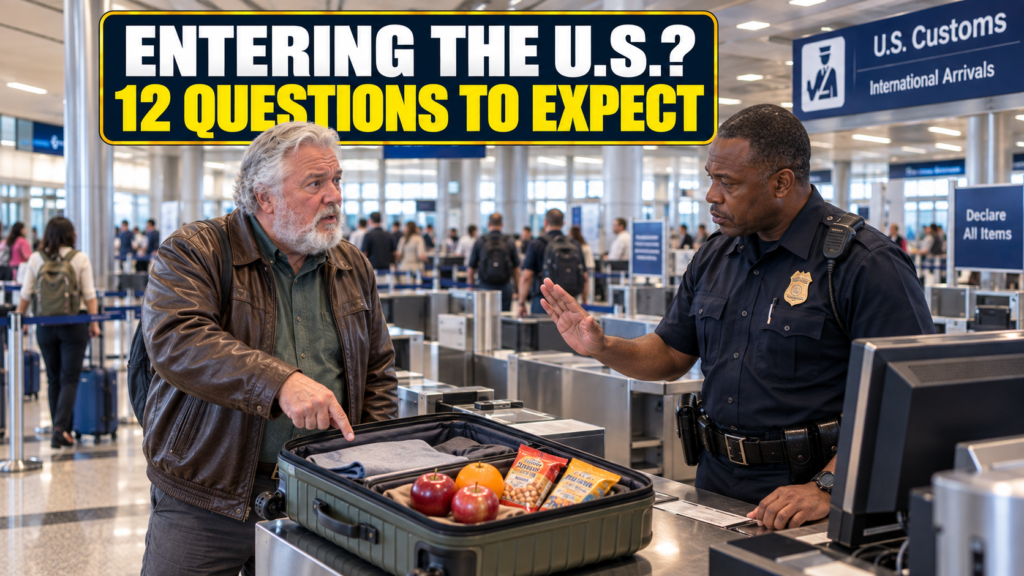
This is where our 70-year-old traveler made his mistake.
His carry-on was open on the inspection counter.
Inside were two apples, an orange and a few packaged snacks.
The officer looked at the food.
“Sir, did you declare all the food in your bag?”
The traveler hesitated.
“No. I thought snacks and fruit didn’t need declaring.”
That assumption is exactly what you want to avoid.
U.S. Customs declaration materials specifically address agricultural and food-related items, including fruits, vegetables, plants, seeds, food and animal products.
That doesn’t mean every food item is automatically prohibited.
The important distinction is between declaring an item and whether that particular item is admissible.
Don’t decide for yourself that something is “too small to count.”
Don’t hide an apple because you don’t want to lose it.
And don’t assume that something being commercially packaged automatically resolves every Customs or agriculture question.
If an item falls within something you’re required to declare, declare it.
Then allow the appropriate officials to determine whether it can enter.
That approach is much safer than guessing.
10. “Are You Carrying More Than $10,000?”
This question generates one of the biggest Customs myths.
Some travelers hear “$10,000” and conclude that bringing more than that amount into the United States must be illegal.
That’s not the basic rule.
CBP Form 6059B asks whether a traveler is carrying currency or monetary instruments over $10,000 U.S. or the foreign equivalent.
The important issue is reporting.
So don’t try to “solve” the question by hiding cash in different bags or dividing money among luggage because you assume the amount itself is forbidden.
And remember that “monetary instruments” can be broader than the physical U.S. dollar bills people usually imagine when they hear this question.
If you’re traveling with a substantial amount of currency or monetary instruments, check the current reporting requirements before departure.
This is particularly important for couples and families because the applicable reporting rules can involve how funds are transported together.
The takeaway is simple:
Don’t confuse a reporting threshold with a blanket prohibition.
11. “Are You Bringing Anything That Will Stay in the United States?”
Imagine you’re visiting your grandchildren.
Your suitcase contains gifts.
Or perhaps you’re carrying products, samples or other goods connected with business activity.
Customs is not concerned only with the clothes and toiletries you plan to take home again.
CBP declaration materials distinguish between personal effects and commercial merchandise and ask visitors about the value of articles that will remain in the United States.
That means you should understand what’s actually in your luggage.
If you’re carrying gifts for relatives, know what they are.
If someone asked you to transport an item for them, know what you’re carrying before you agree.
Never let another person place an unknown object in your luggage simply because they say, “It’s nothing important.”
You are the traveler presenting that baggage at the border.
Know what’s inside it.
12. “What Exactly Are You Bringing Into the United States?”
This final question ties everything together.
Food.
Agricultural products.
Currency.
Gifts.
Commercial merchandise.
Personal belongings.
The worst strategy is trying to predict which answer will make the inspection end fastest.
The better strategy is knowing what you’re carrying and making truthful declarations where required.
Customs declaration forms themselves emphasize truthful declaration.
If you’re uncertain whether an item needs to be declared, don’t turn uncertainty into concealment.
Ask.
Declare when required and allow Customs or the relevant agricultural specialist to determine what happens next.
That doesn’t guarantee every item can enter the United States.
It does mean you aren’t making a border decision based on a travel myth you saw online.
What Travelers Over 60 Should Prepare Before Landing
You don’t need to memorize a 12-question interrogation script.
Instead, spend a few minutes reviewing the information you already have.
Know why you’re traveling.
Know roughly how long you’re staying.
Know your first destination and accommodation.
Know who you’re traveling with.
Know your return or onward plan.
Know what’s inside your luggage.
Pay particular attention to food, agricultural products, substantial amounts of currency or monetary instruments, gifts and anything you’re carrying for another person.
Keep important travel information accessible rather than buried at the bottom of a suitcase.
Most importantly, don’t try to manufacture the “right” answer.
Customs and immigration inspection is not a trivia contest.
A short, truthful answer based on your actual trip is far more useful than a complicated answer you memorized from someone else’s experience.
And remember one final distinction that can prevent a major misunderstanding:
Having a valid visa does not itself guarantee admission into the United States.
The visa generally allows you to travel to a U.S. port of entry and request admission. CBP officials at the port of entry have authority over the admission decision, and if admitted, the authorized period of stay is separate from the visa’s expiration date.
So before your next international flight, don’t spend your time trying to memorize “secret” answers.
Know your trip.
Know your luggage.
Know what you’re declaring.
And when you don’t know whether something counts, don’t guess.
