
AIRPORT TIPS
Over 60? 8 Airport SECRETS No One Tells You About!
Sep
Airports have their own strange rhythm.
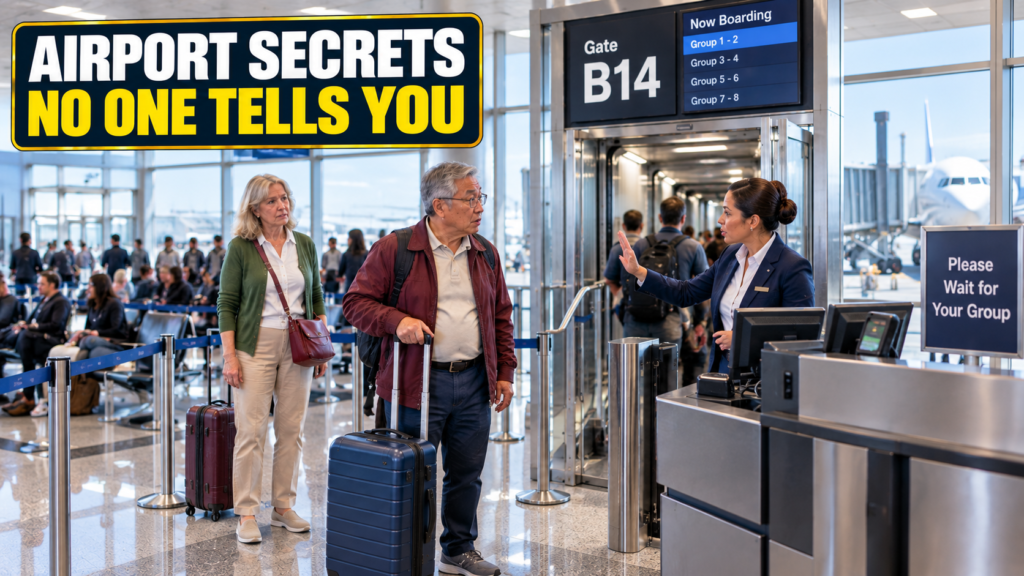
One minute, everyone is sitting quietly at the gate. The next, half the waiting area suddenly stands up—even though boarding has barely started.
At security, another traveler seems to glide through while you’re still deciding what needs to come out of your bag.
Then there are the viral airport “hacks” promising better seats, faster lines, or easier boarding.
Some are useful. Some are misunderstood. And some can make your trip harder.
For travelers over 60, the goal isn’t to race through the airport. It’s to understand what’s happening early enough that you don’t have to rush.
Here are eight airport “secrets” worth knowing before your next flight.
1. That Crowd Around the Gate Has a Nickname
Imagine you’re sitting near your departure gate when several passengers suddenly stand up.
You hear activity near the podium.
People begin moving toward the boarding lane.
So you grab your carry-on and join them.
There’s only one problem: your boarding group hasn’t been called.
Travelers sometimes use the unflattering slang term “gate lice” for passengers who gather around a boarding gate before their turn. It isn’t an official airline or government term, and standing near a gate isn’t automatically some kind of violation.
The practical problem is crowding.
If passengers whose groups haven’t been called occupy the approach to the scanner, passengers who are actually boarding may have difficulty determining where the real line begins or getting to it.
It can also create a chain reaction.
One person stands.
Another assumes boarding must be starting.
Then three more people get up because everyone else is getting up.
Soon the gate looks like boarding has begun for the entire aircraft.
What to do instead
Listen for your boarding group or zone.
Keep an eye on the gate display.
Stay close enough to know what’s happening, but avoid standing directly in the active boarding approach until it’s your turn.
If you’re worried about missing an announcement, you don’t necessarily need to hover beside the scanner. Choose a waiting position where you can see the podium or boarding display.
And if you need boarding assistance or additional time because of a disability or mobility issue, ask the airline what assistance or boarding process is available rather than simply joining whatever crowd forms first.
The “secret” is simple:
A crowd forming doesn’t necessarily mean it’s your turn.
2. Security Bins Are a Good Reason to Clean Your Hands
Think about how many people may handle airport security trays during a busy day.
Shoes go into them.
Phones go into them.
Wallets, belts, jackets and bags go into them.
Then the next traveler grabs the same tray.
Researchers studying frequently touched surfaces at Helsinki-Vantaa Airport collected samples during the 2015–2016 influenza season. In that study, respiratory-virus nucleic acid was detected in four of eight samples taken from plastic security screening trays.
That finding shouldn’t be turned into the exaggerated claim that airport security trays will make you sick.
The study detected viral material on sampled surfaces; it did not establish that touching a particular tray causes a traveler to become ill.
But it does illustrate something useful: security trays are shared, high-touch objects.
For an older traveler, that makes a simple post-security habit worthwhile.
After security
Once you’ve collected everything and moved away from the checkpoint, clean your hands when practical—especially before eating or touching your face repeatedly.
You also don’t need to turn the checkpoint into a contamination emergency.
The useful lesson isn’t:
“Be afraid of the bins.”
It’s:
“Remember what you’ve just touched.”
That same mindset applies to touchscreens, handrails and other heavily shared airport surfaces.
3. A Smooth Security Experience Starts Before You Reach the Scanner
The worst time to begin thinking about security is when you’re already standing at the front of the checkpoint.
That’s when pockets suddenly contain keys, phones and wallets.
A bottle is still buried inside a bag.
An ID is somewhere in a purse.
A laptop may need attention.
And everyone behind you is waiting.
TSA’s published travel checklist advises passengers to have identification and a boarding pass ready before entering the checkpoint. Its standard-screening guidance also tells travelers to empty pockets and provides instructions concerning liquids, shoes and electronics larger than a cellphone.
But there’s an important catch:
Don’t assume every checkpoint will operate exactly the same way.
Screening procedures can differ depending on factors such as whether you’re using a standard lane or an expedited screening program and the equipment and instructions at that checkpoint.
So the smartest approach isn’t memorizing one complicated choreography.
It’s preparation.
Before reaching the front
Know where your ID is.
Keep the items you may need to access organized rather than buried.
Pay attention to signs and officer instructions.
Avoid filling your pockets with loose items immediately before screening.
And don’t automatically copy the passenger in front of you. Their screening situation may not be the same as yours.
For travelers over 60, organization can be more valuable than speed.
You aren’t trying to win a security race.
You’re trying to eliminate the frantic last-minute search for your wallet while your shoes, phone and carry-on are all moving in different directions.
4. “Check-In Chicken” Is a Gamble, Not a Guaranteed Upgrade Trick
Social media has produced a travel trend sometimes called “check-in chicken.”
The basic idea sounds clever.
A passenger who hasn’t paid to select a seat intentionally waits until late in the check-in window.
The theory is that other travelers will already have been assigned the less desirable seats, potentially leaving the late passenger with something better.
It gets presented online as though you’ve discovered a secret way to beat the airline’s seat-selection system.
But there is no guarantee that delaying check-in will produce a better seat.
And deliberately waiting introduces a much more important issue:
airlines have deadlines.
The U.S. Department of Transportation notes that check-in and gate-arrival requirements vary by airline and itinerary. Missing applicable deadlines can jeopardize your reservation.
There’s another reason not to treat late check-in as harmless.
When an oversold flight does not have enough volunteers, airlines establish their own boarding priorities for deciding who may be involuntarily denied boarding. DOT says those criteria can include factors such as check-in time, fare paid or frequent-flyer status, provided the criteria comply with applicable requirements.
That doesn’t mean checking in late automatically gets you bumped.
It means “wait as long as possible” is not a universally safe strategy.
Better approach
If your seat matters, learn your airline’s seat-assignment options before travel.
If your priority is simply reaching your destination with less stress, checking in according to the airline’s instructions is usually more sensible than gambling on a viral seating trick.
A possible better seat is nice.
A confirmed trip that you’re properly checked in for is considerably more important.
5. Your Printed Boarding Pass Isn’t the Last Word on Your Gate
You checked in last night.
Your boarding pass says Gate B14.
So you arrive at B14, find a seat, open a book and stop paying attention.
That’s the habit to avoid.
Operational circumstances can change during a travel day, including departure-gate assignments.
The useful airport habit is therefore not simply:
Find the gate.
It’s:
Confirm the gate again.
Check the airline’s current information and airport flight displays when you arrive in the terminal.
Then check again as departure gets closer.
This becomes particularly useful in a large airport where moving between concourses can take significant time.
For travelers who prefer not to walk long distances unnecessarily, catching a change early can make the difference between a calm transfer and a rushed one.
Another useful habit
Don’t wander far from your gate simply because you arrived early.
If you’re going to eat or shop, know how long it will take to return and continue monitoring current flight information.
A boarding pass is an important travel document.
But the gate printed or displayed on it earlier in your journey should not become the only piece of information you consult for the rest of the day.
6. The Shortest Security Line Isn’t Necessarily the Fastest
You enter the security area and see two lines.
One has 15 people.
The other has nine.
Nine must be faster, right?
Not necessarily.
Queue length is only one factor affecting how quickly you move.
A shorter line can slow dramatically when travelers need additional time preparing belongings or when screening requires additional steps.
Meanwhile, a slightly longer line of prepared passengers can move steadily.
This isn’t a secret TSA formula, and there’s no reliable way to predict exactly how quickly a particular line will move.
Think of it instead as a practical observation.
Look beyond the head count
Is the line actually moving?
Are passengers reaching the front prepared?
Are officers actively directing people into particular lanes?
Most importantly, follow checkpoint staff directions rather than trying to outsmart the queue system.
And once you choose a reasonable line, constantly jumping between lanes can create its own stress.
For an older traveler, shaving an uncertain minute off the wait often isn’t worth dragging luggage back and forth through a crowded checkpoint.
Sometimes the calmest strategy is simply to choose the appropriate lane, prepare your belongings and stay with it.
7. Standing Up Early Doesn’t Make Your Boarding Group Arrive Faster
This sounds obvious.
Yet the moment boarding starts, sitting still can suddenly feel risky.
You see passengers walking toward the podium.
You worry that overhead-bin space will disappear.
You wonder whether you missed your group.
So you stand up.
Then you move closer.
And suddenly you’re part of the crowd described in Secret #1.
But if your airline is boarding passengers according to assigned groups or zones, simply standing next to the scanner doesn’t change the group printed or displayed on your boarding pass.
What it can do is leave you standing longer than necessary while holding or pulling your luggage.
For some travelers over 60, that’s exactly the opposite of what they want before a long flight.
Try this instead
Before boarding begins, identify where the actual boarding lane starts.
Listen carefully as groups are called.
Have your boarding pass ready.
When your group is called, stand up and approach the appropriate lane.
Until then, avoid occupying the lane entrance.
Of course, some passengers may be eligible for specific boarding assistance or procedures. If that’s relevant to you, follow the airline’s instructions for that process.
The key distinction is between being ready and crowding the gate.
You can be completely prepared to board without standing directly in everyone else’s path.
8. Pack Your Carry-On as Though the Plan Could Change
You carefully measured your carry-on.
It meets the airline’s requirements.
You’ve planned to keep it with you.
But smart airport preparation includes thinking about what happens if your bag cannot travel exactly as you expected and airline staff ask for it to be checked.
That’s why the organization inside your carry-on matters.
Imagine reaching the gate and suddenly needing to separate something important from the bag.
If your essentials are scattered beneath layers of clothing, the process becomes stressful.
If they’re organized and accessible, you can respond much more easily.
Before leaving home
Know which belongings should remain accessible during your journey.
Keep important travel documents and valuables organized.
Pay particular attention to items subject to aviation safety restrictions.
For example, spare lithium batteries and power banks have specific rules for air travel and generally belong in carry-on baggage rather than checked baggage, so travelers should check current FAA/TSA and airline guidance for the items they’re carrying.
Also consider what you’ll genuinely need if you become separated from a larger bag during the trip.
The point isn’t to assume your carry-on will be taken away.
It’s to avoid being surprised if your baggage plan changes.
The Biggest Airport “Secret” Is Preparation
None of these ideas requires moving faster.
That’s what makes them especially useful.
You don’t need to race other passengers to the boarding gate.
You don’t need to gamble with check-in timing.
You don’t need to panic about every surface you touch.
And you don’t need to memorize every airport procedure before leaving home.
Instead, build a few habits.
Prepare before you reach security.
Clean your hands after handling heavily shared surfaces when practical.
Monitor current flight and gate information.
Wait for your actual boarding group instead of following a crowd.
Keep important belongings organized.
And treat viral airport “hacks” as ideas to verify—not rules to trust automatically.
The passengers who appear most relaxed at an airport aren’t necessarily people who know a secret shortcut.
Often, they’re simply prepared for what happens next.
And after 60, that’s one airport advantage worth having.
