
CRUISE TIP
Over 60? 10 Cruise Habits Experienced Cruisers Eventually Give Up
Sep
There was a time when I treated every cruise like a challenge.
If breakfast opened at 7:00, I wanted to be there at 7:00. If trivia started at 10:00 and a cooking demonstration began at 10:45, somehow I wanted to do both.
Sea day? I had a schedule.
Port day? Another schedule.
Even relaxation somehow ended up on the schedule.
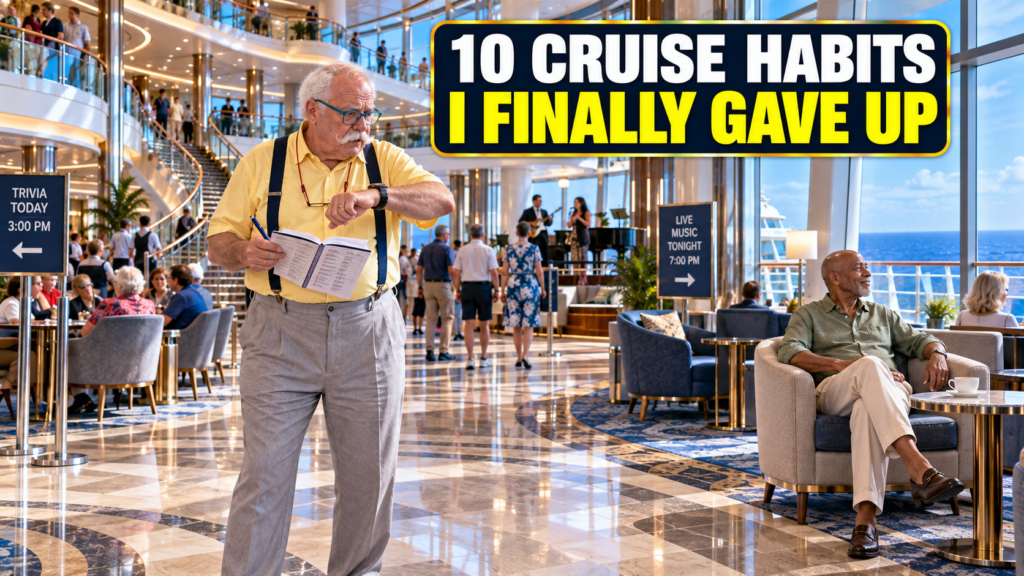
I recently watched a cruiser I’ll call Hal doing exactly that. He stood in an observation lounge with the daily planner in one hand and his watch in front of his face, trying to calculate how quickly he could get to the next activity.
His friend Calvin was sitting by the window with a cup of coffee, watching the ocean.
“We paid for all this,” Hal said. “I’m not missing anything!”
Calvin smiled.
“That’s the habit I gave up years ago.”
Hal looked genuinely confused.
“You stopped getting your money’s worth?”
Calvin glanced toward the ocean.
“No. I stopped turning vacation into work.”
That sentence describes one of the biggest changes many of us make after enough cruises.
Experience doesn’t necessarily teach you how to do MORE.
Sometimes it teaches you what you can finally stop doing.
Here are 10 cruise habits I eventually learned to leave behind.
1. Trying to Get Every Dollar of “Value” Out of the Cruise
This was my biggest one.
When you’ve paid thousands of dollars for a vacation, it’s natural to want your money’s worth.
But there’s a trap hiding inside that idea.
Breakfast, trivia, the pool, lunch, a lecture, afternoon entertainment, dinner, a show, live music and a late-night snack can all sound wonderful individually.
Put them together, and suddenly your vacation has a performance quota.
I’ve learned that cruise value isn’t measured by how many activities I can complete.
Sometimes the best hour of the day is the hour when absolutely nothing happens.
Sit by a window.
Have coffee.
Watch the wake.
Take an afternoon nap without feeling guilty about the activity you missed.
You already paid for the ship.
You don’t have to use every square foot of it every day to justify the fare.
2. Rushing to Board as Early as Possible
I used to want the earliest arrival time I could get.
Why waste a minute of cruise day?
Eventually, I realized that being early isn’t automatically the same as having a better embarkation.
Terminals can have busy arrival periods, and boarding procedures vary by ship, port and sailing.
These days, I pay more attention to the arrival instructions for my sailing than to winning an imaginary race to be among the first onboard.
For travelers over 60, there’s another consideration: energy.
Do I really want to spend part of embarkation morning standing around with carry-ons simply because I wanted to arrive as early as possible?
Sometimes an easier start is worth more than an extra few minutes aboard.
Follow your assigned or permitted arrival process, allow plenty of transportation time, and don’t turn embarkation into a competition.
The ship isn’t going to become less enjoyable because somebody else walked aboard before you.
3. Packing for Every Possible Situation
My early packing philosophy was simple:
What if I need it?
Another pair of shoes went into the suitcase.
Another shirt.
Another jacket.
Something for weather that probably wouldn’t happen.
Then came the difficult part—actually traveling with everything I’d packed.
For many older travelers, reducing unnecessary luggage can make airports, hotels, terminals and cabins much easier to manage.
Now I pack around realistic combinations instead of imaginary emergencies.
Can one pair of trousers work with multiple shirts?
Can a light layer handle several situations?
Will I actually wear four pairs of shoes?
Of course, essential medication, travel documents and genuinely necessary items are different. Those aren’t where I try to save space.
The clothes I might wear once “just in case”?
That’s where I became ruthless.
My goal isn’t to pack as little as humanly possible.
It’s to avoid spending my vacation managing belongings I never needed.
4. Trying to Do Everything on the Daily Schedule
The daily program can be dangerous to an enthusiastic first-time cruiser.
Not because there’s anything wrong with it.
Because there can be so much that looks interesting.
Trivia.
Games.
Music.
Lectures.
Demonstrations.
Fitness activities.
Movies.
Shows.
Social events.
Suddenly you’re highlighting half the schedule.
I used to decide what I wanted to attend by asking:
“Does this sound good?”
Now I ask:
“Is this good enough to give up whatever I would otherwise be doing?”
That’s a much higher bar.
I might circle three things and ultimately attend two.
That’s fine.
The schedule is a menu, not an assignment.
Missing an activity isn’t failing at cruising.
Sometimes it means you were enjoying something else enough that you didn’t want to leave.
5. Automatically Buying a Drink Package
Convenience can make a beverage package appealing.
But I stopped assuming that buying one automatically makes financial sense for every cruise.
Instead, I look at the current package terms for my sailing and compare them with what I’m realistically likely to consume.
Not vacation-me in my imagination.
Actual me.
How many eligible drinks would I normally want in a day?
What is included?
What isn’t?
Are there restrictions or conditions that matter to us?
Does everyone in the cabin have to meet any particular purchase requirements under the applicable package rules?
Those details can vary, which is exactly why I don’t rely on what happened on a different cruise several years ago.
For some travelers, a package can be convenient and worthwhile.
For others, paying as they go may fit their habits better.
The habit I gave up wasn’t buying beverage packages.
It was buying them without doing the math first.
6. Eating Every Meal at the Buffet
I love a good cruise buffet.
What I stopped doing was automatically going there whenever I was hungry.
On my first cruises, the buffet felt like the obvious answer.
It’s easy. There are lots of choices. You can see what you’re getting.
But the ship may have other included or extra-cost dining options worth exploring, depending on the vessel and fare.
Sometimes I want a quieter breakfast.
Sometimes I want to sit down and let someone bring dinner rather than walking around looking for another dish.
Sometimes the buffet is exactly what I want.
That’s the difference.
It became a choice rather than a habit.
For older travelers who dislike carrying plates through crowded spaces, simply knowing the alternatives available on their particular ship can also make meals more comfortable.
Before sailing, I now look at the dining options instead of assuming every meal will happen in the same place.
7. Booking a Packed Excursion in Every Port
I once thought a port day without a major excursion was a wasted opportunity.
Then I started returning to the ship exhausted.
A five-port itinerary doesn’t necessarily require five ambitious excursion days.
Now I look at the whole itinerary.
If Tuesday involves a long excursion with lots of walking, maybe Wednesday doesn’t need another marathon.
Sometimes I book a shorter activity.
Sometimes I explore independently where appropriate and where I’m comfortable doing so.
Sometimes I simply choose a slower day.
The important part is understanding what you’re booking.
Look at duration, transportation, activity level, walking requirements, meeting instructions and what’s actually included.
And always pay attention to the ship’s required return timing and the conditions attached to whichever excursion option you choose.
I stopped asking:
“How much can I fit into this port?”
I started asking:
“What kind of day do I actually want here?”
That small change made port days much more enjoyable.
8. Waiting Until I’m Onboard to Make Every Important Reservation
Spontaneity sounds wonderful.
Until the thing you really wanted has limited availability.
Depending on the ship and sailing, some dining reservations, entertainment, activities or excursions may be available to plan or reserve before embarkation.
Not everything needs to be scheduled.
In fact, that would contradict half this article.
But there’s a difference between overscheduling and protecting the few experiences you genuinely care about.
If there’s one restaurant we really want to try, I investigate it before sailing.
If there’s an excursion that’s important to us, I don’t automatically assume we’ll sort it out after boarding.
My current strategy is simple:
Reserve the priorities. Leave space around them.
That gives me structure without turning the cruise into Hal’s hourly checklist.
9. Staying Connected Every Minute
Cruise Wi-Fi has become increasingly important for many travelers.
There are perfectly legitimate reasons to stay connected.
Family.
Work.
Travel arrangements.
Messages.
Emergencies.
But I eventually noticed something about myself.
I’d sit beside an enormous ocean view and stare at a screen small enough to fit in my hand.
So I changed the habit.
I still use internet access when I need it, but I don’t automatically fill every quiet moment by checking email, headlines or social media.
If you’re considering an internet package, check the current plan details for your sailing: number of users, device rules, expected capabilities and any limitations that matter to you.
Then decide how connected you actually want to be.
For me, one of cruising’s luxuries has become allowing parts of the day to disappear without knowing what’s happening everywhere else.
10. Leaving Final-Night Packing Until the Last Minute
The final evening used to catch me every time.
I’d have dinner.
See a show.
Come back to the cabin.
And suddenly realize I still had to organize everything.
That is not how I want to end a vacation anymore.
Now I start earlier.
I separate what I’ll need overnight and the next morning from anything being prepared for luggage handling.
Travel documents stay accessible.
Medication stays with me.
Valuables stay with me.
The clothes and shoes I need for the morning stay out.
I also review the disembarkation instructions for that particular sailing rather than assuming they’ll work exactly like my previous cruise.
The goal is to make the final morning boring.
Boring is excellent.
No frantic search for glasses.
No realizing the shoes you wanted are somewhere you can’t conveniently reach.
No trying to reorganize an entire cabin when you’re supposed to be leaving.
What Years of Cruising Actually Changed
The funny thing is that I haven’t stopped doing most cruise activities.
I still visit the buffet.
I still book excursions.
I still attend shows.
I may buy a beverage package.
I use Wi-Fi.
I make reservations.
And sometimes I absolutely want a busy day.
What changed is the word automatically.
I don’t automatically rush to be first.
I don’t automatically fill the suitcase.
I don’t automatically buy the package.
I don’t automatically schedule the entire day.
And I don’t measure a successful cruise by how many things I managed to consume, attend or check off.
That’s especially important as we get older.
The vacation should work for our energy, interests and comfort—not the other way around.
Hal thought getting his money’s worth meant squeezing one more activity between lunch and dinner.
Calvin had learned something different.
Sometimes the most valuable thing you’ve purchased is the freedom to sit beside the ocean with nowhere else you need to be.
After enough cruises, I finally understood what Calvin meant:
I stopped turning vacation into work.
Which cruise habit did you eventually give up?
