
CRUISE TIP
Should Cruise Lines Let Older Passengers Who Need Assistance Board First?
Sep
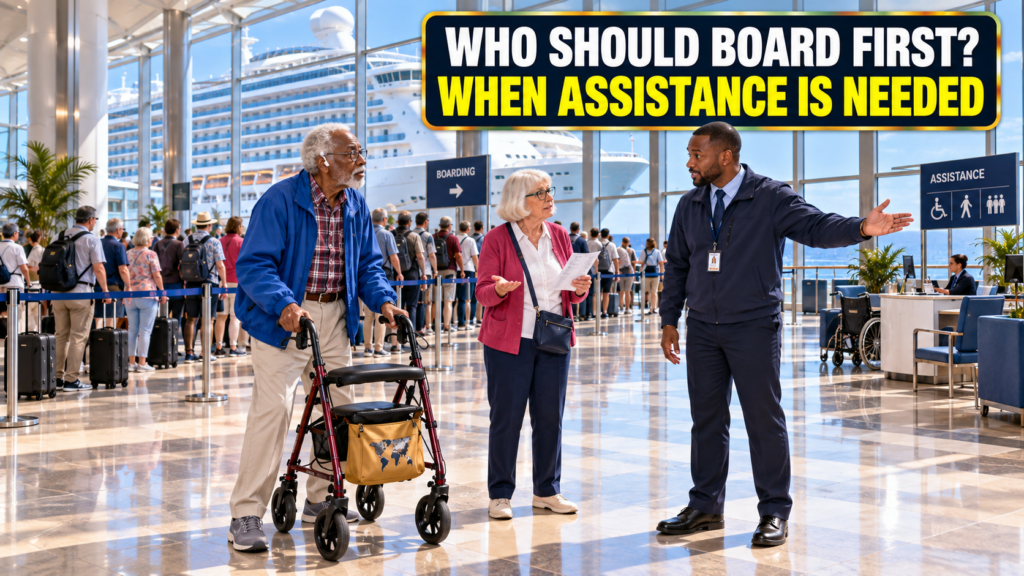
Imagine arriving at the cruise terminal excited for your vacation, only to discover that the hardest part of embarkation may be something you never thought about: standing.
That was the problem facing 78-year-old Earl.
Earl could walk. He wasn’t asking someone to carry him onto the ship, and he wasn’t expecting special treatment simply because of his age.
But when he looked across the terminal and saw a long boarding line, he knew standing there for an extended period could be difficult.
“I can walk,” he explained. “I just can’t stand that long.”
That distinction raises an important question for older cruisers:
Should passengers who genuinely need mobility or boarding assistance be given an easier—or earlier—way onto the ship?
The answer is more complicated than simply putting everyone over a certain age at the front of the line.
1. Being Older Doesn’t Automatically Mean You Need Priority Boarding
Turning 65, 70 or 75 doesn’t automatically mean a passenger has difficulty boarding a cruise ship.
Some travelers in their 70s can comfortably walk through a large terminal and stand in line. Others may have mobility or stamina limitations that aren’t immediately obvious.
That’s why age alone isn’t a very useful way to determine who needs assistance.
The more important question is:
What does this passenger actually need in order to board safely and reasonably?
Someone may be able to walk independently but struggle with prolonged standing. Another passenger may use a cane, walker, rollator, wheelchair or scooter. Someone else may have an accessibility need that isn’t visually obvious at all.
Those situations shouldn’t automatically be treated as identical.
2. Assisted Boarding Already Exists on Some Cruise Lines
This is where first-time cruisers can become confused.
Accessibility assistance isn’t necessarily something you have to invent yourself once you reach the terminal.
Cruise lines may already provide boarding assistance for passengers with qualifying mobility or accessibility needs.
For example, Royal Caribbean currently states that it offers boarding and departure assistance for guests in wheelchairs or with mobility disabilities. Its accessibility information also lists early boarding among services provided for guests with mobility disabilities.
However, that does not mean every passenger using an assistive device instantly skips every line. Royal Caribbean specifically notes that there can still be a wait for assistance during peak periods.
The important lesson is simple:
Assisted boarding and “I automatically get to board before everyone else” are not necessarily the same thing.
3. The Procedure Can Differ From One Cruise Line to Another
This is one of the biggest reasons passengers should investigate accessibility arrangements before embarkation day.
There isn’t one universal terminal procedure that every cruise passenger can assume will apply.
Norwegian Cruise Line, for example, says passengers requesting wheelchair assistance for embarkation must be able to enter the terminal before that assistance begins. NCL crew cannot pick passengers up at the curb because crew members cannot leave the terminal.
NCL says assisted passengers can then be taken to check-in and up the ramp to board, but not all the way to their stateroom. It also notes that wheelchair assistance typically doesn’t begin before 11 a.m.
That is a very specific process.
A passenger who simply arrives assuming, “Someone will meet me at the car and take me directly to my cabin,” could therefore have a very different experience from what they expected.
4. “I Can Walk” Doesn’t Always Mean “I Don’t Need Assistance”
Earl represents an overlooked group of travelers.
He isn’t unable to walk.
He can get up from his rollator, walk through the terminal and move around independently.
His problem is endurance.
Imagine someone who can comfortably walk 100 feet but cannot comfortably remain standing in a slow-moving line for 30 or 40 minutes.
Those are two very different physical demands.
This is why passengers shouldn’t dismiss their own needs simply because they don’t use a wheelchair full time.
If prolonged standing, long terminal distances or boarding ramps may be difficult for you, ask the cruise line what assistance is available for your particular circumstances.
Don’t diagnose yourself into a category.
Just describe what you actually have difficulty doing and ask what arrangements are available.
5. Should Everyone With a Walker or Wheelchair Automatically Go First?
This is where the debate becomes more complicated.
A mobility device is an important indication that a traveler may have accessibility needs, but embarkation involves more than simply deciding who gets to the ship first.
Terminals have check-in procedures, security processing, boarding windows, accessible routes, available personnel and sometimes limited assistance equipment.
Cruise lines also need procedures that work for passengers with very different needs.
One traveler might require someone to push a terminal wheelchair.
Another might have their own power wheelchair and need an accessible route.
A third might use a rollator but primarily need to avoid prolonged standing.
A fourth passenger may need assistance despite having no visible mobility device.
A blanket rule based solely on age—or solely on whether someone has a walker visible—doesn’t capture all of those differences.
A better question for travelers to ask is:
“What assistance is available for my specific limitation, and how do I arrange it?”
6. Don’t Wait Until You’re Standing in the Terminal to Ask
This may be the most useful takeaway from Earl’s situation.
Accessibility planning should ideally begin before embarkation morning.
Royal Caribbean currently tells passengers seeking pier assistance to contact the cruise line before sailing and says advance contact allows the company to prioritize assistance for boarding.
Norwegian also directs passengers with accessibility needs toward its Access Desk and encourages travelers to arrange special assistance in advance.
Exact notice periods and procedures can differ by cruise line and by the accommodation requested, so don’t assume something you read about another cruise—or even another cruise line—automatically applies to yours.
Before sailing, contact your cruise line directly and ask:
- What boarding assistance is available for my specific needs?
- Do I need to request it in advance?
- Where do I report when I arrive at the terminal?
- Does assistance begin at the curb, terminal entrance or check-in area?
- Should I arrive at a particular time?
- Can I use my own walker, rollator, wheelchair or scooter during boarding?
- If I need a cruise-line wheelchair, where do I request one?
- Can my traveling companion remain with me during the assistance process?
Save the answers with your cruise documents.
That is much easier than trying to figure everything out while hundreds of other passengers are arriving.
7. “Early Boarding” Doesn’t Necessarily Mean “No Waiting”
This distinction matters.
Passengers sometimes hear terms such as early boarding, priority assistance or boarding assistance and imagine an immediate trip from the terminal entrance onto the ship.
Reality can involve waiting.
Royal Caribbean explicitly warns that during peak periods there may be a wait for wheelchair assistance.
Norwegian notes that its supply of wheelchairs is limited and describes specific procedures for embarkation assistance.
So even when assistance exists, travelers should build some flexibility into embarkation day.
Bring necessary medication and essential personal items with you rather than assuming you’ll immediately reach your cabin.
And if sitting while waiting is important, ask where the appropriate waiting or assistance area is located.
8. The Companion Question Matters Too
Older couples frequently travel together, and accessibility planning can affect both people.
Suppose Earl needs boarding assistance but Diane doesn’t.
Can Diane remain with him?
Where should they check in?
Should she handle their documents while Earl uses his rollator?
Those may sound like small questions until you’re standing inside a busy terminal with luggage and hundreds of passengers moving around you.
If remaining together during embarkation is important, include that question when arranging assistance.
Don’t assume the procedure will be identical at every port or with every cruise line.
9. The Better Goal May Be a Clearer Process, Not Simply “First”
The headline question asks whether older passengers who need assistance should board first.
But after looking at the actual problem, “first” may not be the only thing that matters.
For someone like Earl, the real priorities might be:
avoiding prolonged standing,
knowing exactly where to report,
having an appropriate place to wait,
getting help through the parts of the terminal that are difficult for him,
and understanding the procedure before arrival.
A passenger might care far more about those things than whether they literally become the first person on the ship.
That’s an important distinction.
Accessibility isn’t simply about moving somebody ahead of somebody else.
It’s about making the boarding process workable for passengers with different physical needs.
Before Your Next Cruise, Check This
If you or someone traveling with you has difficulty walking long distances, standing for extended periods or navigating embarkation without assistance, don’t rely on age alone to determine what happens.
Check your cruise line’s current accessibility information well before departure.
Describe the actual assistance you need.
Confirm where assistance begins.
Ask whether advance arrangements are required.
And then reconfirm the instructions before you travel, especially if your port or itinerary changes.
Earl’s biggest mistake wasn’t that he failed to demand the front of the line.
It was arriving at the terminal without knowing what assistance might already have been available to him.
And that’s the part future cruisers can avoid.
What matters more to you: boarding first—or having a clearly organized assistance process that keeps passengers who need help from standing in a long line?
