
CRUISE TIP
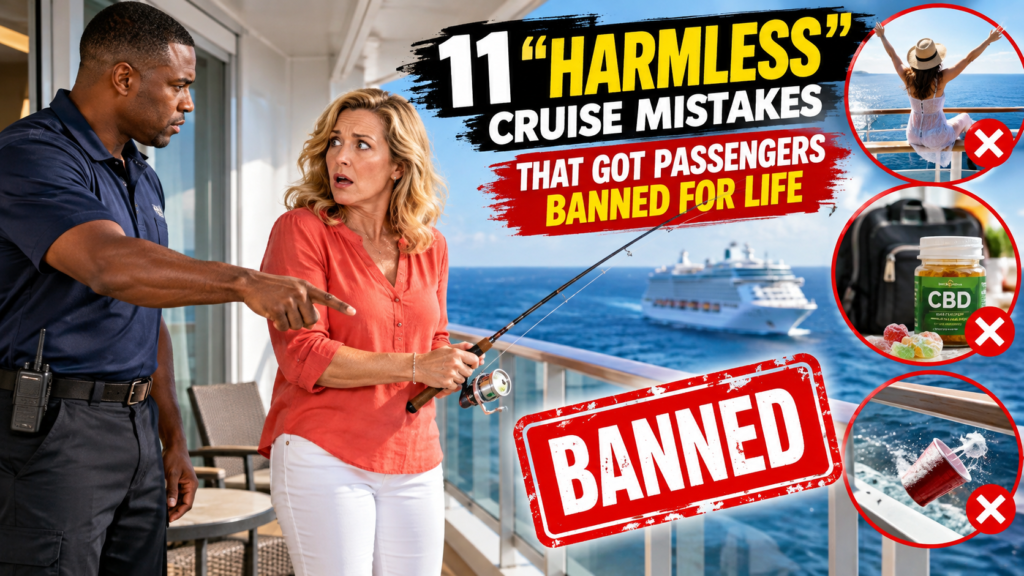
11 “HARMLESS” CRUISE MISTAKES THAT GOT PASSENGERS BANNED FOR LIFE
Sep
A cruise vacation can feel unusually forgiving. You unpack once, food is everywhere, entertainment runs late into the night, and for a few days the ship starts to feel less like transportation and more like a floating resort.
That relaxed atmosphere can also create a dangerous misunderstanding: passengers may assume that something that seems funny, minor, or harmless on land will be treated the same way at sea.
It won’t always be.
Cruise lines maintain detailed guest-conduct, safety, environmental, and prohibited-items policies. Depending on the circumstances, violating them can lead to confiscation of an item, intervention by ship security, removal from the vessel, denial of boarding, or restrictions on future cruises.
And permanent bans are not just theoretical.
Passengers have reportedly received lifetime or permanent cruise-line bans after incidents involving behavior they may initially have viewed as relatively harmless—from fishing off a balcony to climbing over a railing for a photograph.
But there is an important distinction before we examine the list.
Not every mistake below automatically results in a lifetime ban. Some are tied to publicly documented cases in which a passenger was actually banned. Others involve conduct that current cruise-line policies explicitly prohibit and for which future sailing privileges can potentially be denied.
The captain, security team, cruise line, severity of the conduct, and circumstances of the incident can all matter.
With that distinction clear, here are 11 seemingly “harmless” cruise mistakes that passengers should take much more seriously than they might expect.
1. Fishing From Your Cruise Ship Balcony
Imagine stepping onto your private balcony on a beautiful sea day.
The water is calm. You have a small fishing rod in your luggage. You aren’t planning to keep anything, damage the ship, or disturb another passenger.
So you drop a line over the side.
What could possibly go wrong?
Quite a lot.
One highly publicized Carnival incident involved passengers who were identified after video circulated showing fishing from a cruise ship balcony. Carnival confirmed that fishing from its ships was prohibited and that the guests involved would not be allowed to sail with the company again.
That makes balcony fishing particularly relevant to this list because it isn’t merely a hypothetical example of something that could violate a rule. There is a documented case of passengers losing future access to the cruise line after doing it.
The reason also becomes easier to understand when you stop looking at the situation as simply “catching a fish.”
A cruise ship balcony is not a fishing pier.
Lines, hooks, sinkers, and other equipment can introduce safety concerns. Objects are being extended or potentially dropped from a moving vessel. The activity may also conflict with environmental and shipboard safety requirements.
Most importantly, passengers do not get to decide that an activity is acceptable simply because they personally consider it harmless.
If a crew member or security officer tells you to stop an activity, stop.
Trying to argue that you “weren’t hurting anyone” is unlikely to improve the situation.
The safest rule is remarkably simple: enjoy the ocean from your balcony, but don’t turn your balcony into a fishing platform.
2. Climbing Onto a Railing for the Perfect Photo
Cruise ships provide spectacular backgrounds for photographs.
Unfortunately, the desire for one dramatic picture has encouraged some passengers to take extraordinary risks.
Royal Caribbean’s current Guest Health, Safety, and Conduct Policy prohibits guests from sitting, standing, laying, climbing on, or jumping over exterior or interior railings and other protective barriers.
This is not an obscure technical restriction.
It addresses one of the most obvious serious safety hazards aboard a ship.
A widely reported 2019 incident aboard Allure of the Seas demonstrated how seriously the company can treat this behavior. A passenger was photographed standing outside the normal protected balcony area while another person took the picture.
The passenger and her companion were removed from the ship, and Royal Caribbean confirmed that they were banned for life.
Think about how the incident may have begun from the passenger’s perspective.
Perhaps it was supposed to last only a few seconds.
Perhaps she believed she had good balance.
Perhaps the photograph seemed more important than the rule.
None of those considerations changed the underlying danger.
Railings and protective barriers exist precisely because passengers should remain on the safe side of them.
A photograph that receives attention for a few days is not worth losing your vacation—or potentially your ability to sail with a cruise line again.
3. Bringing CBD or Cannabis Products Because They’re Legal at Home
This is one of the easiest cruise mistakes for travelers to misunderstand.
A passenger may legally purchase a cannabis-derived product where they live. It may come from an ordinary retail store. It may look no more threatening than a package of candy.
That does not mean it is permitted on a cruise ship.
Carnival’s prohibited-items guidance includes marijuana, cannabis, and cannabis-derived products, including CBD.
A widely reported 2023 case involved a Texas woman attempting to board Carnival Horizon with CBD gummies. She was denied boarding, and Carnival subsequently informed her that she would not be permitted to sail aboard Carnival Cruise Line ships in the future.
The case attracted significant attention precisely because the passenger reportedly viewed the gummies very differently from the cruise line.
That difference in perception is the lesson.
Passengers sometimes think primarily about the law where they purchased a product. A cruise itinerary can involve ports, countries, maritime rules, customs requirements, and cruise-line policies that do not match the rules at home.
Cruise passengers should therefore check the actual prohibited-items policy of their cruise line before packing.
Do not assume that “legal where I bought it” means “allowed onboard.”
And don’t rely on something a friend carried successfully on another trip.
The cruise line’s current written policy matters far more.
4. Getting Into a Fight Because “They Started It”
Arguments can happen anywhere.
On a cruise, however, an argument that becomes physical can have consequences extending well beyond being told to calm down.
Cruise lines have strong policies regarding threatening, disruptive, abusive, and violent behavior.
Carnival states that disruptive behavior affecting the comfort, enjoyment, safety, or well-being of other guests or crew can result in disembarkation and restrictions on future sailing.
There are also documented incidents in which people involved in cruise-related fights have been placed on a Do Not Sail list.
One recent example involved a large altercation associated with Carnival passengers at PortMiami. Carnival said 16 people involved were placed on its Do Not Sail list.
The important lesson is not whether every shove, argument, or confrontation produces exactly the same punishment.
It doesn’t.
The lesson is that passengers should not treat a cruise ship confrontation like a dispute in a private setting where they can simply “settle it themselves.”
Security personnel have to consider the safety of everyone nearby.
A person who feels provoked should disengage and contact crew or security rather than escalate the confrontation.
And “the other person started it” does not give a passenger permission to ignore crew instructions once security becomes involved.
5. Refusing a Crew Member’s Safety Instruction
This mistake often begins with an argument over something else.
A passenger may be angry about a seat, a restricted area, alcohol service, a balcony activity, an event, or another guest.
A crew member gives an instruction.
The passenger disagrees.
Then the original problem becomes secondary.
Royal Caribbean’s Guest Health, Safety, and Conduct Policy requires guests to follow health, safety, security, and environmental instructions.
The policy also provides for serious consequences that can include removal and denial of future boarding.
This is why the phrase “But I wasn’t doing anything dangerous” can miss the point.
Once trained personnel are addressing a safety or security issue, continuing prohibited behavior or refusing instructions can escalate the incident.
Suppose a passenger is told to move away from a restricted space.
The best response is not to test how many times the employee will repeat the instruction.
Comply first.
If you believe the situation was handled unfairly, there are appropriate ways to raise a complaint afterward.
Turning a minor disagreement into a confrontation with ship security can transform a manageable issue into something much more serious.
6. Throwing Something Overboard
Dropping something into the ocean can seem insignificant.
A napkin. A cup. A piece of food. A small object someone thinks will simply disappear into an enormous sea.
Cruise lines do not necessarily see it that way.
Environmental policies generally prohibit throwing objects or waste overboard, and cruise contracts can provide serious consequences for environmental violations.
Princess, for example, states in its passage contract that violations of environmental policies can lead to consequences that may include disembarkation and revocation of future sailing privileges.
Carnival also warns that guests disembarked for environmental-policy violations may be prohibited from sailing with the company in the future.
There are good reasons for strict rules.
A modern cruise operation manages waste through controlled systems. Passengers deciding independently what can be thrown into the ocean defeats those systems and can create environmental and safety problems.
This is another area where personal judgment should not replace shipboard rules.
It doesn’t matter if an object seems biodegradable.
It doesn’t matter if the ocean looks empty.
And it doesn’t matter if someone says they have seen other passengers do it.
Use the ship’s designated waste facilities.
The ocean is not a trash can.
7. Tampering With Ship Equipment “As a Joke”
Cruise ships contain enormous amounts of equipment that passengers encounter every day.
Doors, alarms, safety systems, emergency equipment, fixtures, electronics, barriers, signs, and other devices may look accessible.
Accessible does not mean passengers are free to interfere with them.
Royal Caribbean’s conduct policy prohibits tampering with ship equipment, facilities, or systems.
Depending on the circumstances, violations of the conduct policy can result in security intervention, removal, and denial of future boarding.
That doesn’t mean touching the wrong button accidentally guarantees a permanent ban.
Intent and circumstances matter.
But deliberately manipulating equipment as a prank is completely different from an innocent mistake.
A passenger might think moving, disabling, opening, activating, or interfering with something will make a funny video.
The crew may have to treat the same action as a safety or security issue until they determine exactly what happened.
The safest approach is straightforward.
If something is clearly intended for crew operation, emergencies, or ship safety, leave it alone.
If you accidentally interfere with something, notify a crew member rather than attempting to hide what happened.
8. Damaging Cruise Ship Property During a “Funny” Moment
Vacation energy can sometimes encourage behavior people would never consider at home.
Someone climbs on furniture.
A group becomes rowdy.
A passenger intentionally damages a fixture for a video.
Another person scratches, breaks, or removes something as a souvenir.
Cruise-line conduct rules can treat vandalism and intentional property damage as serious violations.
Royal Caribbean specifically includes vandalism within prohibited inappropriate or abusive behavior.
Potential consequences under the broader conduct policy can include security involvement, removal from the ship, and denial of future boarding.
Again, this requires careful interpretation.
It would be inaccurate to claim that every broken glass or accidentally damaged cabin fixture results in a lifetime ban.
Accidents happen.
Intentional vandalism is different.
If you accidentally damage something, contact the crew.
Trying to conceal it—or deliberately causing additional damage—can turn an ordinary onboard problem into a conduct issue.
A useful rule is to treat the ship the same way you would want a guest to treat your own property.
9. Entering an Area Clearly Reserved for Crew
Cruise ships can feel like enormous hotels, but large sections of the vessel are operational workplaces.
Some doors and corridors are restricted for a reason.
Passengers may become curious about what exists behind a crew-only door, particularly after seeing social-media videos showing crew areas.
Curiosity does not create permission.
Cruise-line safety and conduct rules restrict unauthorized access to areas designated for crew or otherwise closed to passengers.
There have also been reported cases involving passenger behavior around crew-only areas or inappropriate boundary-crossing with crew that ultimately resulted in future-sailing restrictions.
However, public details surrounding individual cases are not always complete.
For that reason, passengers should avoid simplistic claims such as “open one crew door and you’re banned for life.”
The more accurate lesson is that unauthorized access can become a serious security matter.
If a door says crew only, restricted, authorized personnel, or otherwise indicates passengers should not enter, don’t enter.
If you accidentally find yourself somewhere you shouldn’t be, turn around and follow crew directions.
Exploring the ship is part of the fun.
Exploring restricted operational spaces is not.
10. Treating Crew Boundaries Like They Don’t Matter
Cruise passengers often interact with the same employees repeatedly.
Your server may remember your drink.
A bartender may know your name.
Your cabin steward may greet you every morning.
Entertainment staff can feel familiar after several days.
That friendliness is part of hospitality, but passengers should remember that crew members are working.
Professional boundaries still apply.
Cruise lines maintain conduct standards governing inappropriate, abusive, harassing, threatening, and unsafe interactions.
A passenger who interprets friendly service as permission to enter restricted spaces, interfere with an employee’s work, pursue unwanted personal interaction, or ignore instructions can create a much more serious situation than they expect.
This section deserves particular caution because online stories about passengers being banned after interactions with crew do not always provide the complete internal facts considered by the cruise line.
We therefore should not invent a universal rule saying that one particular social interaction automatically results in a lifetime ban.
The practical lesson is simpler.
Respect the employee’s professional role.
Respect physical and operational boundaries.
And if an employee tells you an area, activity, or interaction isn’t permitted, don’t keep pushing.
11. Assuming “It’s My Vacation” Overrides the Guest Conduct Policy
This final mistake connects nearly every incident on this list.
Passengers pay thousands of dollars for cruises and understandably expect to enjoy themselves.
But buying a cruise ticket does not mean purchasing unrestricted access to do anything aboard the ship.
Cruise lines operate under passenger contracts and guest-conduct policies that give them substantial authority to address behavior they consider unsafe, disruptive, prohibited, or harmful to other guests and crew.
Royal Caribbean’s current policy states that consequences can include denial of boarding, removal from the ship, involvement of law enforcement, and denial of future boarding.
Carnival similarly maintains policies allowing strong action against disruptive behavior and other serious violations.
Princess reserves significant authority under its passage contract as well.
The exact consequence depends on the circumstances.
That point matters.
A passenger should not assume that every policy violation leads to permanent exclusion. At the same time, passengers should not assume that because something looks minor, the cruise line must treat it as minor.
Context matters.
Intent matters.
Safety matters.
Whether the passenger immediately complies with crew instructions can matter.
And the nature of the underlying conduct matters enormously.
Why Can Cruise Lines Ban Passengers From Future Cruises?
Some passengers are surprised that a private cruise company can simply decide it doesn’t want them back.
Cruise travel operates through contractual terms accepted as part of booking and sailing.
Those terms generally give cruise lines broad authority regarding passenger conduct, boarding, safety, and removal.
Cruise lines also maintain internal security systems and records.
A passenger involved in a serious incident may therefore face consequences beyond the current voyage.
Those consequences can range from being removed from a specific sailing to losing future sailing privileges with the cruise company.
In some situations, restrictions may have implications across affiliated brands, depending on the company’s policies and decision.
This is why a “Do Not Sail” designation should not be treated casually.
A cruise line does not need to wait until behavior reaches the level of a criminal conviction before deciding that it no longer wants to carry a particular passenger.
A cruise-line ban and a criminal prosecution are entirely different things.
Does Breaking a Cruise Rule Automatically Mean a Lifetime Ban?
No.
This is perhaps the most important fact in this entire article.
Cruise lines have many rules, and passengers violate minor policies every day without receiving lifetime bans.
Consequences can vary enormously.
A crew member may simply explain the rule.
An item may be confiscated.
A passenger may receive a warning.
Security may document an incident.
Someone may be denied boarding or removed from the vessel.
In more serious cases, future bookings may be denied.
And in some documented incidents, passengers have indeed received permanent or lifetime bans.
That is why sensational claims such as “do this once and you’re banned forever” should be treated skeptically unless a specific cruise-line policy or documented case supports them.
The better question is:
Could this seemingly harmless action create a safety, security, environmental, or conduct problem serious enough for the cruise line to take action?
For every behavior on this list, the answer is yes.
What Should You Do If Cruise Security Stops You?
The worst strategy is usually to escalate the situation.
If security or a crew member tells you to stop an activity, stop.
Listen carefully to the instruction.
Don’t physically interfere with employees.
Don’t encourage friends to surround security personnel.
Don’t continue the behavior just to prove a point.
And don’t assume that filming the confrontation changes the underlying rule.
If you believe an employee misunderstood the situation, remain calm and ask how you can address the issue through the appropriate onboard process.
A disagreement can often remain a disagreement.
Refusing safety or security instructions can turn it into something else.
This is particularly important when the original behavior was genuinely accidental.
Immediate cooperation helps distinguish an honest mistake from deliberate refusal to comply.
Before Your Next Cruise, Check These Policies
Rules vary among cruise companies and can change.
Before departure, passengers should review the current official information for their specific cruise line rather than relying exclusively on social-media advice or something that was permitted on a previous vacation.
Pay particular attention to prohibited items, guest conduct, alcohol and substance policies, balcony safety, environmental rules, restricted areas, and instructions concerning embarkation and security.
If you’re carrying something unusual, verify it before reaching the terminal.
If you’re considering an onboard activity and aren’t sure whether it’s permitted, ask a crew member first.
Five seconds of asking can prevent a much larger problem.
The Bottom Line
The strangest thing about many cruise bans is that the incident may not have started with something the passenger considered serious.
A fishing line dropped from a balcony.
CBD gummies packed because they were legally purchased at home.
A risky photograph outside a railing.
An argument that escalated.
A prank involving equipment.
An object thrown into the ocean.
In the passenger’s mind, the explanation may begin with the same sentence:
“I didn’t think it was a big deal.”
But cruise ships are not ordinary resorts.
They are complex passenger vessels carrying thousands of people, operating under safety procedures, environmental requirements, contractual terms, and company conduct policies.
That changes the consequences.
The documented cases involving balcony fishing, dangerous railing behavior, CBD products, and serious confrontations demonstrate that future-sailing bans are real—not merely warnings buried in fine print.
At the same time, accuracy matters: not every one of these 11 behaviors automatically produces a lifetime ban.
Some have resulted in documented permanent bans. Others fall within current cruise-line policies that allow removal or denial of future sailing privileges when the circumstances justify it.
That distinction shouldn’t make passengers less cautious.
It should make the lesson clearer.
Most cruise vacations pass without anything remotely like these incidents because the basic rules are easy to follow: respect barriers, respect the crew, respect other passengers, don’t interfere with ship operations, check prohibited items before packing, and follow safety instructions when they are given.
A cruise should end with photographs, memories, and plans for the next voyage.
Not with your name on a Do Not Sail list.
