
CRUISE NEW
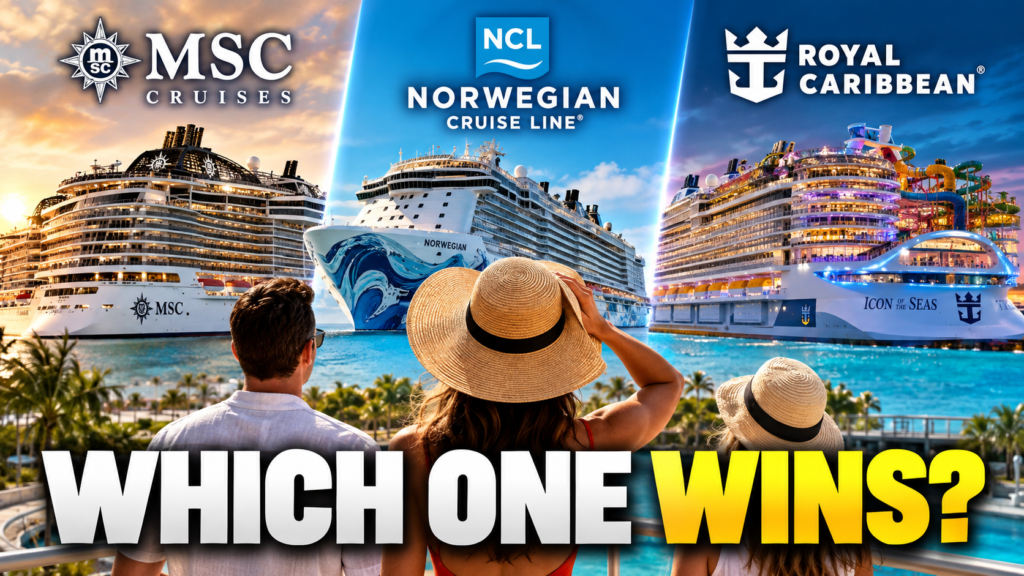
11 DIFFERENCES BETWEEN MSC NORWEGIAN AND ROYAL CARIBBEAN CRUISE LINES
Sep
Choosing between MSC Cruises, Norwegian Cruise Line, and Royal Caribbean can be surprisingly difficult.
At first glance, all three seem to offer the same basic vacation: a big ship, multiple restaurants, pools, entertainment, kids’ activities, tropical ports, and plenty of ways to spend extra money once you’re onboard.
But once you actually start comparing how these cruise lines operate, the differences become much more important.
One line puts enormous emphasis on flexibility. Another blends an international atmosphere with Mediterranean influence and an increasingly ambitious generation of modern ships. The third has pushed the cruise ship itself toward becoming a destination packed with massive family attractions.
And sometimes the differences show up in places you would never expect.
Imagine getting dressed for dinner, walking into the restaurant expecting the same table you had the night before, and being told there is no permanently assigned table waiting for you.
For a passenger used to traditional cruise dining, that could be frustrating.
For a Norwegian Cruise Line passenger who specifically chose Freestyle Dining, that flexibility may be exactly the point.
That is why choosing a cruise line based only on price can be a mistake.
Here are 11 important differences between MSC Cruises, Norwegian Cruise Line, and Royal Caribbean that can help you decide which experience fits your vacation style.
Important: Cruise products change frequently. Restaurants, entertainment, attractions, packages, dining systems, and benefits can vary by ship, itinerary, market, cabin category, and sailing date. Always verify the details for your specific sailing before booking.
11. DINING WORKS VERY DIFFERENTLY
Dining is one of the clearest examples of how three cruise lines can offer similar products while creating very different experiences.
Norwegian Cruise Line has built a major part of its identity around Freestyle Dining. Norwegian describes the system as having no fixed dining times or pre-assigned seating, allowing guests to choose when and how they want to dine rather than following a traditional nightly schedule.
That flexibility can be extremely appealing.
You may decide to eat early one evening because you want to see a show, then eat much later the following night after returning from port.
But passengers accustomed to traditional assigned dining should understand what they are booking. Freestyle Dining does not mean that the same table will automatically be waiting for you at the same time every evening.
MSC is more complicated because its dining structure can depend on the ship and experience booked. MSC currently describes three dinner-seating models, including traditional Assigned Seating and flexible options. Its newer Dine on Your Time program is currently offered on specific ships, while Aurea guests have access to My Choice Dining.
Royal Caribbean also offers a combination of traditional and flexible approaches depending on the dining arrangement selected and availability.
The takeaway is simple:
Norwegian makes dining flexibility a central part of its brand identity, while MSC and Royal Caribbean retain more of a mix between structured and flexible dining options.
For travelers who hate organizing their evening around a dinner clock, Norwegian’s approach can be a major advantage.
For cruisers who love having a predictable dining routine, the difference matters just as much.
10. THE WAY YOU PAY FOR EXTRAS CAN FEEL DIFFERENT – 11 DIFFERENCES BETWEEN MSC
Do not compare these cruise lines by looking only at the advertised cabin price.
What matters is the total vacation cost after you add the things you actually plan to use.
Norwegian has long emphasized bundled vacation offers, and its current Free at Sea structure can combine benefits connected with beverages, specialty dining, Wi-Fi and other vacation extras depending on the offer and booking.
There is also a paid Free at Sea Plus upgrade with additional benefits. Current promotional terms, for example, list upgrades involving beverages, Wi-Fi, specialty dining and service charges.
But there is an important distinction:
Do not assume every Norwegian fare automatically includes unlimited drinks, unlimited Wi-Fi, and unlimited specialty dining.
Always check the exact terms of your booking.
MSC also sells beverage packages and other add-ons. Its current U.S. beverage lineup includes Premium Extra, Alcohol-Free and Minors packages, with availability and conditions depending on the sailing.
Royal Caribbean takes a familiar base-fare-plus-upgrades approach. Its current guidance says the cruise fare generally includes the stateroom, complimentary dining, entertainment, pools, hot tubs, fitness facilities and many onboard activities. Specialty restaurants, certain beverages and various premium experiences can cost extra.
This makes headline-price comparisons dangerous.
A cruise that initially appears cheaper may not remain cheaper once you add Wi-Fi, drinks, specialty dining, activities and other extras.
Compare the vacation you actually intend to take—not simply the first number shown on the booking page.
9. ALL THREE HAVE A PREMIUM EXPERIENCE — BUT THEY ARE NOT THE SAME
Want a private luxury retreat without leaving a large mainstream cruise ship?
MSC and Norwegian have especially strong answers.
MSC Yacht Club
MSC Yacht Club is MSC’s premium enclave concept.
Current Yacht Club benefits include dedicated private venues, concierge service, priority embarkation and disembarkation, and 24-hour butler service.
Guests can also access a dedicated Yacht Club restaurant, private sun deck and Top Sail Lounge. MSC currently includes its Premium Extra beverage package as part of the Yacht Club experience.
In other words, you can leave your private enclave and enjoy the energy of a giant cruise ship, then retreat to a much more exclusive environment.
The Haven by Norwegian
Norwegian’s answer is The Haven.
Norwegian describes it as a private enclave with some of its most luxurious accommodations. Current benefits include a 24-hour butler, concierge service, priority embarkation and disembarkation, and priority reservations.
Depending on the ship, Haven guests may also have access to an exclusive restaurant, lounge, courtyard, pool and sundeck.
Royal Suite Class
Royal Caribbean approaches premium accommodations differently with Royal Suite Class, which uses Sea, Sky and Star tiers on applicable ships.
Benefits increase with the category booked, and Royal Caribbean’s Royal Genie service is associated with Star Class on applicable Oasis, Quantum and Icon Class ships.
So although all three companies can sell you an elevated experience, they organize that experience differently.
For travelers fascinated by the true “ship within a ship” concept, MSC Yacht Club and Norwegian’s Haven deserve particularly close comparison.
8. THEIR PRIVATE ISLAND EXPERIENCES HAVE DIFFERENT PERSONALITIES
Private destinations have become a major part of the modern cruise vacation.
All three companies have compelling options in the Bahamas, but they do not feel identical.
MSC — Ocean Cay MSC Marine Reserve
MSC’s Ocean Cay emphasizes an island-and-beach atmosphere.
Guests can find beaches, water activities, live music and family programming, while MSC Yacht Club guests receive access to an exclusive area at Ocean Cay as part of their benefits.
Ocean Cay can appeal to travelers who want their private-island day to still feel heavily centered around the sea, sand and island environment.
Norwegian — Great Stirrup Cay
Norwegian’s private island is Great Stirrup Cay.
And it has recently become a much more important part of the comparison.
Norwegian scheduled the first guest access to the new Great Tides Waterpark for September 4, 2026, tied to Norwegian Luna’s visit. The waterpark adds a major attraction component to the destination.
That means older comparisons describing Great Stirrup Cay only as a relatively straightforward beach day are increasingly outdated.
Royal Caribbean — Perfect Day at CocoCay
Royal Caribbean has taken the private-destination concept in a particularly attraction-heavy direction at Perfect Day at CocoCay.
Guests can use included areas such as beaches, lounge chairs and Oasis Lagoon, while paid upgrades can include experiences such as Thrill Waterpark, Hideaway Beach and Coco Beach Club.
That creates an important distinction.
Some cruisers want their private-island day to be simple: find a chair, look at the ocean and relax.
Others want slides, pools, entertainment and premium areas.
Your answer can significantly influence which cruise line feels right.
7. FAMILIES SHOULD LOOK BEYOND THE WORD “FAMILY-FRIENDLY”
All three cruise lines welcome families.
That statement alone tells you almost nothing.
What matters is how they design a family vacation.
MSC currently operates five dedicated kids’ club categories covering ages 0 through 17, with age-specific programming and trained multilingual personnel.
That multilingual component fits naturally with MSC’s broader international character.
Norwegian also offers family accommodations, dining, entertainment and activities, while its flexible dining philosophy can be useful for families who do not want every evening built around a rigid dinner schedule.
Royal Caribbean, particularly on its newest ships, pushes the family-resort concept much further physically.
Icon Class, for example, includes Surfside, a neighborhood specifically designed around family activities. Icon of the Seas also features Category 6, a massive waterpark with six waterslides, alongside attractions such as Crown’s Edge, FlowRider and other activity zones.
But there is one crucial warning:
Do not assume every Royal Caribbean ship has Icon of the Seas attractions.
It does not.
The difference between an older ship and a new Icon Class ship can be substantial.
The same principle applies to MSC and Norwegian.
When traveling with children, compare ship versus ship, not merely cruise line versus cruise line.
6. ROYAL CARIBBEAN PUSHES THE “SHIP AS THE DESTINATION” IDEA PARTICULARLY HARD
For some travelers, the itinerary is the star.
For others, the ship is the vacation.
Royal Caribbean has invested heavily in the second idea, particularly with its newest classes.
Icon Class illustrates this clearly.
Royal Caribbean promotes Category 6 as the largest waterpark at sea, with six slides. Surfside is built around family experiences, while Crown’s Edge combines elements of a skywalk, obstacle course and thrill attraction.
There are pools, sports areas, entertainment venues and numerous other activities competing for your attention before you even think about the ports.
MSC is hardly standing still.
Its newer ships have increasingly ambitious entertainment districts, water attractions and family spaces. MSC World Atlantic, for example, is being marketed with features including an aquapark, ropes course, large kids’ facilities and the Cliffhanger over-water swing when the ship enters service.
Norwegian also offers major attractions on specific ships and classes.
The broader lesson is not that one cruise line “has activities” while the others do not.
It is that Royal Caribbean has made enormous onboard attractions an especially visible part of its modern brand identity.
If you are the kind of traveler who could happily spend an entire sea day exploring the ship, that matters.
5. ENTERTAINMENT HAS A DIFFERENT PERSONALITY
After dinner, what do you actually want to do?
This question is more important than many first-time cruisers realize.
Royal Caribbean has become strongly associated with elaborate onboard entertainment and purpose-built venues on certain ships. Depending on the vessel, that can include major theatrical productions, ice performances, aquatic productions and live entertainment.
Norwegian has also made entertainment a major component of its onboard product, but its overall philosophy often feels connected to the same freedom-and-choice idea behind Freestyle Cruising.
MSC offers theater productions, live music, dancing, bars and entertainment that can reflect the line’s more international passenger mix.
None of that means one company objectively has “better entertainment.”
That is a matter of taste.
Instead, ask yourself:
Do you want giant spectacle?
Live music?
Late-night energy?
Family entertainment?
A more international atmosphere?
Or do you mainly want dinner and a quiet drink afterward?
Once you answer those questions, entertainment becomes a meaningful differentiator instead of another checkbox on a cruise comparison chart.
4. THE FOOD PHILOSOPHY ISN’T IDENTICAL
Cruise-food debates can become emotional very quickly.
But declaring that one line has “the best food” is not especially useful because food quality is subjective and can vary between restaurants, ships and even individual sailings.
A better comparison is philosophy.
MSC currently emphasizes Mediterranean and international cuisine alongside specialty restaurants. Its current dining information also promotes more than 10 complimentary MSC Food Experiences across applicable dining concepts.
Norwegian emphasizes choice and flexibility.
Its Freestyle philosophy allows guests to move away from the traditional idea that cruise dinner must happen at a specific time at an assigned table. Norwegian ships offer complimentary main dining rooms, buffets and casual venues, plus specialty dining options.
Royal Caribbean’s cruise fare includes a selection of complimentary dining. Its current official guidance specifically identifies options such as the Main Dining Room and Windjammer, with additional complimentary venues depending on the ship.
Then there are specialty restaurants and premium experiences available at additional cost.
The practical advice?
Before booking, look at the actual restaurant list for your specific ship.
If food is a major part of your vacation, the restaurant lineup on the vessel you are considering matters more than broad internet arguments about which cruise line “wins.”
3. SOLO TRAVELERS SHOULD PAY PARTICULAR ATTENTION TO NORWEGIAN
Solo cruising creates one obvious problem:
Many cruise cabins were originally designed and priced around two occupants.
Norwegian has invested heavily in addressing that market.
The company currently sells several categories specifically for solo travelers, including Solo Balcony, Oceanview, Inside and Studio accommodations on applicable ships.
Its Studios are particularly notable.
On ships such as Norwegian Prima, Getaway, Escape and Encore, Studio cabins are specifically designed and priced for solo travelers. Norwegian also offers a Studio Lounge for guests in Solo Studio accommodations on applicable vessels.
That does not automatically mean Norwegian will always be the cheapest option for someone traveling alone.
Cruise pricing changes constantly.
MSC and Royal Caribbean can also have options worth comparing, and promotions can change the economics dramatically.
But if you are traveling solo, Norwegian deserves serious attention because solo accommodation is not simply an afterthought in parts of its fleet.
Always compare the final solo price, cabin size, location and included benefits rather than assuming a “solo” label guarantees the lowest fare.
2. THE OVERALL ATMOSPHERE CAN FEEL VERY DIFFERENT
This difference is difficult to put into a spreadsheet, yet it can determine whether you love your cruise.
MSC has European roots and operates internationally, and that can translate into a more international onboard atmosphere. Its dining and entertainment frequently emphasize Mediterranean and global influences, while newer vessels increasingly combine that identity with the scale and attractions American travelers associate with modern mega-ships.
Norwegian’s identity revolves heavily around freedom and flexibility.
Freestyle Dining is the easiest example: no traditional fixed dining time or pre-assigned seating.
The idea is that your vacation should follow your schedule rather than the other way around.
Royal Caribbean—especially when discussing ships such as those in the Oasis and Icon families—often feels closer to a gigantic floating resort.
The ship can become a major destination in its own right.
None is universally better.
A traveler who loves Royal Caribbean’s high-energy mega-ship experience might find another style too quiet or too different.
A passenger who wants a more internationally flavored atmosphere may be attracted to MSC.
Someone who hates being told when to eat may immediately understand Norwegian’s appeal.
Cruise lines are not interchangeable hotels floating in the ocean.
Their personalities matter.
1. THE BIGGEST DIFFERENCE IS WHO EACH CRUISE LINE FITS BEST
So which one should you actually book?
There is no universal winner.
But there are clear reasons someone might lean toward one over the others.
Choose MSC Cruises if…
You like the idea of an international atmosphere, Mediterranean influence and increasingly ambitious modern ships.
MSC also deserves serious consideration if you want a mainstream cruise but are attracted to a premium enclave. MSC Yacht Club combines access to the larger ship with dedicated venues, concierge service and 24-hour butler service.
Ocean Cay can also be appealing if a beach-focused private-island experience is important to you.
Choose Norwegian Cruise Line if…
Freedom is one of your biggest priorities.
If you dislike traditional assigned dinner schedules, Norwegian’s Freestyle Dining philosophy immediately stands out.
Norwegian is also particularly interesting for solo travelers because of its dedicated Solo and Studio accommodation options on applicable ships.
And if you want luxury without abandoning the larger ship, The Haven gives Norwegian a compelling premium product.
Choose Royal Caribbean if…
You want the ship itself to be a huge part of the vacation.
Families and multigenerational groups may be especially attracted to the enormous range of activities available on Royal Caribbean’s newest ships.
Icon Class demonstrates just how far this idea can go, with dedicated family neighborhoods, large-scale water attractions and numerous activities.
Perfect Day at CocoCay extends that resort-style experience onto land.
But again, choose the ship, not just the logo.
A Royal Caribbean experience on one class of ship can be dramatically different from another.
SO, WHICH IS ACTUALLY BETTER?
Here is the question cruisers love to ask:
MSC vs. Norwegian vs. Royal Caribbean—which cruise line is best?
The more useful answer is another question:
Best for what?
For flexibility?
Norwegian has a compelling argument.
For an international atmosphere combined with a strong premium enclave?
MSC deserves a close look.
For giant attractions and a ship that can feel like a floating destination?
Royal Caribbean is difficult to ignore, particularly on its newest vessels.
But price can change everything.
A fantastic fare on the right MSC sailing might outweigh an attraction you would have preferred on Royal Caribbean.
A Norwegian itinerary may visit exactly the ports you want.
An older Royal Caribbean ship may cost dramatically less than a brand-new mega-ship.
Or MSC Yacht Club or Norwegian’s Haven may provide the premium experience you actually wanted instead of booking a completely different luxury cruise line.
That is why the smartest comparison happens in this order:
Itinerary → specific ship → cabin → what’s included → total price → onboard experience.
Do not reverse that process and choose purely because you recognize the cruise-line name.
FINAL VERDICT
MSC Cruises, Norwegian Cruise Line and Royal Caribbean compete for many of the same travelers, but they do not deliver identical vacations.
MSC brings a strong international identity, Mediterranean influence, family programming, modern ships and the distinctive Yacht Club premium experience.
Norwegian places unusual emphasis on freedom, especially through Freestyle Dining, while also offering strong solo accommodations and The Haven.
Royal Caribbean has pushed the modern mega-ship concept toward an enormous floating resort, particularly with Icon Class, while Perfect Day at CocoCay extends that philosophy beyond the ship.
The most important difference may therefore have nothing to do with which company has the biggest pool, the fanciest restaurant or the flashiest advertisement.
It is how you want your vacation to feel.
Some people want structure.
Some want freedom.
Some want relaxation.
Some want a ship so packed with attractions that getting off in port almost feels optional.
Figure out which traveler you are first.
Then choose the cruise line—and more importantly, the specific ship—that matches you.
And before you pay that deposit, remember one final rule:
Never assume something you saw on one MSC, Norwegian or Royal Caribbean ship exists on every ship in that fleet.
That one mistake can completely change the vacation you thought you were booking.
