
AIRPORT TIPS
Flying with Kids? 8 Ways to Keep Your Family Seated Together
Sep
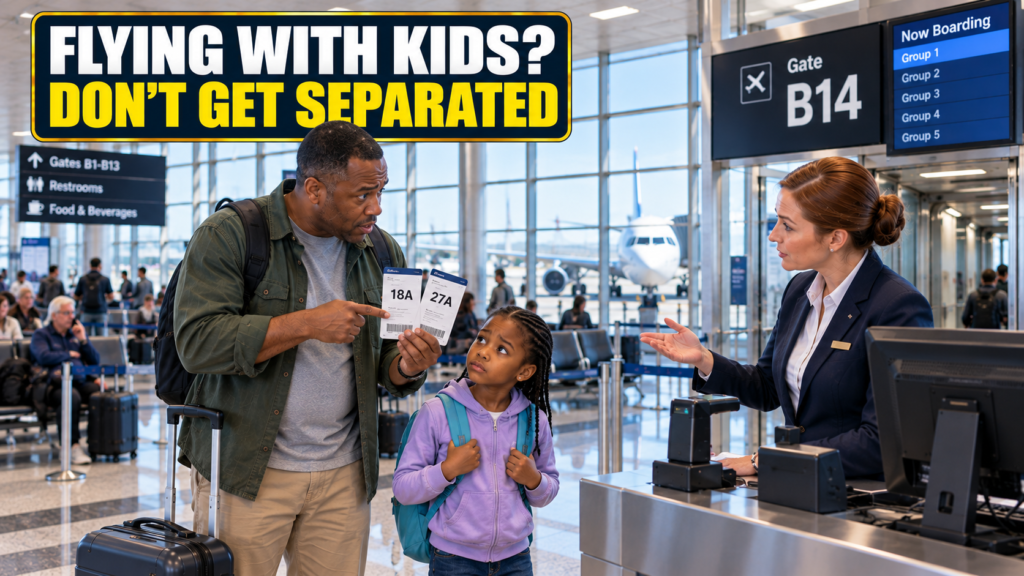
You arrive at the airport with your 8-year-old daughter.
The bags are checked. Security is behind you. You find your gate with plenty of time to spare.
Then you look at the boarding passes.
Dad: 18A.
Daughter: 27A.
Now the relaxed airport morning suddenly feels very different.
Your child is several rows away, boarding may begin soon, and you’re wondering whether the airline will fix it—or whether you’ll end up walking onto the aircraft and asking strangers to trade seats.
This is exactly the kind of family-travel problem that is easier to handle before you reach the airplane door.
The good news is that parents can take several steps long before boarding begins.
The important thing is understanding what airlines actually promise, what the U.S. Department of Transportation recommends, and what you should never simply assume.
Here are eight things families should know.
1. Check the Airline’s Family-Seating Policy Before You Buy
The first opportunity to avoid a seating problem comes before you enter your credit-card number.
When comparing flights, most travelers naturally look at departure time, duration and price.
Families should add another question:
What does this airline say about seating children with an accompanying adult?
Don’t assume every carrier handles family seating identically.
The U.S. Department of Transportation maintains a Family Seating Dashboard showing whether covered airlines have made a commitment to guarantee adjacent seating for a child age 13 or under and an accompanying adult at no additional cost for all fare types, subject to limited conditions.
That phrase—subject to limited conditions—matters.
And not every airline currently shown on DOT’s dashboard has made the same commitment.
So before buying a fare solely because it is $20 or $30 cheaper, look at what control you’ll actually have over your family’s seats.
Watch basic economy carefully
A low fare can be attractive when buying three, four or five tickets.
But DOT warns that basic-economy fares may not give consumers the ability to select a seat.
That doesn’t automatically mean your child will be separated from you.
It does mean you shouldn’t assume a cheap fare gives you the same seat-selection flexibility as another fare.
If sitting together is a major priority, compare the complete booking—not just the headline ticket price.
Look at the airline’s current family-seating policy.
Look at seat-selection conditions.
And determine what happens if you don’t pay to choose seats.
Five minutes of checking before purchasing can save a much more stressful conversation at the gate.
2. Put the Child and Accompanying Adult on the Same Reservation
This sounds like a minor booking detail.
It isn’t.
If you’re buying the family’s tickets at the same time, keeping the child and accompanying adult on the same reservation can make it easier for the airline’s system to recognize that you’re traveling together.
It’s also specifically relevant to the commitments displayed on DOT’s Family Seating Dashboard.
For airlines that assign seats, DOT says the airline may condition its fee-free family-seating guarantee on the child and accompanying adult being on the same reservation.
This becomes particularly important when families book in different ways.
Perhaps Dad used miles for his ticket while Mom paid cash for the children’s tickets.
Maybe Grandma purchased one ticket.
Perhaps part of the family booked earlier and the child was added later.
Now you may have people traveling together who don’t appear together in the same reservation record.
If you’ve already booked separately
Don’t wait until boarding day and hope the airline automatically recognizes the relationship.
DOT recommends contacting the airline when children and adults are booked on separate reservations and asking whether the reservations can be placed together or cross-referenced in the reservation notes.
That doesn’t create a universal guarantee about the final seats.
But it gives the airline important information before airport day.
When it comes to family seating, the system can’t necessarily act on information it doesn’t have.
3. Check Every Seat Assignment as Soon as It Appears
This is where our airport story went wrong.
Dad had a boarding pass.
His daughter had a boarding pass.
Everything looked ready.
Until he noticed:
18A and 27A.
The problem wasn’t hidden.
It simply wasn’t noticed until they reached the gate.
Don’t make that mistake.
Whenever seat assignments become available, check the entire family’s seats.
Don’t just confirm that everyone has a seat.
Look at the actual numbers and letters.
Are the child and accompanying adult next to each other?
Are they in the same part of the aircraft?
Has one seat changed since the last time you looked?
If something looks wrong, act early
Contact the airline rather than assuming the problem will magically correct itself.
DOT advises families who can’t obtain seats together to contact the airline through reservations to ask what assistance may be available before the flight or at the airport.
The earlier you notice the problem, the more time you have to understand your options.
That’s very different from discovering it after you’ve boarded and passengers are already filling the overhead bins.
And don’t assume that because your seats looked right three months ago, they’ll remain unchanged forever.
That leads to the next airport surprise.
4. Understand What “Free Family Seating” Really Means
This is where online advice can become misleading.
You may hear statements such as:
“Airlines have to seat every child next to a parent for free.”
That is too broad as a description of the current DOT framework.
DOT encourages airlines to guarantee adjacent seating for young children and accompanying adults without an additional fee, and it maintains a dashboard showing which airlines have made that commitment.
At the time of this article, the DOT dashboard shows Alaska, American, Frontier, Hawaiian and JetBlue with the commitment to guarantee adjacent seats for a child 13 or under and an accompanying adult at no additional cost for all fare types, subject to limited conditions.
The dashboard shows Allegiant, Delta, Southwest and United without that specific commitment.
Because airline commitments can change, check DOT’s current dashboard rather than treating that list as permanent.
What are the “limited conditions”?
For an airline that assigns seats, DOT says the carrier may condition its guarantee on circumstances including:
- the child and accompanying adult being on the same reservation;
- adjacent seats being available at booking in the selected class of service;
- the aircraft not being substituted for a smaller aircraft;
- the adult following specified seat-selection conditions for the reservation; and
- the aircraft’s physical seat layout making the requested arrangement possible.
So “fee-free family seating” should not be translated into:
“My family can demand any specific pair of seats we want.”
It is about adjacent family seating under the carrier’s applicable commitment and conditions—not a guaranteed upgrade, preferred row or particular window seat.
What about the proposed federal rule?
DOT has proposed a broader rule that would require covered U.S. and foreign carriers to seat children age 13 or under adjacent to at least one accompanying adult without an additional fee, subject to limited exceptions.
But a proposed rule is not the same thing as a final rule already in force.
That’s why travelers should check the current DOT dashboard and the current airline policy rather than relying on an old social-media post saying, “The law says they have to.”
5. Recheck Your Seats After an Aircraft Change
You did everything right.
You booked early.
You selected seats.
Your child was beside you.
Then the airline changes the aircraft.
Suddenly, the seat map isn’t the one you remember.
Aircraft substitutions can happen for operational reasons, and a replacement aircraft may have a different seating configuration.
DOT specifically identifies substitution to a smaller aircraft as one of the limited conditions relevant to airlines’ dashboard commitments.
That’s a major reason families should not treat an old screenshot of a seat map as the final word.
Check again before travel
As the flight gets closer, review your reservation.
Confirm the flight details.
Confirm the aircraft information available to you.
Most importantly, confirm everyone’s current seat assignment.
If your original 18A and 18B have turned into 18A and 27A, you want to discover that while you still have time to contact the airline—not when your child is walking down the jet bridge.
This is especially important when an airline notifies you of a schedule or equipment change.
Don’t just verify the departure time.
Check the seats too.
6. Don’t Wait Until You’re Inside the Airplane to Ask for Help
Suppose you’ve reached the airport and your family is still separated.
What now?
Don’t make the aircraft cabin your first help desk.
If possible, speak with airline personnel before boarding.
In our example, Dad notices that he has 18A while his 8-year-old daughter has 27A.
He approaches the gate agent before boarding and says:
“My daughter is eight. Why are our seats in different rows?”
That’s a much better moment to identify the problem than after everyone is inside the aircraft.
The gate agent can check the reservation and whatever seating options are actually available.
What the agent should not be portrayed as doing is guaranteeing an instant solution before checking.
Seat availability, the airline’s policy, the reservation and the aircraft configuration can all matter.
Don’t begin by confronting another passenger
A common social-media version of this situation starts inside the cabin.
A parent finds the assigned seat, discovers the child is elsewhere and immediately asks another traveler to surrender a window or aisle seat.
Sometimes passengers voluntarily agree to exchanges.
But building your entire family-seating plan around a stranger agreeing to move is not a reliable strategy.
Start with the airline.
And start as early as you can.
DOT also advises families to arrive at the airport early enough to give themselves and the airline time to address seating issues.
The goal isn’t confrontation.
It’s giving airline personnel a chance to review the situation before the cabin fills.
7. Disability-Related Seating Can Be a Different Legal Situation
General family-seating advice and disability-related seating rights should not be mixed together.
Under DOT disability rules implementing the Air Carrier Access Act, qualifying passengers with disabilities may have specific seating-accommodation rights.
For example, DOT says an airline must provide an adjoining seat when a companion provides certain assistance to a passenger with a disability, such as a personal care attendant performing a function during the flight that airline personnel are not required to perform.
DOT’s family-travel guidance gives the example of a traveler assisting a child with a disability with a function such as eating.
When the traveler self-identifies the need to the airline, applicable disability rules may require adjoining seating within the class of service purchased.
That is different from simply saying:
“We’re a family, so the airline legally owes us these particular seats.”
Tell the airline what accommodation is needed
If disability-related assistance is involved, don’t assume airline personnel will understand the need simply by looking at the reservation.
Communicate with the airline.
DOT notes that depending on the accommodation and circumstances, passengers may need to request certain seating accommodations in advance or meet applicable check-in requirements.
At the airport, confirm that the airline has the accommodation request on record.
If you believe disability-related rights under the Air Carrier Access Act are not being followed, DOT says you can ask for the airline’s Complaint Resolution Official (CRO)—an airline employee specifically trained to handle disability-related issues.
That’s a very different process from an ordinary disagreement over preferred family seats.
Knowing the distinction matters.
8. If the Problem Isn’t Resolved, Know What to Do Next
Sometimes you prepare early, contact the airline and speak with the gate agent—and you’re still unhappy with what happened.
Document the issue.
Keep your reservation information.
Record the seat assignments involved.
Keep relevant communications with the airline.
Then contact the carrier through its customer-service or complaint process.
DOT’s Family Seating Dashboard also directs travelers who are dissatisfied with a family-seating experience to the option of filing a complaint with the airline or DOT.
This isn’t about turning every seat disagreement into a major dispute.
It’s about creating an accurate record when you believe the airline didn’t follow the commitment or policy that applied to your trip.
Be specific
Instead of writing:
“The airline ruined our vacation.”
Explain what happened.
For example:
- the child’s age;
- whether child and adult were on the same reservation;
- original seat assignments;
- later seat assignments;
- whether there was an aircraft change;
- when you contacted the airline;
- what assistance you requested; and
- how the airline responded.
Specific facts make the problem easier to understand.
The Family-Seating Checklist to Remember
Family seating becomes much less confusing when you stop treating the gate as the beginning of the process.
The process starts when you shop for the ticket.
Before buying: check the airline’s current family-seating policy and understand what your fare allows.
When booking: whenever possible, keep the child and accompanying adult on the same reservation.
After booking: check the actual seat assignments.
Before airport day: check them again, especially after an aircraft or schedule change.
At the airport: if something is wrong, speak with airline personnel before boarding rather than assuming it will fix itself.
If disability-related assistance is involved: understand that separate federal seating-accommodation protections may apply and communicate the need to the airline.
And if an unresolved experience appears inconsistent with the applicable airline commitment or passenger protections, document what happened and use the appropriate complaint process.
The biggest mistake isn’t necessarily receiving two different seat numbers.
It’s discovering those numbers too late to do anything calmly about them.
So the next time you’re flying with children, don’t wait until your family is standing in the aircraft aisle.
Check the seats before you reach the plane.
