
AIRPORT TIPS
Flying After 60? 8 Airport and Airplane Mistakes That Could Get You Fined
Sep
Most experienced travelers know the basics: arrive early, bring the right identification, keep prohibited items out of your carry-on, and listen to the flight crew.
But there is another category of travel mistake that deserves more attention—especially if you have been flying for decades and assume you already know how everything works.
Some actions at an airport or aboard an airplane aren’t simply inconvenient. Depending on exactly what happens, they can trigger a civil penalty, involvement from law enforcement, loss of travel privileges, or even more serious consequences.
And sometimes the traveler involved never intended to cause trouble.
A forgotten item was left in a bag. A passenger assumed that because something was legally purchased, it could be used onboard. Someone became frustrated during screening and made a bad decision in the heat of the moment.
That is why understanding the difference between a minor travel inconvenience and a potentially serious violation matters.
Here are eight mistakes U.S. travelers should know about before heading to the airport.
1. Don’t Bring a Firearm to the TSA Security Checkpoint
For gun owners, this may be the single most important packing check before leaving home.
Firearms and ammunition are prohibited at TSA passenger screening checkpoints. A traveler who is legally transporting a firearm must follow the applicable checked-baggage procedures rather than taking it through passenger screening.
TSA says a firearm must be unloaded, packed in a locked hard-sided container as checked baggage, and declared to the airline at the ticket counter. Airline requirements and state, local, and destination laws can add other considerations.
The expensive mistake happens when someone forgets that a firearm is still inside a carry-on bag.
That can happen more easily than you might imagine if the same backpack or shoulder bag is used both for everyday purposes and for travel.
Finding the firearm at the checkpoint can immediately change the situation.
TSA says that when a firearm is discovered during passenger screening, officers stop screening and contact local law enforcement. TSA can also impose a civil penalty. According to current TSA firearm guidance, that penalty can reach roughly $15,000, depending on the circumstances. TSA PreCheck eligibility can also be affected.
Having a concealed-carry permit does not make the firearm acceptable at the passenger checkpoint. TSA has specifically warned that a permit to carry does not authorize someone to take a firearm onto an aircraft through passenger screening.
What to do instead: Before leaving home, physically empty every compartment of the bag you plan to carry through security. If traveling with a firearm, check TSA’s current requirements, the airline’s rules, and the laws that apply at both ends of the trip.
Don’t rely on memory.
Actually look inside the bag.
2. Don’t Try to Bypass or Interfere With Security Screening
Airport security can be frustrating.
Maybe your bag is selected for additional inspection. Maybe you are asked to step aside. Maybe an item that caused no trouble on a previous trip gets another look today.
Getting frustrated does not make bypassing the screening process a good idea.
TSA has enforcement authority covering interference with screening, and TSA records include civil enforcement actions involving such incidents.
For an ordinary traveler, the practical lesson is straightforward: don’t turn a delay into a confrontation.
If an officer tells you that additional screening is required, remain calm and ask what you need to do next. If you believe something has been handled incorrectly, use the appropriate complaint or review process instead of attempting to walk around, obstruct, or interfere with the screening operation.
This distinction matters.
Being annoyed is not the same thing as interfering with screening.
Asking a question is not automatically interference.
Politely requesting clarification is not the problem.
The risk increases when behavior moves from disagreement into deliberate obstruction, bypassing security controls, or otherwise interfering with the screening process.
What to do instead: Build extra airport time into your schedule. That gives you room to deal with an unexpected bag check or additional screening without feeling that every extra minute will make you miss your flight.
3. Don’t Ignore Flight-Crew Safety Instructions
You paid for the ticket.
You selected the seat.
You may have flown hundreds of times.
None of those things make safety instructions optional.
Federal aviation rules require passengers to comply with applicable crew instructions concerning safety requirements such as smoking restrictions and seat belts. FAA regulations, for example, require passengers to comply with crewmember instructions related to those requirements.
This becomes particularly important during taxi, takeoff, landing, turbulence, and other situations where the crew needs the cabin secured.
The mistake is assuming:
“It’s probably fine. I’ve done this before.”
Perhaps you want to stand up while the seat-belt sign is illuminated. Perhaps you want to retrieve something from the overhead bin. Perhaps the flight attendant asks you to sit down and you think the instruction is unnecessary.
Arguing can make the situation worse.
FAA enforcement cases show how repeated refusal to follow crew instructions can become part of a much more serious interference incident.
That does not mean every misunderstanding or momentary mistake results in a fine.
Context matters.
The smarter response is much simpler.
What to do instead: Follow the safety instruction first. If you don’t understand it, ask politely when it is safe to do so.
A disagreement over convenience is rarely worth turning into an aviation enforcement problem.
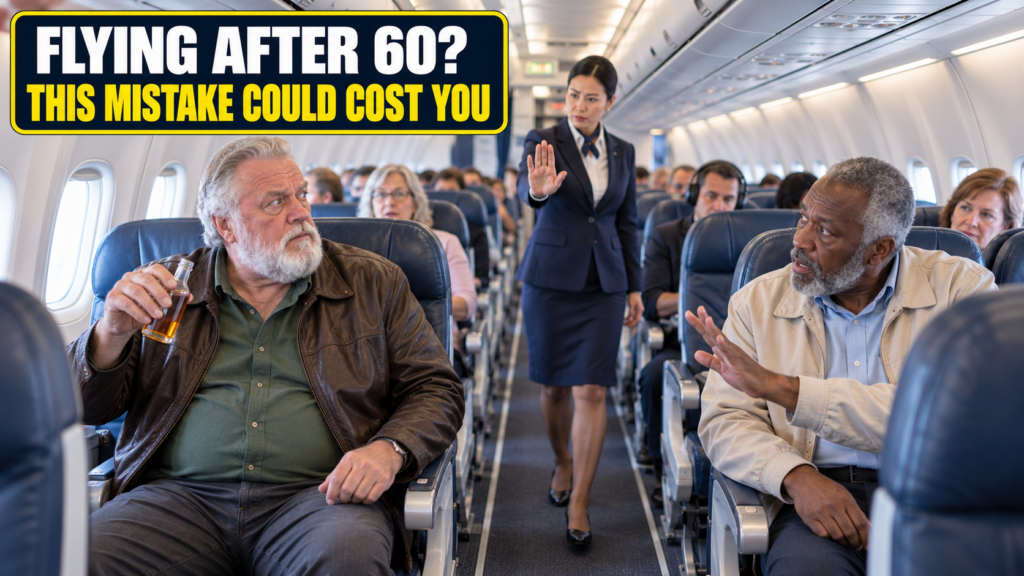
4. Don’t Assume You Can Drink Your Own Alcohol Onboard
This rule surprises plenty of travelers.
Imagine buying or carrying a small bottle of alcohol that you’re legally allowed to have with you.
You board the plane, sit down, take the bottle out, pour yourself a drink, and assume there is no problem because the alcohol belongs to you.
That’s the mistake.
FAA rules restrict passengers from consuming alcoholic beverages aboard an aircraft unless the beverage is served by the certificate holder operating the aircraft.
In other words, possession and onboard consumption are two different questions.
The fact that you have a bottle with you does not automatically give you permission to serve yourself during the flight.
FAA enforcement history includes cases where drinking from a personal bottle was part of the alleged misconduct. In one case, the FAA alleged that a passenger repeatedly failed to follow instructions to stop drinking from a personal bottle and subsequently became increasingly disruptive.
Again, the important lesson is not that simply possessing every bottle of alcohol automatically results in a fine.
It doesn’t.
The lesson is that you should not assume that because you legally obtained or transported the bottle, you may pour it yourself once you’re seated.
What to do instead: If you want an alcoholic beverage during the flight, use the carrier’s onboard service and follow crew instructions.
And remember that an airline may refuse alcohol service when appropriate.
5. Don’t Smoke or Vape on the Aircraft
For traditional cigarettes, most travelers already understand the rule.
But vaping can create confusion.
Someone may think:
“There’s no actual cigarette smoke, so what’s the problem?”
Do not make that assumption aboard an aircraft.
Federal aviation requirements prohibit smoking in aircraft lavatories, and passengers must comply with applicable no-smoking requirements and crew instructions. FAA passenger-safety guidance also specifically addresses the smoking prohibition and the requirement to follow flight-attendant instructions concerning it.
The lavatory is not a loophole.
Neither is attempting to hide what you’re doing.
This matters because smoke and potential fire aboard an aircraft are treated as serious safety issues. At altitude, the crew cannot simply pull over and evacuate everyone onto a sidewalk.
Aircraft lavatories are therefore equipped with fire-safety systems, including smoke detection.
FAA safety material explains that lavatory smoke-detection and fire-protection requirements were strengthened following concerns and investigations involving inflight fires.
What to do instead: Wait until you are off the aircraft and in a location where smoking or vaping is actually permitted.
Don’t assume that a quick trip to the lavatory makes the rule disappear.
6. Never Tamper With a Lavatory Smoke Detector
This deserves its own section because it goes beyond simply breaking a smoking rule.
Suppose someone enters an aircraft lavatory intending to smoke or vape and notices the smoke detector.
Then comes a particularly bad idea:
“I’ll just cover it for a minute.”
Don’t.
FAA passenger-safety guidance explicitly states that tampering with, destroying, or disabling lavatory smoke detectors is prohibited by federal law.
There’s a reason this equipment receives such serious treatment.
A fire aboard an aircraft can develop in an environment where immediate access, evacuation, and firefighting options are limited.
The smoke detector is part of the aircraft’s safety system.
FAA material explains that lavatory smoke detectors are intended to provide warnings to the cockpit or cabin crew.
Interfering with that system is therefore fundamentally different from an ordinary disagreement about a comfort or service issue.
What to do instead: Never cover, disable, remove, damage, or otherwise interfere with aircraft safety equipment.
If something in the lavatory appears damaged or malfunctioning, tell a flight attendant.
Don’t try to fix it yourself.
7. Don’t Threaten, Intimidate, or Interfere With the Flight Crew
A delayed flight can ruin a carefully planned vacation.
A missed connection can cost money.
A seat problem can be infuriating.
None of those situations gives a passenger permission to threaten or intimidate the crew.
FAA enforcement material makes clear that interfering with crewmembers can lead to serious consequences. Federal law also addresses assaulting or intimidating a crewmember when that conduct interferes with the performance of the crewmember’s duties.
This is one area where travelers should understand how quickly an ordinary complaint can escalate.
Consider the progression:
“Why was my seat changed?”
That’s a question.
“I want to speak with someone about this.”
Still a complaint.
But if the confrontation progresses into threats, intimidation, physical aggression, or conduct that prevents crew members from performing safety duties, you are now in very different territory.
The cabin crew’s primary responsibility is not customer-service conflict resolution. They have safety responsibilities.
Distracting or preventing them from performing those duties can therefore create consequences far beyond whatever originally caused the argument.
What to do instead: If you have a serious service complaint, document what happened. Keep receipts, names, seat information, and other relevant details. Then pursue the complaint through the airline’s appropriate customer-service channel.
You can dispute a service issue later.
You cannot undo an onboard confrontation once it has escalated.
8. Don’t Let an Argument Turn Into a Serious Onboard Disturbance
The final mistake is broader than any single rule.
It is escalation.
Maybe another passenger reclines a seat.
Someone puts a bag where you wanted to place yours.
A person bumps your arm.
Your seat assignment changes.
Your flight has already been delayed for hours and your patience is gone.
These situations can be genuinely aggravating.
But an argument aboard an aircraft operates in a very different environment from an argument in a restaurant or hotel lobby.
The crew must maintain a safe cabin.
If a passenger’s behavior becomes threatening, physically aggressive, or interferes with crew duties, what started as a customer-service problem can become an aviation safety and enforcement matter.
FAA enforcement examples show incidents escalating from refusal to follow instructions into shouting, disruptive actions, law-enforcement involvement, and proposed civil penalties.
So when another passenger irritates you, resist the temptation to “handle it yourself.”
Call a flight attendant.
Explain what happened.
Then allow the crew to decide how to address it.
This is especially important if alcohol is involved or emotions are already running high.
Walking away from an argument is not losing.
At 35,000 feet, it may be the smartest decision you make all day.
Before You Fly: A 60-Second Safety Check
Many of the problems on this list can be prevented before you ever reach the checkpoint.
Before leaving home, take one minute and check:
- Empty every compartment of your carry-on and personal item.
- If you travel with a firearm, verify the current TSA, airline, and applicable legal requirements before departure.
- Use TSA’s current “What Can I Bring?” information when you’re uncertain about an item.
- Keep acceptable identification accessible.
- Don’t assume a rule from a flight years ago is still the rule today.
- Follow TSA officers’ and flight crewmembers’ safety instructions.
- Never interfere with aircraft safety equipment.
- If a disagreement occurs, keep it calm and let the appropriate employee handle it.
TSA itself recommends planning ahead and packing properly, and its “What Can I Bring?” resource is designed to help passengers check questionable items before arriving at security.
One More Thing: Not Every Mistake Means an Automatic Fine
This distinction is important.
You shouldn’t leave this article thinking that every minor airport mistake automatically produces a giant federal fine.
That isn’t how enforcement works.
TSA explains that civil penalty amounts are based on its published sanction guidance. Factors can include the nature of the violation, whether conduct was inadvertent or deliberate, previous violations, the security risk created, corrective action, and other aggravating or mitigating circumstances.
There is also a huge difference between accidentally packing an ordinary item that cannot go through the checkpoint and bringing something that creates a significant security risk.
The same common sense applies onboard.
A misunderstanding that is immediately corrected is not the same factual situation as repeatedly refusing crew instructions, threatening someone, or deliberately interfering with safety equipment.
That’s why the best rule isn’t:
“Be afraid of getting fined.”
It’s:
Know the rules, correct mistakes quickly, and don’t turn a small problem into a serious one.
For travelers over 60, experience is usually an advantage. You already know how much smoother a trip becomes when you prepare before leaving home.
But experience can sometimes create one dangerous assumption:
“I’ve flown for decades. I already know all of this.”
Airport procedures, airline policies, security requirements, and enforcement priorities can change. And even a familiar rule may be more specific than you remember.
Before your next trip, spend a few minutes checking current TSA guidance and your airline’s requirements.
Because the cheapest travel mistake is the one you catch while you’re still packing at home.
